Famous Trademark Lawsuits Over Logos, and What They Decided
Most logo fights never reach a courtroom. A cease-and-desist letter goes out, a small company quietly redraws its mark, and nobody outside the two legal departments hears about it. The famous trademark lawsuits are the exceptions: cases where both sides had the money and the stubbornness to let a judge or a jury decide who owns a color, a stripe, a fruit or a joke.
Those exceptions are worth studying because they set the rules everyone else negotiates by. Below are the cases designers, brand managers and law students still cite, with the courts, years and outcomes checked against court records and reputable coverage. This is a plain-English history for curious readers, not legal advice. If you have a real dispute, talk to a trademark attorney.
Trademark law in plain English
A trademark is anything that tells shoppers who made a product: a name, a logo, a slogan, a sound, a bottle shape, even a color. In the United States the main federal statute is the Lanham Act of 1946. Registration with the U.S. Patent and Trademark Office helps a lot, but rights actually come from using the mark in commerce.
Three ideas explain almost every case on this page.
- Likelihood of confusion. Infringement happens when a competitor’s mark is likely to make ordinary buyers think the two products come from the same source, or that one company sponsors the other. Courts weigh factors such as how similar the marks look, how close the products are, evidence of actual confusion and whether the copier acted in bad faith.
- Secondary meaning. Some marks are protected from day one because they are made up or arbitrary (Apple for computers). Others, like a color or a stripe pattern, only qualify once the public has learned to link them with one company. The Supreme Court confirmed in Qualitex Co. v. Jacobson Products (1995) that a single color can be a trademark if it has acquired that kind of meaning.
- Dilution. Very famous marks get extra protection against uses that blur their distinctiveness or tarnish their reputation, even when nobody is confused about who made what.
A trademark is different from a copyright (which protects creative works like a photograph or a drawing) and from a patent (which protects inventions). Logo disputes sometimes mix all three, which is one reason they get messy. For the longer back story of how marks became legal property in the first place, see our history of logos from ancient symbols to modern brand identity.
Apple vs Apple Corps: three settlements and a buyout
The longest-running logo feud in pop culture pitted the Beatles’ company, Apple Corps (founded in 1968), against Apple Computer (founded in 1976). Apple Corps sued for trademark infringement in 1978. The 1981 settlement had Apple Computer pay $80,000, a figure kept quiet at the time, and split the territory: the computer company would stay out of music, and the Beatles’ company would stay out of computers.
That line did not hold. When Apple added MIDI and audio-recording features to its machines in the late 1980s, Apple Corps sued again in 1989. The 1991 settlement cost Apple Computer about $26.5 million and spelled out in detail where each company could use the name and fruit logo.
Then came iTunes. In 2003 Apple Corps argued that putting the Apple logo on a music store broke the 1991 deal. The case was tried in London, and on May 8, 2006, Mr Justice Mann of the High Court ruled for Apple Computer, finding that the iTunes use was covered by a clause in the 1991 agreement and that no breach had been shown. Apple Corps said it would appeal, but on February 5, 2007, the two sides announced a final settlement: Apple Inc. took ownership of all the “Apple” trademarks and licensed some back to Apple Corps. Terms were confidential, though newspapers reported a figure around $500 million. The Beatles catalog arrived on iTunes in November 2010.
Three settlements in 26 years came down to one weak spot: a coexistence agreement holds only while both businesses stay where they were when they signed. Our look at the Apple TV logo shows how far the company has since stretched that bitten apple into media.
The Adidas three stripes lawsuit against Thom Browne
Adidas has used three parallel stripes on its shoes since around 1949, and it defends them harder than almost any brand defends anything. The company has filed hundreds of stripe cases around the world over the decades. Our Adidas logo history explains how the stripes became the trefoil and then the performance “mountain.”
The New York designer Thom Browne had used three stripes on jackets until Adidas objected in the late 2000s, and he switched to a four-bar design. Adidas sued anyway in June 2021, arguing that the four bars on Browne’s sportswear were too close to its mark. The case went to trial in the U.S. District Court for the Southern District of New York before Judge Jed Rakoff. On January 12, 2023, the jury found that Thom Browne did not infringe or dilute the Adidas marks, and it reached that verdict within hours of closing arguments.
Adidas pressed on. The Second Circuit affirmed the judgment in May 2024. Adidas then sought a new trial over emails it said Thom Browne had withheld during discovery; Rakoff refused, and in April 2026 the Second Circuit upheld that refusal. Supreme Court records show Adidas got two extensions and filed a petition for certiorari in late September 2026, which was pending as this article was published.
Europe has been tough on the stripes too. In June 2019 the EU General Court upheld a decision cancelling one Adidas registration for three parallel stripes, ruling that Adidas had not proved the plain pattern was distinctive across the whole European Union. A simple geometric mark is easy to recognize and hard to fence off, since stripes are also plain decoration on thousands of garments that have nothing to do with Adidas.
The Louboutin red sole case
Christian Louboutin started lacquering the soles of his heels red in 1992, and the U.S. Patent and Trademark Office registered the red sole as a trademark in 2008. In 2011 he sued Yves Saint Laurent over a line of monochrome shoes, including an all-red pump with a red sole.
District Judge Victor Marrero denied Louboutin a preliminary injunction that August and went further, suggesting that a single color could never serve as a trademark in the fashion business. On September 5, 2012, the U.S. Court of Appeals for the Second Circuit rejected that broad rule. It held that the red sole had acquired secondary meaning, but only when it contrasts with the rest of the shoe, and it ordered the registration limited to that use. YSL could keep selling its red-on-red shoe. Both sides claimed victory, and both were partly right.
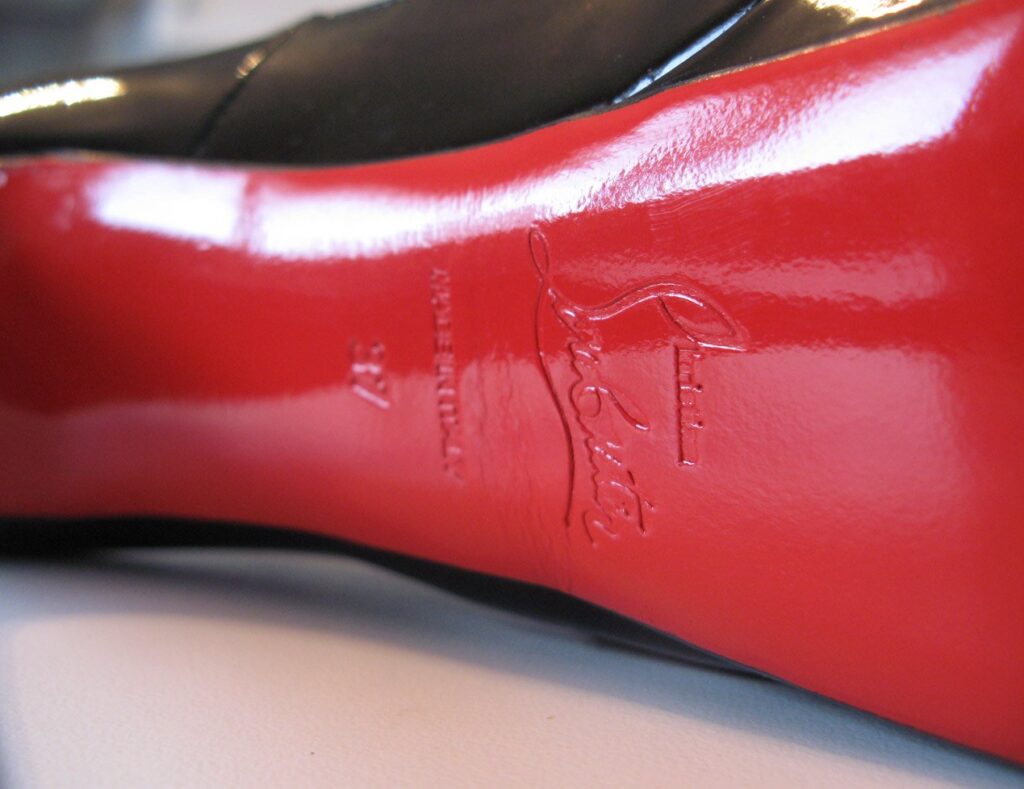
Read alongside Qualitex, the ruling draws a narrow line: a color can work as a logo, but the protection covers only the specific way buyers have learned to read it. Saint Laurent, for its part, has its own famous mark; our piece on the YSL monogram traces Cassandre’s 1961 design.
Tiffany vs Costco: a $21 million win that did not last
In 2013 Tiffany & Co. sued Costco after a shopper spotted display signs reading “Tiffany” next to diamond engagement rings that Tiffany had not made. Costco’s defense was that “Tiffany setting” is the ordinary jewelry-trade name for a six-prong solitaire mount, and that it was describing the style, not the maker.
The trial court in Manhattan sided with Tiffany on summary judgment, and a jury then set damages. The jury awarded $3.7 million in profits and $8.25 million in punitive damages; after the judge trebled the profits and added interest, the judgment came to about $21 million, plus roughly $5.9 million in attorneys’ fees and costs. On August 17, 2020, the Second Circuit vacated it. The appeals court said a jury, not a judge, needed to decide whether shoppers were actually confused, whether Costco acted in good faith and whether its use was a fair, descriptive one. The companies settled in July 2021 on undisclosed terms.
A famous brand name can double as a generic description in one narrow trade, and that overlap is what sank Tiffany’s summary judgment. Our articles on the Tiffany & Co. logo and Tiffany Blue and the Costco logo cover the two brands themselves.
Jack Daniel’s vs VIP Products: when is a parody a trademark?
VIP Products sold a squeaky dog toy called Bad Spaniels, shaped like a Jack Daniel’s bottle, with “Old No. 2 on your Tennessee Carpet” in place of “Old No. 7 Tennessee Sour Mash Whiskey.” After Jack Daniel’s demanded the toy be pulled, VIP asked a court in 2014 to declare it lawful, Jack Daniel’s countersued, and the case bounced through the Arizona federal courts and the Ninth Circuit for years.
The question that reached the Supreme Court was whether a parody gets the strong First Amendment shield of the Rogers test, which courts had used for artistic works such as films and songs. On June 8, 2023, a unanimous Court said no, at least where the parodist uses the borrowed design as its own product’s trademark. Justice Elena Kagan’s opinion sent the case back for the ordinary likelihood-of-confusion analysis, noting that a parody’s humor can still weigh in that analysis.
The aftermath shows why “winning” at the Supreme Court is not the same as winning the case. On remand, the Arizona district court found in January 2025 that the toy did not infringe but did dilute Jack Daniel’s marks by tarnishment, and he blocked sales. In early August 2026 the Ninth Circuit reversed that finding and vacated the injunction, holding that Jack Daniel’s expert evidence did not show this particular toy was likely to harm the whiskey’s reputation. Twelve years after the dispute first reached a courtroom, the dog toy company was ahead.
Hermès vs Rothschild: the MetaBirkins case
In late 2021 the artist Mason Rothschild sold a collection of 100 NFTs called MetaBirkins, digital images of fuzzy, furry versions of the Hermès Birkin bag. Hermès sued in the Southern District of New York in January 2022. Rothschild argued the images were art and protected speech under Rogers.
Judge Rakoff let the case go to a jury, and on February 8, 2023, jurors found Rothschild liable for trademark infringement, dilution and cybersquatting. They awarded Hermès $133,000. In June 2023 the judge granted a permanent injunction barring further sales and use of the MetaBirkins domain. Rothschild appealed to the Second Circuit.
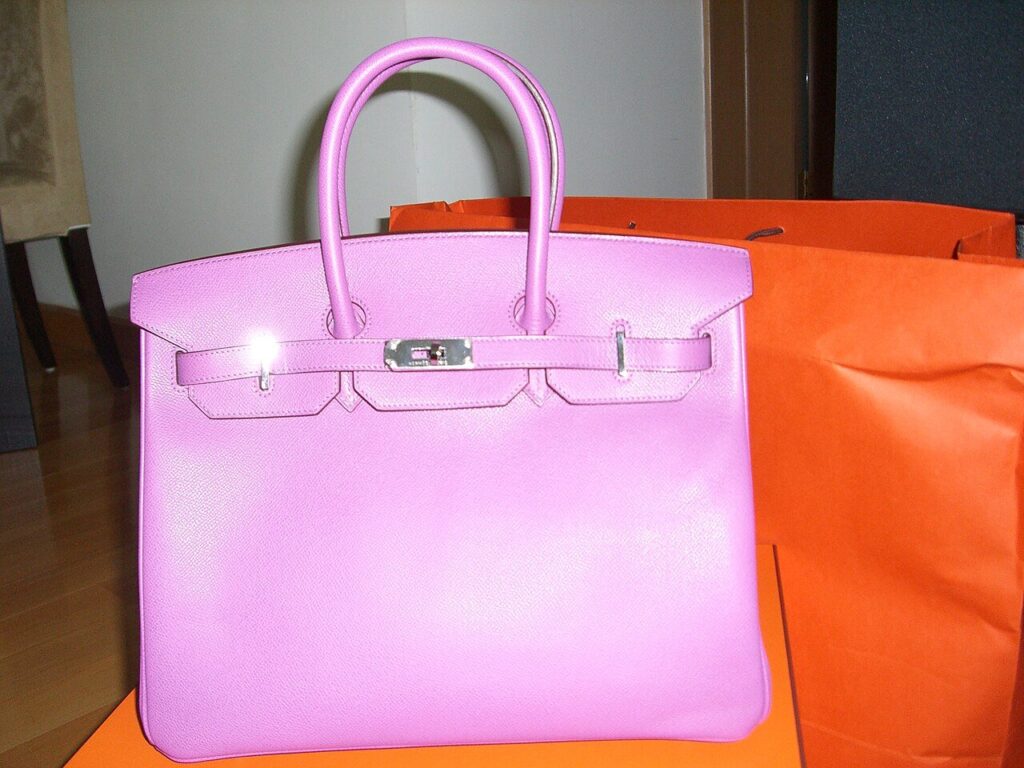
Jurors were told that the art defense would fail if Rothschild intentionally misled buyers into thinking Hermès was behind the NFTs, so calling something art did not end the inquiry. For luxury houses, the verdict confirmed that trademark rights travel into digital goods. For a wider view of how these houses built their marks, see luxury fashion logos explained.
Famous trademark lawsuits at a glance
| Case | Court and year | What was at stake | Outcome |
|---|---|---|---|
| Apple Corps v. Apple Computer | Settled 1981 and 1991; English High Court 2006; settled 2007 | The Apple name and logo in music | $80,000, then about $26.5 million; Apple won in 2006; Apple Inc. took all Apple marks in 2007 |
| Starbucks v. Wolfe’s Borough Coffee | S.D.N.Y. and Second Circuit, 2001 to 2013 | “Charbucks” coffee blend | No dilution found; Starbucks lost after 12 years |
| Louboutin v. Yves Saint Laurent | Second Circuit, 2012 | Red sole on monochrome red shoes | Mark valid only where the sole contrasts with the shoe |
| Tiffany v. Costco | S.D.N.Y. 2017; Second Circuit 2020 | “Tiffany” signs on unbranded rings | About $21 million judgment vacated; settled 2021 |
| Adidas v. Thom Browne | S.D.N.Y. jury 2023; Second Circuit 2024 | Four bars vs. three stripes | Jury found no infringement; affirmed on appeal |
| Hermès v. Rothschild | S.D.N.Y. jury 2023 | MetaBirkins NFTs | Liable; $133,000 and an injunction |
| Jack Daniel’s v. VIP Products | U.S. Supreme Court 2023; Ninth Circuit 2026 | Bad Spaniels parody dog toy | 9 to 0 for Jack Daniel’s on the legal test; toy maker won on infringement in 2025 and on dilution in 2026 |
Other trademark infringement examples worth knowing
Starbucks and “Charbucks”
Starbucks sued Black Bear Micro Roastery, a small New Hampshire roaster run by Wolfe’s Borough Coffee, in 2001 over its dark roast called Charbucks Blend (also sold as Mister Charbucks). A survey found 30.5 percent of respondents thought of Starbucks when they heard “Charbucks,” but courts found the association too weak to prove dilution. The Second Circuit finally affirmed the ruling for Black Bear in November 2013. The siren itself is covered in our piece on how the most famous company logos became global symbols.
The Lacoste crocodile dispute
Lacoste has worn its crocodile since the 1930s and has spent decades fighting Crocodile Garments, a Hong Kong clothing company with its own reptile logo. Lacoste won in Hong Kong in 1999. In mainland China the two settled in 2003, with Crocodile agreeing to redraw its animal with a more vertical tail and more scales. The fight has continued elsewhere: in New Zealand, Lacoste lost ground in 2017 under the “use it or lose it” rule, and the Philippine Supreme Court dismissed a Lacoste suit in a decision released in 2024, citing pronounced differences between the two marks. Emblem logos like this, or the polo player discussed in our Ralph Lauren logo history, invite lookalikes because animals and sports figures are free for anyone to draw.
Levi’s stitching and Walmart’s knockoff dresses
Levi Strauss has long policed the arcuate stitching on its back pockets and its Red Tab, both explained in our Levi’s logo history. In Levi Strauss & Co. v. Abercrombie & Fitch (2011), the Ninth Circuit held that a dilution claim does not require the two designs to be identical or nearly identical. On the other side of the ledger, the Supreme Court ruled in Wal-Mart Stores v. Samara Brothers (2000) that a product’s design, unlike a logo, is protected as trade dress only after it gains secondary meaning. That decision is why retailers like Walmart can sell close copies of many unbranded designs.
When the logo itself is the problem
Not every logo lawsuit is about trademark. The photographer Jacobus Rentmeester sued Nike in 2015, claiming the Air Jordan Jumpman silhouette copied his 1984 photo of Michael Jordan. That was a copyright claim, and the Ninth Circuit ruled for Nike in 2018, holding that the pose idea was not protected and Nike’s version differed in its specific expression.
What these logo lawsuits teach brand owners
- Simple marks are hard to own outright. Stripes, single colors and common animals win protection only for the specific way the public recognizes them, as Adidas and Louboutin learned.
- Juries are unpredictable. Adidas, a household name, lost to a much smaller fashion label in a matter of hours. Tiffany’s big win evaporated when an appeals court decided a jury should weigh the facts.
- Agreements age badly. Apple and Apple Corps settled three times because the 1981 map of their businesses stopped matching reality.
- Parody gets the ordinary test. After Jack Daniel’s, a joke used as your own brand name is judged on likelihood of confusion like any other mark, and Bad Spaniels shows it can still survive.
Many of the marks in these cases also hide clever details of their own. If that is your interest, our list of famous logos with hidden meanings and the 10 most recognizable logos in the world are good next stops.
Sources and further reading
- Apple Corps v Apple Computer, Wikipedia
- Adidas v. Thom Browne: a timeline, The Fashion Law
- Second Circuit rules that a single color can be a trademark, Loeb & Loeb
- Second Circuit vacates Tiffany’s $21 million win over Costco, Jones Day
- Tiffany and Costco settle 8-year lawsuit, CNBC
- Jack Daniel’s Properties v. VIP Products, Wikipedia
- Mason Rothschild appeals Hermès win in MetaBirkins case, The Fashion Law
- Crocodile Garments and the Lacoste disputes, Wikipedia