Rust Logo: The Red Warning Square Explained
Rust is a multiplayer survival game from Facepunch Studios, the British company run by Garry Newman, creator of Garry’s Mod. It entered Steam Early Access on December 11, 2013, left it on February 8, 2018, and reached PlayStation 4 and Xbox One on May 21, 2021, in versions made with Double Eleven.
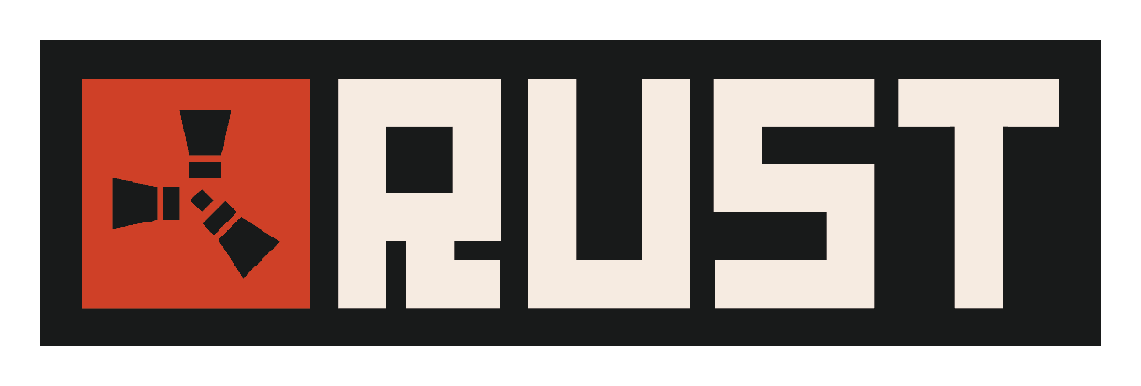
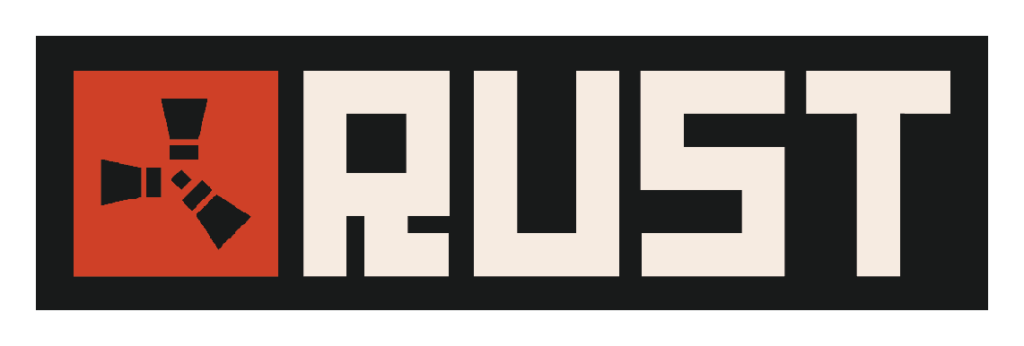
The logo is plain by gaming standards: a red square with a dark three-part symbol cut into it, next to the word RUST in blocky off-white capitals on a near-black bar. It looks like a warning label on a piece of industrial equipment, which suits a game set among radioactive monuments, rusted barrels and scrap.
What is the symbol in the Rust logo?
Inside the red square sit three dark wedge shapes arranged in a triangle around the center: one at the top, two at the lower corners. The layout matches the trefoil used on radiation warning signs, simplified and drawn with chunky edges. Radiation is part of how Rust plays. Monuments such as the Launch Site and the Military Tunnels are irradiated, and players need hazmat suits or anti-radiation pills to loot them.
Facepunch has not published an explanation of the mark, so some players read the shapes differently, for example as a fan or a set of speakers. The trefoil reading is the most common one and fits the game’s setting, but it is an interpretation rather than a confirmed brief.
Why does the Rust wordmark look hand-cut?
The four letters are built from straight rectangles with almost no curves. The R and U have square counters, the S is a stack of right-angled bars, and the T is a simple crossbar on a stem. The effect is close to a stencil or letters cut from sheet metal, matching the crafted, makeshift look of the bases, doors and weapons players build in the game.
The colors are limited: a brick red, roughly #CE422B, an off-white, and a near-black. All three can be reproduced on a server banner, a Steam capsule or a T-shirt without losing anything, and the logo still works in a single color.

How did Rust start, and did the branding change?
Newman has said openly that “Rust started off as a DayZ clone,” a reference to the ARMA 2 survival mod that was popular in 2012 and 2013. The early alpha had zombies and a different look. In 2014 Facepunch rebuilt the game in an experimental branch, which later replaced the original version, dropped the zombies and moved toward the open-world player-versus-player game Rust is today.
The branding settled as the game did. The red-square-and-wordmark lockup has been the standard mark through the full release and the console editions. Native PlayStation 5 and Xbox Series X|S versions arrived in summer 2025, again under the same logo.
Who uses the Rust logo outside Facepunch?
Community servers, streamers and tournament organizers use the logo constantly, often recolored or combined with their own names. Rust became a streaming phenomenon in early 2021, when it peaked above one million concurrent Twitch viewers on January 3, mostly because of a large OfflineTV server event. By the end of 2021 it had sold close to 12.5 million copies.
Escape from Tarkov, in beta since 2017, shares Rust’s rule that dying costs you your loot, and ARK: Survival Evolved, which entered early access in 2015, runs on a similar gather, craft and raid loop. Both sit in the survival-crafting lane that Minecraft opened up in 2009. Rust also has a roleplay server scene, a cousin of the GTA roleplay servers that run on FiveM.
Quick facts
| Developer | Facepunch Studios (United Kingdom) |
| Studio head | Garry Newman |
| Early Access | December 11, 2013 |
| Full release | February 8, 2018 |
| Console Edition | May 21, 2021 (PS4, Xbox One), with Double Eleven |
| Logo | Red square with a trefoil-like symbol, blocky RUST wordmark |
| Colors | Brick red, off-white, near-black |
| Sales | About 12.5 million copies by the end of 2021 |