
Tatra Logo History: Meaning, Symbolism & Brand Heritage
Tatra holds a rare position in automotive history. Founded in 1850, it predates most modern car manufacturers and evolved from carriage-making into one of the earliest automobile innovators. In the broader context of Škoda Logo History and Mercedes-Benz Logo Meaning, Tatra represents a different lineage—one rooted in Central European engineering tradition and early experimentation.
Within Automotive Logos, the Tatra logo history reflects more than branding updates. It mirrors industrial shifts, political changes, and technological evolution. Despite redesigns across decades, the brand has maintained a strong visual continuity built around a circular badge and distinctive typography, forming a recognizable logo heritage.
Tatra Logo Meaning and History: From Carriages to Automotive Innovation
Tatra’s origin dates back to a small carriage workshop founded by Ignác Šustala. Over time, the company expanded into more complex vehicle production and eventually entered the automotive field at the end of the 19th century. By 1897, Tatra had already produced one of the earliest passenger cars in Europe.
Through the early 20th century, the company developed innovative engineering solutions, including air-cooled engines and advanced chassis designs. These technical achievements influenced not only Tatra’s reputation but also its visual identity. The brand needed a logo description that could represent both tradition and industrial strength.
As the company grew, especially after adopting the Tatra name in the 1920s, its identity became more defined. The circular emblem introduced during this period became the foundation of Tatra’s logo heritage, remaining recognizable even as styles and execution evolved over time.
Tatra Logo Symbolism: The Circle, Motion, and Mechanical Identity
Tatra logo symbolism is rooted in simplicity and industrial strength.
The circular badge is the most consistent element across the brand’s history. In automotive branding, a circle often represents movement, continuity, and mechanical precision—qualities directly tied to vehicle engineering. For Tatra, the circle also creates a contained space for its distinctive lettering, reinforcing unity and balance.
Typography plays a major role in the logo meaning. The custom stretched lettering, often arched to follow the circular frame, gives the logo a unique identity. It feels engineered rather than decorative, reflecting the company’s technical heritage.
Color adds another layer of symbolism. Red is associated with power, energy, and motion, making it a natural choice for an automotive brand. White provides contrast and clarity, while silver outlines in modern versions introduce a sense of refinement and contemporary design.
Tatra Logo History Timeline: Evolution of a Historic Automotive Emblem
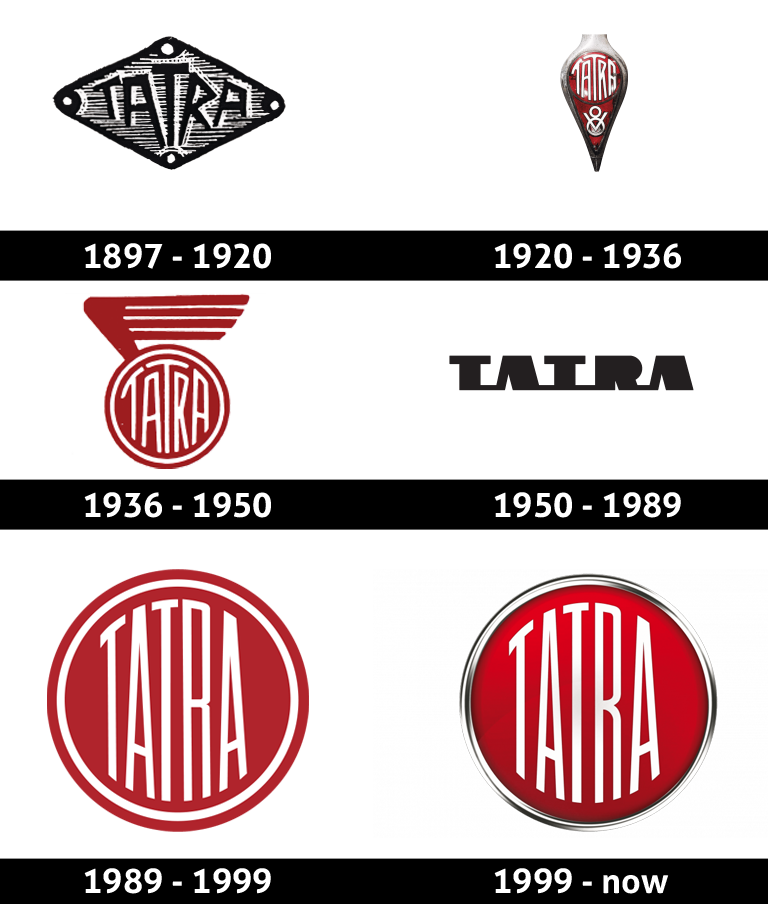
1897–1920: The Early Metallic Badge and Experimental Identity.
The first Tatra logo appeared as a rhombus-shaped metallic plaque with engraved lettering. The design felt handcrafted, reflecting the company’s origin as a carriage workshop transitioning into early automotive production. This stage represents the brand’s experimental phase before establishing a consistent visual system.

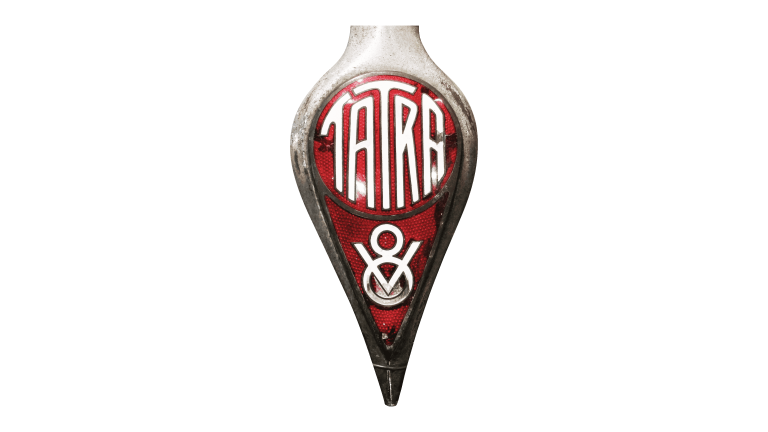
1920–1936: The Introduction of the Red Circular Emblem.
In the 1920s, Tatra introduced the red circular badge that would define its logo heritage. The emblem featured white lettering set within a bold red field, often placed on a metallic base. This marked the transition from handcrafted identity to a more standardized automotive brand symbol.
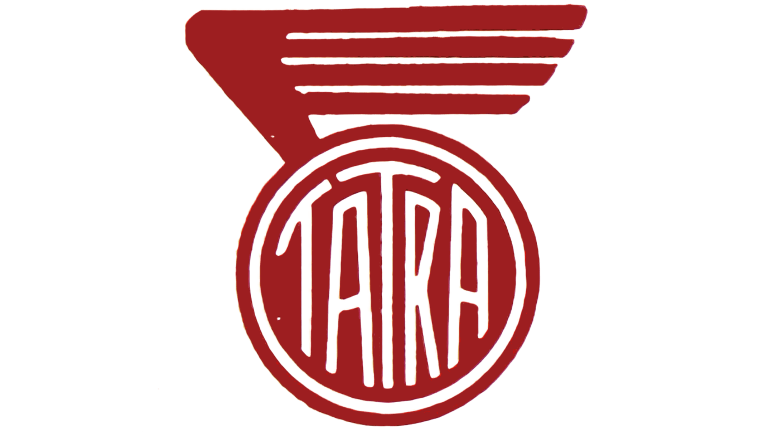
1936–1950: Simplified Circle and Aerodynamic Wing Detail.
The 1936 redesign refined the circular emblem into a cleaner, two-dimensional form with a white outline. A subtle wing element was added, hinting at speed and aerodynamic innovation—an important theme in Tatra’s engineering philosophy during this era.
1950–1989: Experimental Typography and Mechanical Styling.
During the mid-20th century, Tatra explored a more abstract wordmark composed of rounded shapes and mechanical lines. This departure from the circular badge reflected industrial design trends of the time but lacked the timeless clarity of earlier versions.

1989–1999: Return to the Classic Circular Badge.
By the late 20th century, Tatra returned to its established emblem. The red circular badge with white arched lettering reappeared, reinforcing continuity and reconnecting the brand with its historical identity.
1999–Today: Modernized Red Circle with Refined Detailing.
The current Tatra logo builds on the classic design with improved proportions and a cleaner finish. A silver outline adds depth and modern appeal, while the arched white lettering remains the focal point. This version preserves the original logo meaning while adapting it for contemporary automotive branding.
Tatra Logo Heritage: A Timeless Automotive Identity
Tatra’s logo history demonstrates how a brand can evolve while maintaining a strong visual core. The circular emblem introduced in the early 20th century has remained the anchor of its identity, surviving stylistic changes and industrial shifts.
Today, the Tatra logo meaning continues to communicate power, precision, and engineering heritage. Its logo symbolism is simple but effective: motion, strength, and continuity. By preserving its core elements while refining execution, Tatra has built a logo heritage that reflects both its long history and its ongoing role in the automotive industry.
Tatra Logo History FAQ: Meaning, Symbolism, and Origin
What does the Tatra logo represent?
The Tatra logo represents engineering strength and motion, using a circular badge and bold typography to reflect its automotive heritage.
Why is the Tatra logo circular?
The circle symbolizes movement, continuity, and mechanical precision, which are key aspects of automotive design.
When was Tatra founded?
Tatra was founded in 1850, making it one of the oldest vehicle manufacturers in the world.
What do the colors in the Tatra logo mean?
Red represents energy and power, while white ensures clarity and contrast. Silver accents in modern versions add refinement.
Has the Tatra logo changed over time?
Yes, but the core circular emblem introduced in the 1920s has remained the foundation of the brand’s visual identity.