Activision Logo History: From Four Atari Programmers
Activision is one of the oldest and most consequential publishers in video game history. It was founded in October 1979 by four former Atari programmers who left to start their own company after disputes over pay and credit at Atari, making Activision the first third-party video game publisher. Its logo has gone through three main eras: the original 1979 wordmark, the Mediagenic rebrand of 1988-1992, and the modern monochrome wordmark used since the company’s return to the Activision name.
Origins: Four Atari Programmers and a New Kind of Company (1979)
Activision was founded on October 1, 1979, in Sunnyvale, California, by David Crane, Larry Kaplan, Alan Miller, and Bob Whitehead, all of whom had been programmers at Atari. The four had grown frustrated that Atari did not credit individual programmers for their games or pay them based on a title’s sales. Crane and Miller left Atari first, in 1979, and the group recruited Jim Levy, a businessman with a background in marketing and the record industry, to serve as the new company’s first CEO. Sutter Hill Ventures provided early funding.
Because Activision made cartridges for the Atari 2600 without being part of Atari itself, it is widely credited as the first third-party video game publisher, a business model that the rest of the industry later adopted. Atari sued Activision in 1980 over the practice, but the case was dismissed after about two years, clearing the way for outside studios to publish games for consoles they did not manufacture.
The Original Logo (1979-1988)
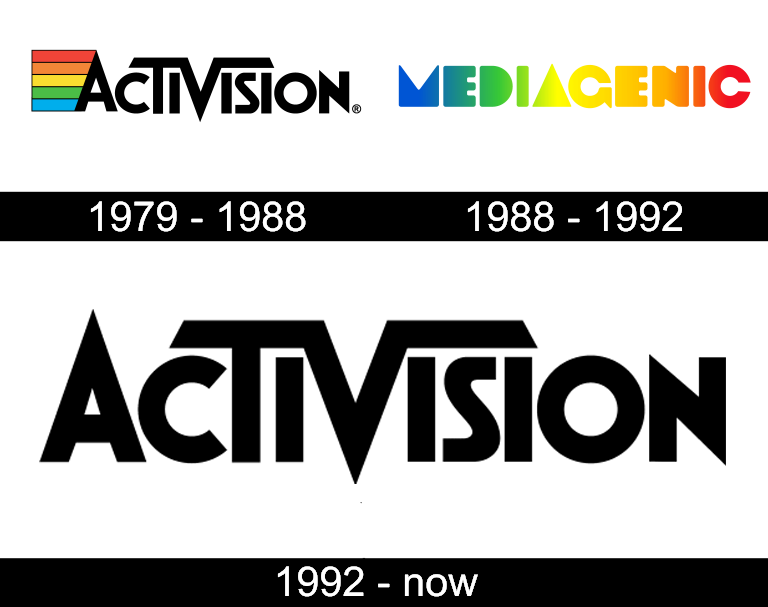
Activision’s first logo, used from 1979 to 1988, paired an elongated, stretched lowercase “v” with a rainbow-striped trapezoid graphic set against the “A.” The multicolor bars were typical of late-1970s and early-1980s consumer technology branding, a period when companies used bright, segmented color blocks to signal a connection to computing and electronics.
The Mediagenic Era: A Rebrand Born of Diversification and Debt (1988-1992)
The Mediagenic Logo (1988-1992)
By the mid-1980s, the home console market had collapsed and Activision’s game sales had weakened. Under CEO Bruce Davis, who had taken over leadership around the company’s 1986 acquisition of text-adventure studio Infocom, the company pushed into business and productivity software, including HyperCard-based titles, as a hedge against the games business. In 1988 the company reorganized around this broader media and software strategy and renamed itself Mediagenic, adopting a new gradient-typography logo to match. It continued to release games under the Activision and Infocom brand names even as the corporate parent carried the Mediagenic name.
The diversification did not solve the company’s underlying problems. By 1991, Mediagenic reported a loss of about $26.8 million on revenue of roughly $28.8 million, with debts exceeding $60 million, putting the company in serious financial distress.
Back to Activision: The Kotick Turnaround (1991-1992)
The Modern Logo (1992-Present)
In 1991, Robert Kotick, together with a group of investors, acquired a controlling stake in Mediagenic after Davis declined an earlier buyout offer. Kotick became CEO, cut the company down to a small core staff, and restructured it through a reorganization plan. The company dropped the Mediagenic name, returned to the Activision name, and refocused entirely on games. The company was renamed Activision by the end of 1992, moved its headquarters to Los Angeles, and went public again on NASDAQ in October 1993. The modern logo introduced in this period is a plain monochrome wordmark, dropping the gradients and multicolor elements of the two earlier eras in favor of a simple, legible typeface.
Later Corporate History: Activision Blizzard and the Microsoft Acquisition
Activision’s later corporate history includes two major transactions. In 2008, Activision merged with Vivendi Games, the parent company of Blizzard Entertainment, to form Activision Blizzard, with Kotick continuing as CEO of the combined company. In October 2023, Microsoft completed its acquisition of Activision Blizzard in a deal reported at about $68.7 billion, one of the largest acquisitions in the technology and gaming industries. Activision continues to operate as a publisher within Microsoft’s gaming division, alongside sibling studios such as Blizzard Entertainment and King.
Activision’s current rivals among first-party and platform publishers include companies tied to major console makers, such as Sony and Microsoft itself, though those companies’ own branding follows separate histories.
Quick Facts
| Founded | October 1, 1979, in Sunnyvale, California |
| Founders | David Crane, Larry Kaplan, Alan Miller, and Bob Whitehead, all former Atari programmers |
| First CEO | Jim Levy |
| Mediagenic era | 1988 to 1992, under CEO Bruce Davis, following diversification into business software and mounting debt |
| Return to Activision name | 1991-1992, after Robert Kotick and an investor group took control and restructured the company |
| Current corporate status | Operates as a publisher within Microsoft’s gaming division, following Microsoft’s October 2023 acquisition of parent company Activision Blizzard |
FAQ
Who founded Activision?
Activision was founded in October 1979 by David Crane, Larry Kaplan, Alan Miller, and Bob Whitehead, four former Atari programmers, with businessman Jim Levy serving as the company’s first CEO.
Why did Activision change its name to Mediagenic?
In 1988, under CEO Bruce Davis, the company reorganized around a broader strategy that included business and productivity software in addition to games, and renamed itself Mediagenic to reflect that diversification. The company was also dealing with weak game sales and, by 1991, serious financial losses and debt.
Why did the company change its name back to Activision?
In 1991, investor Robert Kotick led a group that took control of the financially struggling Mediagenic. Kotick became CEO, restructured the company around its original games business, and the Activision name was restored by the end of 1992.
What happened to Activision in 2008?
Activision merged with Vivendi Games, the parent company of Blizzard Entertainment, to form Activision Blizzard.
Is Activision still an independent company?
No. Microsoft completed its acquisition of Activision Blizzard in October 2023, and Activision now operates as a publisher within Microsoft’s gaming division.