Luxury Brand Logos: How LV, Chanel, Gucci and Fendi Built Their Monograms
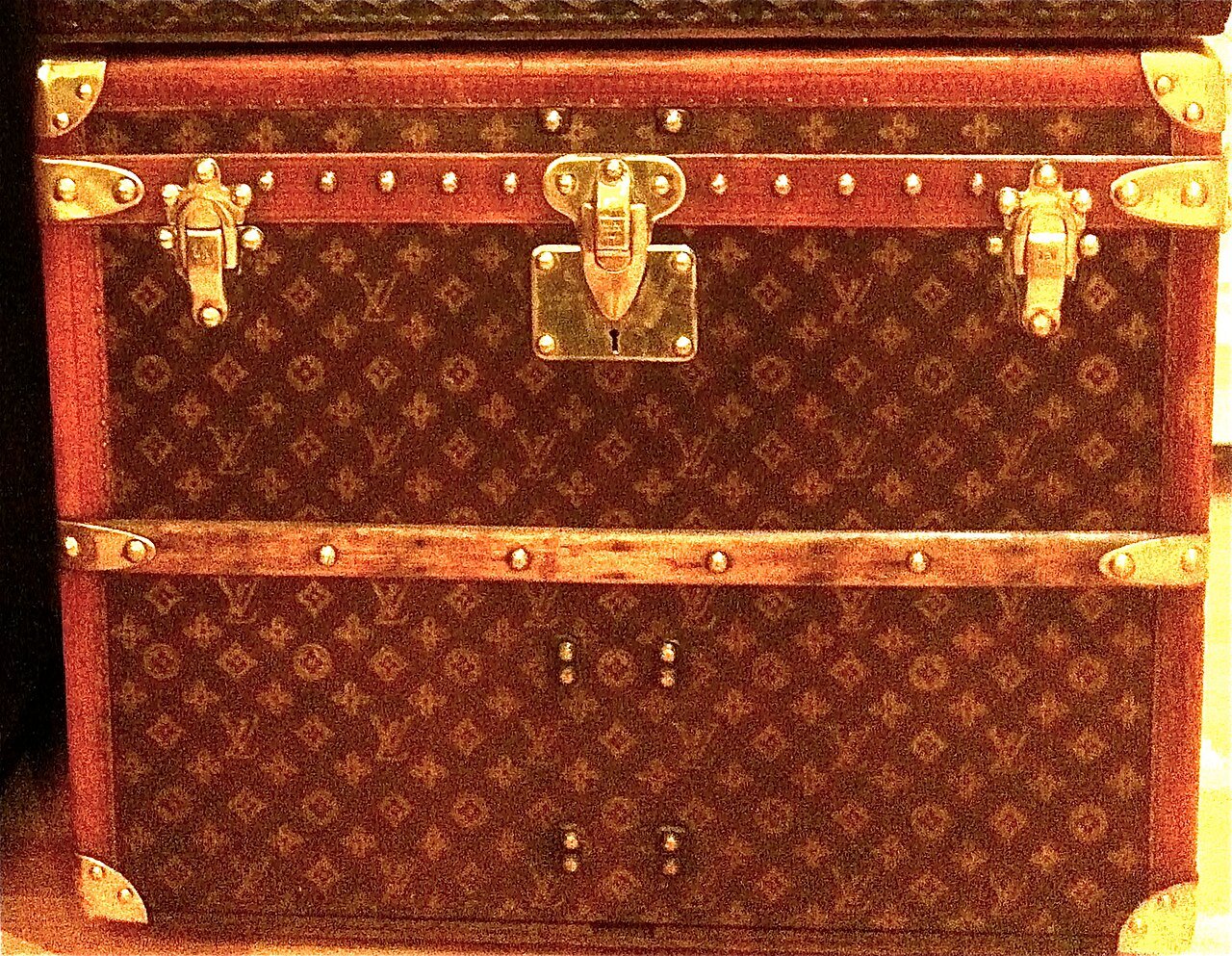
Most luxury brand logos started as legal and practical tools. Louis Vuitton covered its trunks in a pattern of initials and flowers in 1896 because rivals kept copying its earlier canvases, and Goyard painted tiny chevrons onto its luggage for much the same reason. Decades later Chanel, Gucci, Fendi and Dior turned their initials into prints, clasps and buckles, and the monogram became one of the most copied graphic devices in retail.
A pattern built to stop counterfeiters ended up as the thing counterfeiters most want to reproduce. Below are the origin stories of the major designer monograms, with the documented dates kept apart from the house legends.
Why luxury brand logos became monograms
In the 19th century, a Paris trunk maker’s real asset was its canvas. Trunks were stacked in train cars and ship holds, and a distinctive covering told porters and owners whose luggage was whose. It also told competitors what to copy. Louis Vuitton’s gray Trianon canvas of the 1850s was imitated, then its striped canvas of 1876, then the checkerboard Damier of 1888, which carried a small “marque L. Vuitton déposée” (registered trademark) inscription that was easy to miss.
Initials are legally specific in a way stripes and checks are not, and a dense repeating print is harder to fake well than a two-color grid. Many houses still lean on their founders’ letters rather than abstract symbols for that reason. For the longer backstory of how trademarks grew out of makers’ marks, see our history of logos from ancient symbols to modern brand identity.
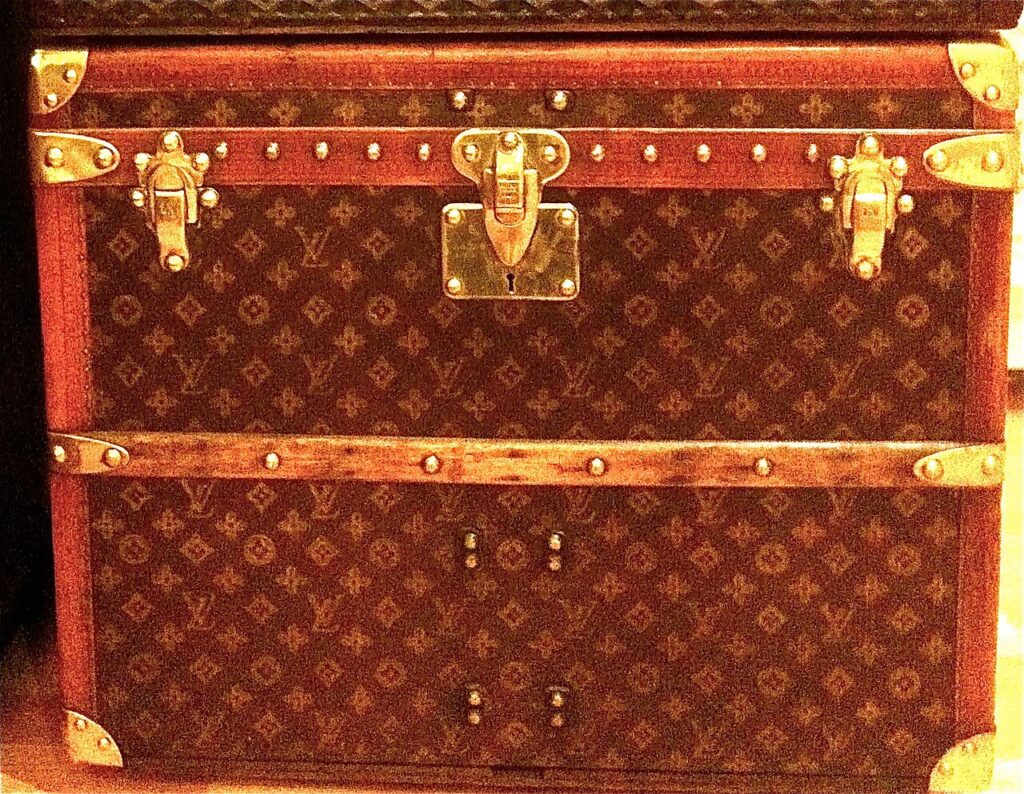
Goyard, founded in Paris in 1853 and Vuitton’s old rival in the trunk business, reached a similar answer. Edmond Goyard introduced the Goyardine canvas, usually dated to 1892, though some histories place its debut at the 1900 World’s Fair. From a distance it looks like a field of dots. Up close, the dots form three small chevrons stacked into a Y, the middle letter of the family name. The first lengths were probably painted by hand, and the house still hand-paints customers’ initials and stripes on request, a service it calls marquage.
LV monogram history: Georges Vuitton’s 1896 answer to copycats
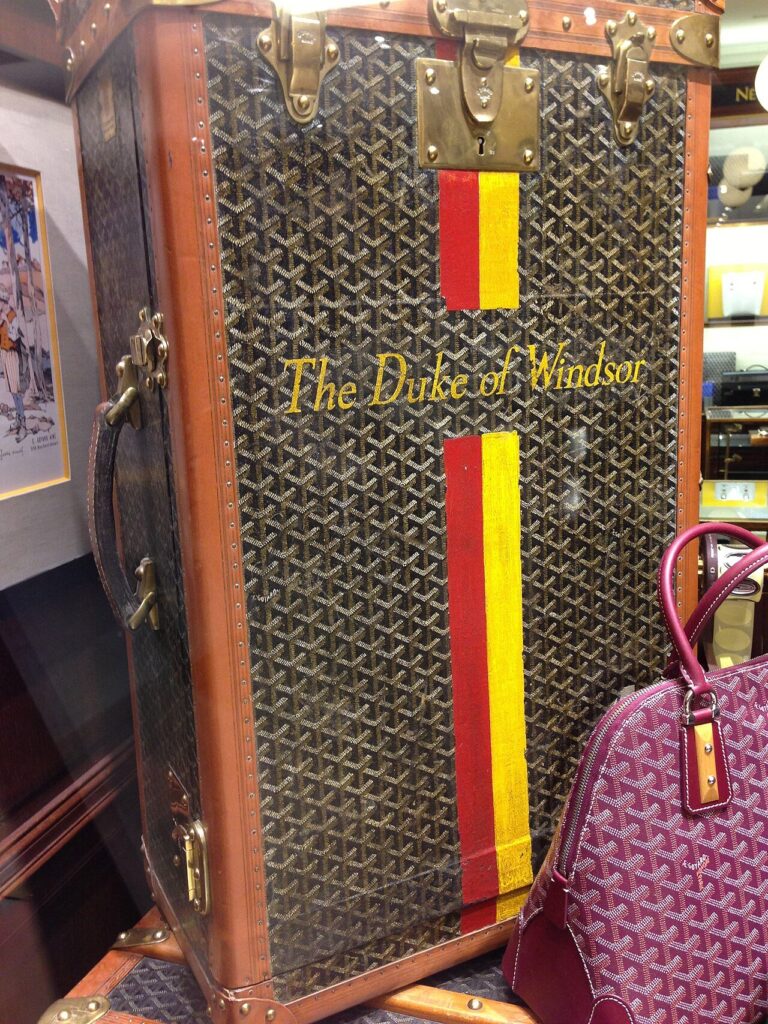
Louis Vuitton died on February 27, 1892. Four years later his son Georges launched the Monogram canvas, pairing the overlapping L and V with three geometric flowers: a four-pointed star, a four-petal flower inside a circle, and the same flower in negative inside a diamond. The company protected the design with patents, and Louis Vuitton has long said the canvas was created to defeat counterfeiters.
Where the flowers came from is less certain. The usual explanation points to the Japanese family crests known as mon, which were fashionable in late Victorian Europe, and Georges is known to have admired Japanese ornament. He never spelled out his sources, though. The pattern is also often described as a tribute to his father, which fits the timing but rests on company storytelling rather than anything Georges wrote down.
From trunk lining to logomania
For most of the 20th century the Monogram stayed on luggage and a few classic bags. Marc Jacobs, hired in 1997, changed that. Stephen Sprouse scrawled graffiti over the canvas in 2001, and Takashi Murakami recolored it on white and black grounds for the Monogram Multicolore line in 2003. In 2017 the house printed it alongside the box logo of Supreme, the same streetwear label it had sent a cease-and-desist letter in 2000 over skate decks that borrowed the Monogram. A year later Louis Vuitton named Virgil Abloh, founder of Off-White, artistic director of menswear.
The Chanel CC logo and the Château de Crémat question
Two back-to-back Cs, one facing left and one facing right. Chanel filed U.S. trademark applications for its name and the interlocking CC in November 1924, and both were registered in February 1925, which is the safest date to give for the Chanel CC logo as a registered mark.
The design’s origin is murkier. A popular story says Gabrielle “Coco” Chanel took the interlocking Cs from the Château de Crémat, a wine estate near Nice whose owner was a friend and used a similar motif in its decoration. Other accounts link the shape to the stained glass at the Aubazine abbey, where Chanel spent part of her childhood. The house has confirmed neither, so all that can be said with confidence is that the letters stand for Coco Chanel.
Unlike Louis Vuitton, Chanel rarely used its logo as an allover print. The CC sits on the turn-lock of the 2.55 bag, first shown in February 1955, on buttons, on the No. 5 bottle cap and on sunglasses. Its reputation for logo-heavy runway shows came later, under Karl Lagerfeld, who ran the house from 1983 and was happy to stamp the CC on almost anything.
The Gucci GG logo, from Diamante to double G
Gucci‘s first pattern was not a monogram at all. The Diamante canvas, a hemp fabric printed with small linked diamonds, dates to the 1930s, when sanctions against Mussolini’s Italy made good leather hard to get in Florence. Shortages during World War II kept Gucci working in canvas. The green-red-green Web stripe, modeled on a saddle girth, came after the war and is usually dated to 1951.
Accounts of the double G differ. Some trace an early GG mark to the 1930s and to Aldo Gucci, Guccio’s son and the family member who later built the American business. Most histories date the interlocking GG people know today, two mirrored Gs for founder Guccio Gucci, to 1964, when it went onto belt buckles and other hardware. Gucci has not published a formal design credit. The GG canvas that followed made the brand a favorite of counterfeiters, and in 1977 alone Gucci filed 34 counterfeiting lawsuits.
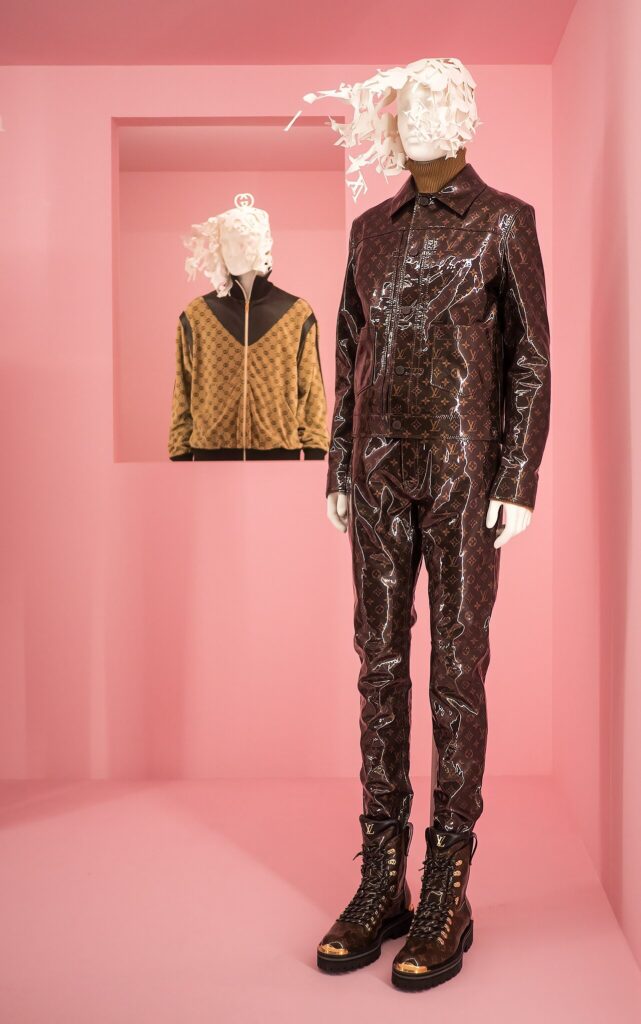
Every creative director since has turned the GG up or down. Tom Ford, who took over design in the mid-1990s, used it sparingly. Alessandro Michele, at the helm from 2015 to 2022, put it back everywhere, including on a 2017 jacket that closely copied a 1989 Louis Vuitton print piece by Harlem tailor Dapper Dan. Gucci answered the criticism by partnering with him, and his Lenox Avenue atelier opened with Gucci’s backing in 2018.
Fendi, Dior and the 1960s monogram boom
The 1960s were the decade the monogram moved from luggage onto clothing and small leather goods, and most of the big Paris and Rome houses got one.
The Fendi FF logo and “Fun Fur”
Fendi was founded in Rome in 1925 by Adele and Edoardo Fendi as a leather and fur shop. Their five daughters took over, and in 1965 they hired a young German designer named Karl Lagerfeld to modernize the fur line. One of his early contributions was a logo: two Fs, one upside down against the other. Sources date it to 1965 or 1966.
The letters are often said to stand for “Fun Fur,” after Lagerfeld’s lighter, dyed and cut furs, though they also simply stand for Fendi. A popular story has Lagerfeld sketching the mark in a few seconds at Carla Fendi’s request. Nobody can prove it. The pattern is said to have started as a lining print before moving outside as the Zucca canvas, and our article on the Fendi FF monogram follows it through the later Zucchino and the 2020s revivals under Kim Jones.
Dior Oblique, YSL and the rest
Christian Dior died in 1957, and it fell to Marc Bohan, the house’s artistic director from 1961, to give Dior a print to match its rivals. Bohan drew the Dior Oblique, a jacquard canvas spelling out the name in slanted letters, in 1967, and it reached the public by 1969. It sold well for two decades, faded, and came back twice: when John Galliano put it on the Saddle bag around 2000, and when Maria Grazia Chiuri revived it for fall 2018.
Yves Saint Laurent had already commissioned the poster artist A. M. Cassandre to draw the stacked YSL monogram in 1961. Givenchy built its 4G from four interlocking Gs. In 1970 the Spanish leather house Loewe added its anagram of four Ls, drawn by the painter Vicente Vela.
Celine’s Triomphe arrived in the early 1970s, with a better anecdote than most. Founder Céline Vipiana’s car is said to have broken down at the Place de l’Étoile, where she noticed the chains around the Arc de Triomphe; the interlocking links, read as two Cs, became the house emblem. Sources give 1972 or 1973. The mark faded after the 1980s, and Hedi Slimane put it back at the center of the brand after he took over in 2018.
Luxury monograms compared
The table collects the dates and credits that hold up best against company histories and press coverage. Where sources disagree, both dates are given.
| Brand | Monogram or pattern | Introduced | Credited to | Original purpose |
|---|---|---|---|---|
| Goyard | Goyardine chevrons | 1892 (some say 1900) | Edmond Goyard | Distinctive trunk canvas |
| Louis Vuitton | LV Monogram canvas | 1896 | Georges Vuitton | Stop counterfeit trunks |
| Chanel | Interlocking CC | Registered 1925 | Gabrielle Chanel (house) | Perfume and accessories mark |
| Gucci | Diamante, then GG | 1930s; GG on hardware in 1964 | No official credit; often linked to Aldo Gucci | Canvas when leather was scarce |
| Saint Laurent | YSL | 1961 | A. M. Cassandre | New couture house identity |
| Fendi | FF (Zucca) | 1965 or 1966 | Karl Lagerfeld | Fur lining print |
| Dior | Oblique | 1967 (shown 1969) | Marc Bohan | Jacquard for bags and clothes |
| Celine | Triomphe | 1972 or 1973 | Céline Vipiana | Hardware and canvas emblem |
| Burberry | TB | 2018 | Riccardo Tisci and Peter Saville | Rebrand under a new designer |
Most of these marks share two traits. They come from a founder’s real initials, which gives them legal weight and a ready story, and they are symmetrical, so a buckle or clasp reads correctly from any angle. Monogram canvas is also cheaper to make than leather and carries the brand on every square inch.
New ones still appear. When Burberry rebranded in August 2018, a few months after Riccardo Tisci arrived, Peter Saville drew a TB monogram for founder Thomas Burberry. American labels did the same at a lower price point: Coach launched its Signature C canvas in the early 2000s, and Michael Kors put its MK on hardware and print. Our guide to luxury fashion logos and their origins covers the wordmarks and founders behind more than a dozen houses.
Counterfeiting: the problem monograms were meant to solve
Georges Vuitton’s plan worked for a while. Patents and trademark filings gave the company something concrete to sue over, and a dense print raised the cost of a convincing copy. But a pattern that recognizable is also the easiest thing on a bag to fake from a photo, and by the 1970s and 1980s monogram canvas was the backbone of the counterfeit trade.
In a 2025 report, the OECD and the EU Intellectual Property Office put global trade in fake goods at $467 billion in 2021, the latest year with full data, or about 2.3% of world imports. Clothing, footwear and leather goods made up 62% of seizures, and China was the leading source. Luxury houses now spend heavily on customs training and online takedowns, and some have begun attaching digital product passports to individual bags.
Harlem wrote its own chapter. In the 1980s Dapper Dan’s boutique made custom jackets and car interiors out of Gucci, Louis Vuitton and Fendi logo material he printed himself, until legal action led by Fendi helped shut the shop in 1992. By 2018 he was working with Gucci, and a year later his designs were on display at the Metropolitan Museum of Art.
Logomania vs. quiet luxury: Hermès and Bottega Veneta
Not every major house took the monogram route. Hermès has an H-pattern canvas, but it never built its business on an allover print. A Birkin or a Kelly carries a small heat-stamped “Hermès Paris” and little else. The most visible letter is the H belt buckle, and the official emblem, a horse-drawn Duc carriage, rarely appears on the product at all. Waiting lists do the signaling that a print does elsewhere.
Bottega Veneta, founded in Vicenza in 1966, put the same argument into an advertising line. Its 1970s slogan “When your own initials are enough” poked at logo-covered rivals, and the woven intrecciato leather became the identifier instead. The line returned in a 2022 campaign.
The AP reported in April 2023 that “quiet luxury,” sometimes called stealth wealth, had become a talking point, helped along by the wardrobes on HBO’s Succession and by labels like Loro Piana, Brunello Cucinelli and The Row. Minimalism had peaked before, the report noted, in the 1990s and again during the 2008 to 2009 recession. Each time the prints came back, usually when a new creative director needed a quick, sellable signature.
Sources and further reading
- Louis Vuitton (Wikipedia)
- Louis Vuitton: History of the Monogram (Montecristo Magazine)
- Chanel (Wikipedia)
- Gucci (Wikipedia)
- Fendi sisters to Kim Jones: the history of the double F brand (Istituto Marangoni)
- Goyard (Wikipedia)
- Two of fashion’s favorite lawsuits never actually happened (The Fashion Law)
- Global trade in fake goods reached USD 467 billion (OECD)
- Quiet luxury: no flash, no logos, but big-time style (AP via NY1)