Janssen Logo History Since 1953
Janssen was built by one of the most prolific drug inventors in pharmaceutical history. Paul Janssen founded his research laboratory in Turnhout, Belgium, in 1953, funded by 50,000 Belgian francs from his father, and over his career discovered more than 80 medicines, several of which remain on the World Health Organization’s Essential Medicines list. Janssen became a Johnson & Johnson subsidiary on 25 October 1961, and the company’s later history includes the Risperdal off-label marketing scandal, a 2021 opioid settlement, and the single-dose COVID-19 vaccine that was briefly paused in the United States over rare blood clot cases, none of which the old article mentioned at all.
How did Janssen actually grow, and what has it discovered?
Paul Janssen founded his own research laboratory in Turnhout, Belgium, in 1953, building on a pharmaceutical distribution business his father Constant Janssen had started in 1933. The lab relocated to Beerse, Belgium, in 1957 and grew rapidly as Paul Janssen’s team produced one discovery after another: haloperidol, marketed as Haldol, an antipsychotic that became a global standard for treating schizophrenia; fentanyl, the opioid analgesic now also known for its role in overdose deaths; loperamide, sold as Imodium; and risperidone, sold as Risperdal, a later-generation antipsychotic. Johnson & Johnson acquired Janssen on 25 October 1961, and Paul Janssen continued leading the company’s research as a subsidiary, founding the Janssen Research Foundation in 1987 and later co-founding a center using supercomputers to search for AIDS treatments. He was elevated to the Belgian nobility as a baron in 1991 and died on 11 November 2003 in Rome, Italy, at age 77.
Janssen’s more recent history includes real controversy the old article skipped entirely. Between 2004 and 2012, the US Department of Justice investigated Janssen’s promotion of Risperdal for unapproved uses in elderly and pediatric patients, a case that led to a $2.2 billion settlement in November 2013. In 2021, Janssen agreed to pay $230 million to settle an opioid lawsuit with New York State, part of a broader set of opioid-related settlements involving Johnson & Johnson. Janssen also developed a single-dose COVID-19 vaccine, authorized for emergency use in the United States on 27 February 2021; US health authorities recommended a pause in its use on 13 April 2021 after rare blood-clotting cases emerged, lifting the pause on 23 April 2021 once regulators determined the benefits outweighed the risks for most adults. Today Janssen employs roughly 45,000 people worldwide as Johnson & Johnson’s pharmaceutical research division, headquartered in Beerse.
Janssen Logo History Timeline

1960s-1990s: the deer-and-J emblem
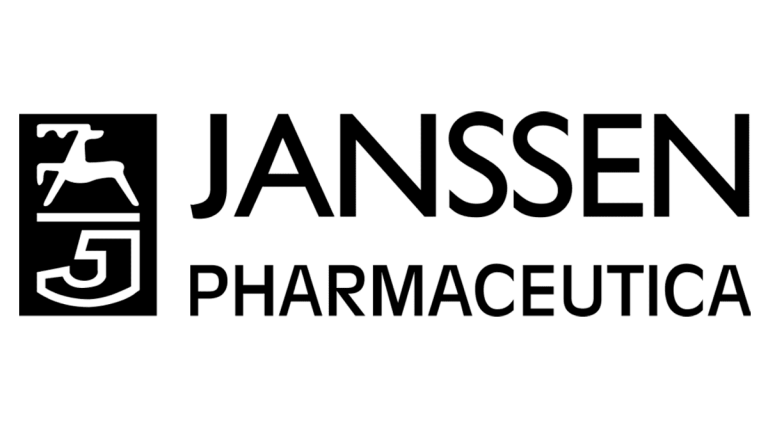
Janssen’s earliest logo paired a formal two-line wordmark reading “Janssen Pharmaceutics” with an emblem showing a simplified deer above an outlined letter “J” inside a vertical black rectangle, a restrained design typical of mid-20th-century pharmaceutical branding.
1990s-2012: blue and a rhombus
In the 1990s the logo’s black elements became blue, the rectangular emblem was reshaped into a rhombus, and the typography tightened into a bolder sans-serif, a period that coincided with Paul Janssen’s final years leading the company’s research before his 2003 death.
2012-today: a minimalist wordmark
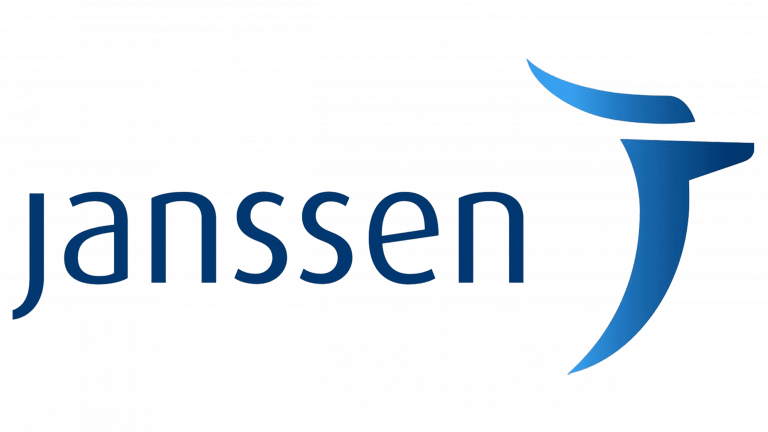
The current logo, introduced in 2012, drops the deer entirely for a lowercase sans-serif wordmark alongside a compact icon built from two fluid shapes forming the letter “J,” a design that was already in place when Janssen developed its COVID-19 vaccine and absorbed the Risperdal and opioid litigation outcomes.
Logo symbolism
The early deer referenced alertness and natural instinct, a common visual shorthand in older European corporate heraldry. The current abstract “J” icon drops that literal imagery for a simpler suggestion of movement, while blue has remained constant across every version as a reference to clinical trust, a common color choice across pharmaceutical branding generally rather than something unique to Janssen.
Typography and color
Janssen’s current wordmark uses a lightweight, lowercase sans-serif typeface chosen for legibility across scientific publications, packaging, and regulatory filings. Blue has anchored the brand since the 1990s redesign, with the brighter blue icon set against the darker wordmark for a subtle visual hierarchy.
Quick facts
| Founded | 1953, Turnhout, Belgium, by Paul Janssen |
| Acquired by Johnson & Johnson | 25 October 1961 |
| Paul Janssen died | 11 November 2003, Rome, Italy |
| Risperdal settlement | $2.2 billion, November 2013 |
| Opioid settlement with New York State | $230 million, 2021 |
| COVID-19 vaccine US pause | 13-23 April 2021, over rare blood-clot cases |
Related reading
Further reading
FAQ
Who founded Janssen?
Paul Janssen founded the company in 1953 in Turnhout, Belgium, with funding from his father, and went on to discover more than 80 medicines over his career.
When did Johnson & Johnson acquire Janssen?
Johnson & Johnson acquired Janssen on 25 October 1961, and Janssen has operated as its pharmaceutical research division ever since.
What was the Risperdal controversy?
The US Department of Justice investigated Janssen’s promotion of the antipsychotic Risperdal for unapproved uses between 2004 and 2012, resulting in a $2.2 billion settlement in November 2013.
Why was the Janssen COVID-19 vaccine paused?
US health authorities paused its use from 13 to 23 April 2021 after rare blood-clotting cases emerged, resuming it once regulators concluded the benefits outweighed the risks for most adults.