Pfizer Logo History Since 1849
Pfizer’s old article never names its own founders, just calling the company “Pfizer” throughout, and it skips the two acquisitions that reshaped the business behind the logo: the 2009 purchase of Wyeth and the 2023 purchase of Seagen. It also states as fact, with no source, that the logo was “designed by Gene Grossman,” a claim that design-history sites repeat inconsistently and that cannot be independently confirmed.
Who actually founded Pfizer, and what did the company first sell?
Pfizer was founded in 1849 in Brooklyn, New York, by two cousins who had recently emigrated from Ludwigsburg, Germany: Charles Pfizer, a trained chemist, and Charles F. Erhart, who had trained as a confectioner. Erhart later became Pfizer’s brother-in-law as well, marrying Pfizer’s sister Fanny in 1856. The business started as Charles Pfizer & Company, making fine chemicals that were not then widely produced in the United States.
Its first commercial success was santonin, an antiparasitic used against intestinal worms, which were common at the time. Santonin worked, but its bitter taste made patients avoid it. Erhart’s confectionery background solved that problem: he mixed the santonin with an almond-toffee flavoring and shaped the mixture into a candy cone, making an effective medicine palatable enough for people to actually take it. That product won awards at the American Institute in 1867 and the 1876 Centennial Exposition.
What was the real story behind Pfizer’s 2009 logo redesign?
The old article mentions a 2009 redesign (a tilted blue gradient oval with simplified lettering) but never says why it happened that year. In January 2009, Pfizer announced it would acquire the drugmaker Wyeth, a deal that closed on October 15, 2009, for about $68 billion in cash and stock, including assumed debt. It was one of the largest pharmaceutical mergers in history at the time, and it coincided directly with that year’s identity update, which design-industry sources, including an award listing from Brand New, credit to the branding firm Siegel+Gale.
Why did Pfizer redesign its logo again in 2021, and what happened to it after?
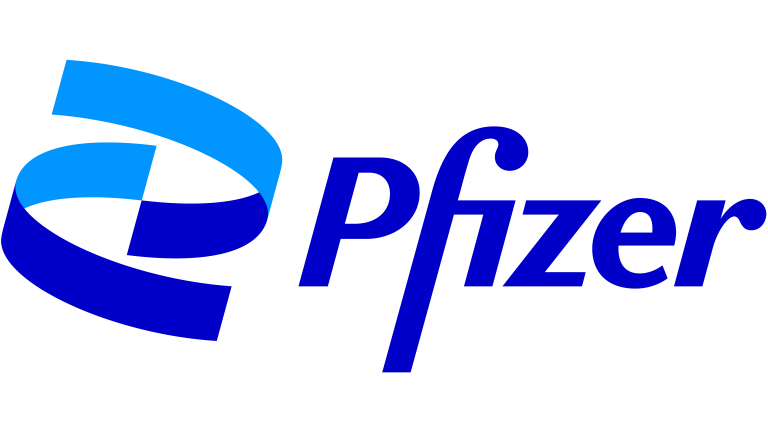
The single biggest gap in the old version is that it treats the current logo as just another step in a visual timeline, without explaining what drove it. On January 5, 2021, Pfizer retired its decades-old pill-shaped oval for a design built around a DNA double helix, a change the company described as a shift “from commerce to science.” The redesign, created by the branding firm Pentagram, took more than 18 months and drew on research with patients and doctors. It followed Pfizer spinning off or combining several of its older businesses (generics into Viatris, animal health into Zoetis, consumer health into a joint venture with GSK) to focus more narrowly on innovative medicines.
That science-first focus deepened in December 2023, when Pfizer completed its roughly $43 billion acquisition of Seagen, a company specializing in antibody-drug conjugates for cancer treatment. The deal was Pfizer’s largest since Wyeth and pushed the company further into oncology, the same direction its post-pandemic branding had signaled two years earlier.
Logo evolution

1849-1948: the industrial seal era
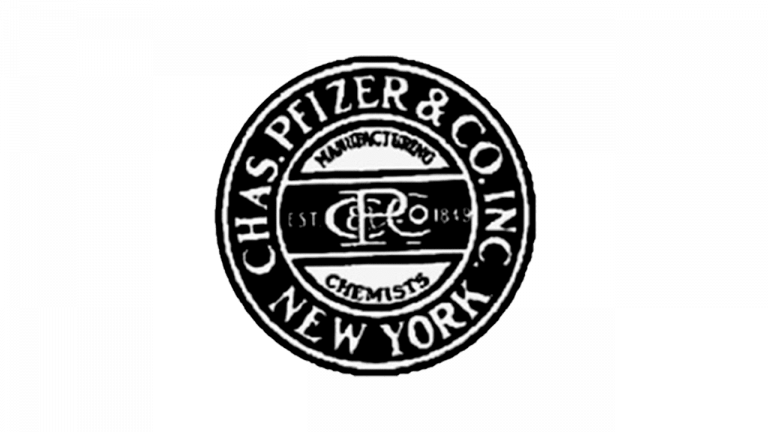
Pfizer’s earliest marks were circular seals, built from a double ring, a banner, and a monogram, typical of 19th and early 20th century industrial branding rather than a consumer-facing logo.
1948-1950: the first oval concept
In 1948, Pfizer introduced its first oval-based mark: a light brown wordmark set on a yellow globe crossed with meridian lines, a brief transitional design before the classic oval took shape.
1950-1990: the black oval classic
From 1950, Pfizer settled into the mark most associated with the company for decades: a white serif “Pfizer” wordmark set inside a solid black oval. Design-history accounts often credit this ellipse version to designer Gene Grossman, though sources differ on the exact date and this attribution is not independently confirmed.
1990-2009: blue and sans-serif
The 1990 update dropped the black-and-white palette for blue, switched to a sans-serif typeface, and elongated the stroke of the “F,” giving the wordmark a more modern, pharmaceutical-industry look.
2009-2021: the gradient oval
The 2009 redesign, timed to the Wyeth acquisition, tilted the oval, simplified the typography, and introduced a blue gradient, softening the flat 1990s look.
2021-today: the DNA ribbon
The current identity, introduced in January 2021 and designed by Pentagram, removes the oval entirely in favor of two flowing ribbon shapes in two shades of blue, evoking a double helix, with the wordmark set independently beside it.
Quick facts
| Founded | 1849, Brooklyn, New York, by Charles Pfizer and Charles Erhart |
| First product | Santonin, an antiparasitic, flavored with almond toffee to mask its bitter taste |
| Wyeth acquisition | Announced January 2009, closed October 15, 2009, for about $68 billion |
| 2021 logo redesign | Introduced January 5, 2021; designed by Pentagram; replaced the oval with a DNA double helix motif |
| Seagen acquisition | Completed December 2023 for about $43 billion, expanding Pfizer’s oncology business |
Related reading
Further reading
FAQ
Who founded Pfizer, and when?
Pfizer was founded in 1849 in Brooklyn, New York, by cousins Charles Pfizer and Charles Erhart, recent immigrants from Ludwigsburg, Germany.
What did Pfizer’s logo have to do with the Wyeth deal?
Pfizer’s 2009 logo redesign, a tilted blue gradient oval, came the same year Pfizer announced and completed its roughly $68 billion acquisition of Wyeth.
Who designed Pfizer’s current logo?
The branding firm Pentagram designed the DNA-helix logo Pfizer introduced on January 5, 2021. Earlier versions are credited to different firms and designers in design-industry accounts, including Siegel+Gale for the 2009 gradient oval, though the attribution for the 1950 black oval, often given as designer Gene Grossman, is not independently confirmed.
What was Pfizer’s Seagen acquisition about?
Pfizer completed its roughly $43 billion acquisition of Seagen in December 2023, gaining Seagen’s antibody-drug conjugate cancer treatments and deepening Pfizer’s push into oncology.