Bayer Logo History: IG Farben, Zyklon B, and the Monsanto Deal
Bayer spent more than two decades as part of IG Farben, the conglomerate that manufactured Zyklon B and ran slave-labor factories at Auschwitz, before Allied forces broke it up in 1951 and Bayer re-emerged as an independent company. Decades later, Bayer’s 2018 acquisition of Monsanto brought a different kind of reckoning: tens of billions of dollars in Roundup cancer litigation.
How did Bayer actually grow, and what happened with IG Farben and Monsanto?
Bayer was founded in 1863 in Barmen, Germany, as a dyestuffs factory, later developing and patenting acetylsalicylic acid as Aspirin and, in the 1930s, researcher Gerhard Domagk’s Prontosil, one of the first antibacterial drugs. In 1925, Bayer merged with five other German chemical companies to form IG Farben, which became the world’s largest chemical and pharmaceutical conglomerate and, under the Nazi regime, manufactured the Zyklon B gas used in concentration camp gas chambers and ran slave-labor factories, including one at Monowitz, part of the Auschwitz complex, where tens of thousands of prisoners were forced to work. After the war, Allied authorities broke up IG Farben in 1951, and Bayer reincorporated as an independent company; in 1956, Fritz ter Meer, an IG Farben executive convicted at Nuremberg for war crimes and crimes against humanity, was elected chairman of Bayer’s supervisory board.
More recently, Bayer completed its $66 billion acquisition of Monsanto on June 7, 2018, inheriting Monsanto’s Roundup weedkiller business along with mounting claims that its active ingredient, glyphosate, causes cancer. By 2023, roughly 165,000 Roundup claims had been filed against Bayer, and the company agreed in June 2020 to pay about $9.6 billion to settle more than 10,000 of them, with individual jury verdicts in other cases reaching into the hundreds of millions of dollars before appeals reduced them. The deal has been widely described as one of the costliest corporate acquisitions in recent history.
Logo evolution
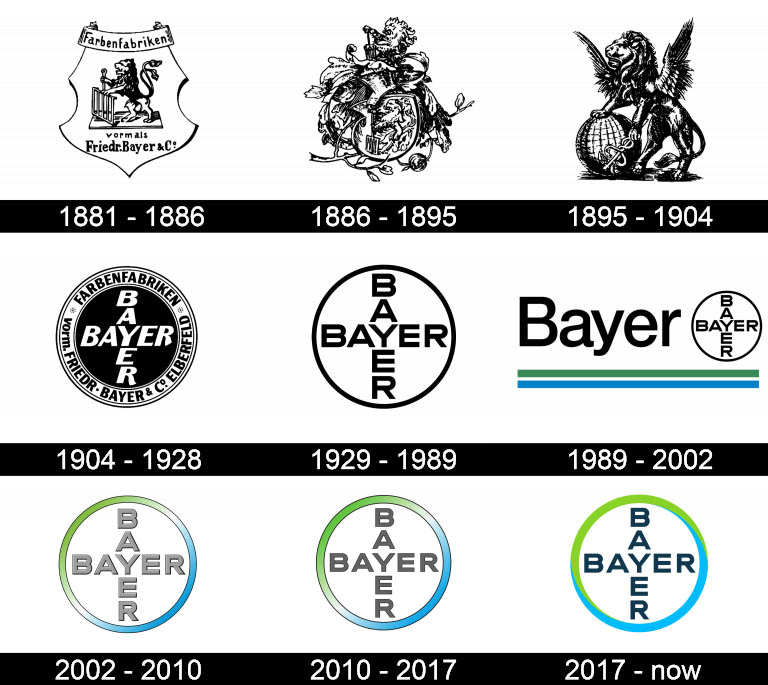
1881-1886: heraldic origins
Bayer’s first emblem, introduced in 1881, borrowed from the coat of arms of Elberfeld, featuring a lion motif typical of 19th-century corporate heraldry.
1886-1895: ornamental complexity
The 1886 version added a denser composition of lions, foliage, and decorative engraving, visually rich but less practical for a fast-growing industrial brand.
1895-1904: medical imagery
The 1895 redesign simplified the emblem to a winged lion atop a globe holding a snake-entwined scepter, referencing medicine as Bayer’s pharmaceutical business grew.
1904-1928: the Bayer Cross
In 1904, Bayer introduced the Bayer Cross: the word “BAYER” written horizontally and vertically, intersecting at the “Y,” inside a circle. Registered as a trademark that year, Bayer began stamping it directly onto tablets, especially Aspirin, from 1910 as a counterfeiting deterrent.
1929-1989: unchanged through IG Farben and after
The Bayer Cross stayed visually unchanged for six decades, through the IG Farben years, the 1951 breakup, and Bayer’s postwar reconstruction as an independent company.
1989-2002: a wordmark and color bars
The 1989 update paired the cross with a larger sans-serif wordmark and green-and-blue horizontal bars, colors that became central to Bayer’s later branding.
2002-2010: color arrives
The 2002 redesign gave the Bayer Cross its first fully colored treatment, with blue and green gradients while preserving the historic structure.
2010-today: flattened for digital use
The 2010 and 2017 refinements removed gradients and dark-gray lettering in favor of flatter, screen-friendly colors, keeping the Bayer Cross intact.
Typography and color
The Bayer Cross relies entirely on its intersecting typography rather than a figurative symbol, set in a clean sans-serif. Blue signals trust and medical authority; green signals the company’s agricultural science business, now expanded by the Monsanto acquisition.
Quick facts
| Founded | 1863, Barmen, Germany, as a dyestuffs factory |
| Bayer Cross introduced | 1904; stamped on tablets from 1910 |
| Merged into IG Farben | 1925 |
| IG Farben broken up, Bayer independent again | 1951 |
| Monsanto acquisition completed | June 7, 2018, for $66 billion |
| Roundup litigation | About 165,000 claims by 2023; roughly $9.6 billion settlement agreed in June 2020 |
Related reading
Further reading
FAQ
Was Bayer part of IG Farben?
Yes. Bayer merged into IG Farben in 1925; the conglomerate produced Zyklon B and ran slave-labor factories under the Nazi regime before Allied authorities broke it up in 1951, when Bayer became independent again.
Why is Bayer facing lawsuits over Roundup?
Bayer acquired Monsanto, Roundup’s maker, in 2018, and inherited roughly 165,000 claims alleging that Roundup’s glyphosate causes cancer, agreeing to a $9.6 billion settlement in 2020 for part of them.
When was the Bayer Cross introduced?
In 1904, and Bayer began stamping it directly onto tablets in 1910 to deter counterfeiting.
What do the Bayer logo’s colors represent?
Blue represents trust and medical authority, while green represents the company’s agricultural science business.