
Universal Logo History: Meaning, Symbolism & Brand Heritage

Universal Pictures is one of the most enduring names in global entertainment. Founded in 1912 and recognized as the oldest operating movie studio in the United States, Universal has shaped cinema culture for more than a century. From silent films to worldwide blockbuster franchises, its identity has always leaned on an unmistakable visual signature: the globe.
While the studio has refreshed its logo many times, its core idea has stayed remarkably consistent — a world wrapped in storytelling, ambition, and cinematic reach.
Meaning and Symbolism of the Universal Logo
Across every redesign, the Universal emblem has centered on a stylized planet Earth. The globe represents global entertainment, international distribution, and the studio’s ambition to reach audiences everywhere.
Even when artistic directions shifted — from monochrome graphics to rich 3D renderings — the symbolism remained the same: Universal makes films for the whole world, and the world is the heart of its brand identity.
Logo Evolution Through the Years
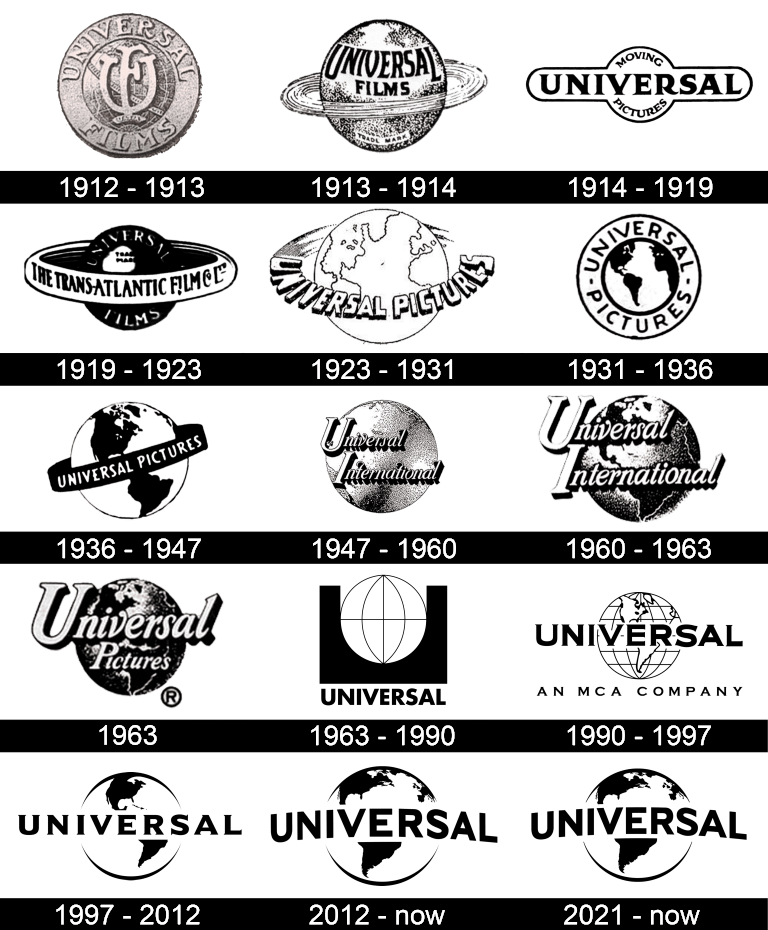
1912–1913: The First Globe
The earliest Universal logo already introduced the globe motif. A thick orbital ring circled a stylized planet, with “Universal Films” set in a serif typeface across the top. Simple and monochrome, this badge established the foundation for everything that followed.
1913–1914: Planet and Meteor Ring
A refined black-and-white illustration followed, featuring a more detailed planet wrapped by a meteor-like disk. The inscription remained at the top but appeared taller and more elegant.

1914–1919: A Globe-Inspired Frame
This is the only Universal logo without an actual planet. Instead, the nameplate sat inside a circular framing device that suggested a globe silhouette, preserving the symbolic spirit.
1919–1923: Return of the Planet
The studio returned to a globe as the centerpiece. Typography and placement shifted across variations, but the emblem became instantly recognizable and set the stage for future refinements.

1923–1931: A Modernized White Globe
Universal introduced a bright, white globe outlined with clean black lines. The lettering circled the planet like an orbit, bold and shadowed for depth. This version felt lighter and more modern for its time.

1931–1936: Stronger Contrast
The emblem became flatter but bolder. A thick white frame encircled the planet, with dense black accents providing greater visual impact. The sans-serif wordmark wrapped around the outer ring with clarity and precision.

1936–1947: Ribbon Orbit Era
For nearly a decade, Universal used a globe surrounded by a black ribbon carrying “Universal Pictures” in full uppercase. The lettering was hand-drawn, simple, and solid, giving the design a cinematic presence.

1947–1960: Detailed Three-Dimensional Globe
Universal embraced a more realistic Earth with shading, texture, and gradient effects. The wordmark transitioned to a cursive style with a dramatic shadow, bringing sophistication and motion.

1960–1963: Enlarged Wordmark and Defined Continents
The script lettering grew larger, and for the first time, the continents were clearly illustrated on the globe — most notably the American continent.

1963 (Short-Lived): Universal Pictures Returns
For a brief period, the wording shifted to “Universal Pictures” in enlarged uppercase script above the globe. Although visually striking, it was quickly replaced.

1963–1990: Minimalist Modern Block Logo
A radically different approach emerged: a flat white-and-black globe placed inside a cropped black square. Modern, geometric, and instantly iconic, this symbol became the studio’s identity for nearly 30 years.

1990–1997: Bolder Emblem and Simplified Name
In 1990, Universal introduced a more polished globe with bold black lettering. The name was shortened to “Universal”, reflecting a contemporary, streamlined identity.

1997–2012: Clean, Refined Modern Globe
The familiar globe was simplified once again, removing unnecessary details and focusing on clarity. It aligned well with digital formats as the film industry entered the modern era.

2012–Today: Sleek, Minimal, and Confident
The current logo features a smooth monochrome globe with an elegantly arched UNIVERSAL wordmark. Bold sans-serif lettering conveys confidence, while the gentle arc nods to the global reach of the studio.

2021–Present: Wider Proportions
A subtle refinement squeezed the composition vertically, creating a wider silhouette that enhances readability across widescreen formats.
Typography and Color
The Universal wordmark traditionally uses bold sans-serif fonts, clean and modern to support the cinematic emblem.
The palette remains black and white, reinforcing timelessness, neutrality, and the studio’s global identity.
Across on-screen adaptations, color and depth vary, but the core logo — globe and title — stays dominant.
A Century of Global Identity
Few logos in film history are as enduring as Universal’s globe. For more than 110 years, the studio has preserved a visual identity that mirrors its mission: to tell stories that travel across borders. Each redesign sharpened and modernized the emblem, but the core message remains untouched — Universal belongs to the world, and the world belongs at the center of cinema.
FAQ Universal Logo
What does the Universal logo represent?
The Universal logo symbolizes the studio’s global reach and commitment to international storytelling. The globe has remained its core icon for more than a century.
Why has Universal kept the globe for so long?
Because the company’s mission has always centered on worldwide distribution and cultural impact, the globe perfectly represents its identity across generations.
When was the Universal logo first introduced?
The original logo appeared in 1912, featuring a stylized planet and orbit. Every version since has built on this foundation.
What font does Universal use in its logo?
Universal typically uses a bold, clean sans-serif typeface, modernized across redesigns to suit contemporary cinematic aesthetics.