Fanta Logo History: The WWII Origin Story Behind the Brand
Fanta wasn’t invented to compete with Coca-Cola. It was invented because Coca-Cola couldn’t be made at all. When a wartime trade embargo cut off the syrup supply to Nazi Germany in 1940, the head of Coca-Cola’s German operation built a replacement drink out of whatever was left over, and the brand that grew from it eventually sold over 200 flavors worldwide.
How did Fanta actually start?
Coca-Cola GmbH, the German arm of The Coca-Cola Company, lost access to the syrup needed to make Coca-Cola in Germany once the United States trade embargo and British naval blockade took hold during World War II. Rather than shut down, Max Keith, the head of the German operation, in 1940 developed a new drink using only ingredients available domestically: sugar beet, whey, and apple pomace, which Keith himself called “the leftovers of the leftovers.”
The name came from a brainstorming session where Keith told his team to use their imagination, in German “Fantasie.” A salesman, Joe Knipp, responded “Fanta!” and the name stuck. By 1943, wartime Fanta had sold three million cases in Germany, and under severe sugar rationing, many people used it as a cooking ingredient rather than a drink. Production stopped in 1949 after the war ended, and Coca-Cola regained control of the German plant and the brand.
The now-familiar orange-flavored Fanta dates to 1955, when Coca-Cola relaunched the brand in Naples, Italy, reformulated around real oranges. From there it expanded into the global, multi-flavor brand sold today, with more than 200 flavors worldwide and local variants tailored to individual markets.
Logo history timeline
1940: the original handwritten wordmark
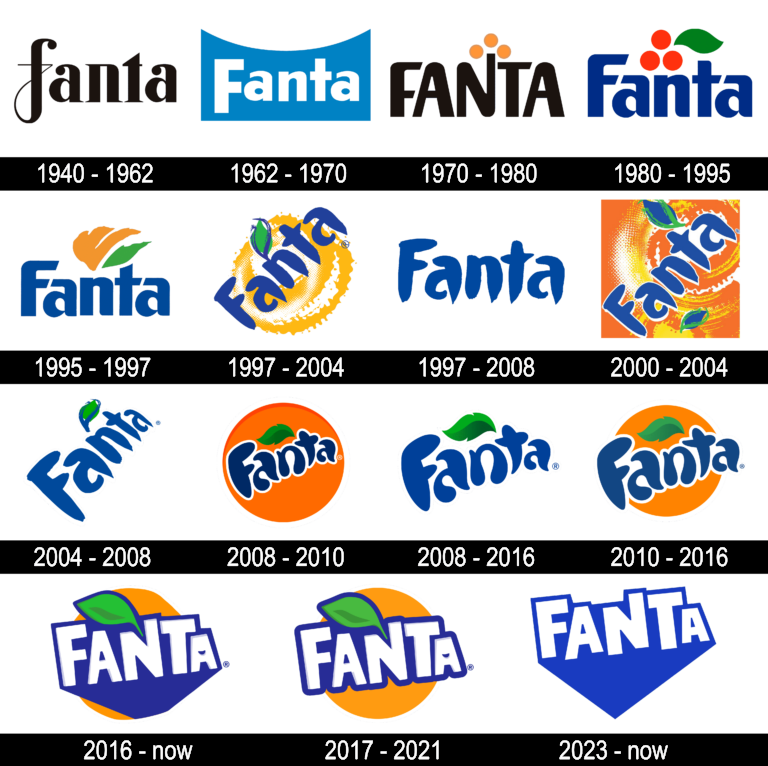
The first Fanta logo, used on the wartime German product, was a lowercase script wordmark with an exaggerated, elongated tail on the letter “F” curving beneath the word, rendered in solid black with no background or color accents.
1962-1970: the smiling blue badge
After the brand’s 1955 relaunch, a 1962 redesign replaced the script with a clean sans-serif wordmark in white on a light-blue rectangle, its top edge curving into a subtle smile shape.
1970-1980: oranges enter the logo
The 1970 redesign added the brand’s first direct flavor reference: three orange circles arched above the letter “N,” tying the logo visually to Fanta Orange.
1980-1995: deeper color and a leaf
In 1980, the wordmark turned deep blue, the circles turned red, and a green leaf was added alongside them, moving the brand further into fruit-forward visual branding.
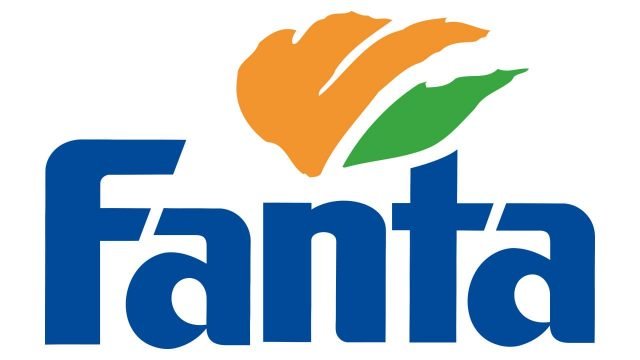
1995-1997: a single abstract leaf
The 1995 update removed the three oranges in favor of one abstract orange leaf, shifting away from literal fruit imagery toward something more symbolic as the brand expanded beyond a single flavor.
1997-2008: diagonal energy and wordmark experiments
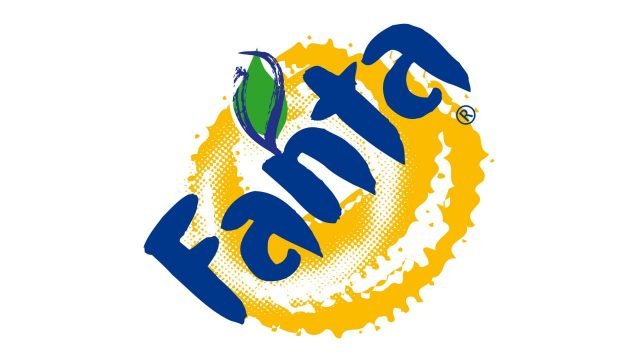
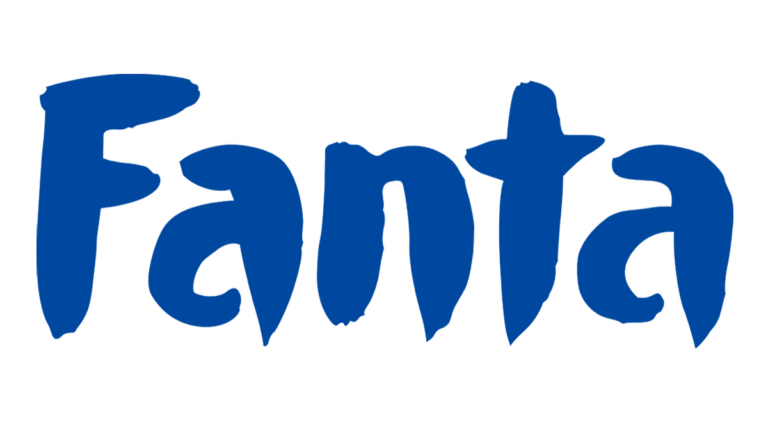
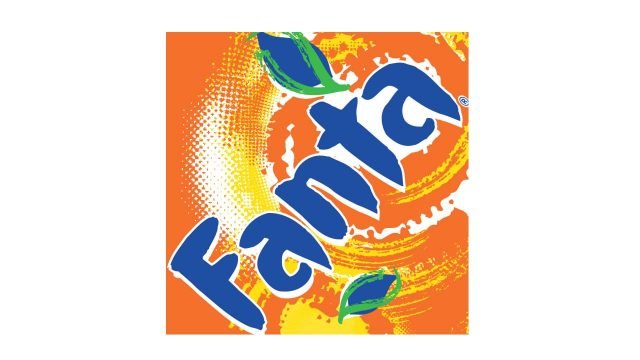
From 1997, Fanta ran a diagonally tilted wordmark on bright orange or yellow backgrounds with a stylized leaf by the “N,” alongside a separate stripped-down version using only a blue wordmark with uneven letter weights, used selectively across markets.
2000-2008: outlines, gradients, and a clean revival
A circa-2000 variant added white outlines and gradient orange backgrounds for more contrast, before a 2004 cleanup returned to a blue wordmark on white, still angled diagonally, with a single green leaf above the lettering.
2008-2016: the circular emblem and global system
The 2008 redesign placed the wordmark inside a solid orange circle suggesting both the fruit and the sun, in dark blue with a white outline and a gradient leaf above the lettering. As Fanta grew to more than 70 flavors worldwide, this became the basis of a flexible branding system adapted by market and flavor; a 2010 update enlarged the wordmark and shrank the circle for better legibility.
2016-2021: squared geometry and simplification
In 2016, the wordmark switched to squared, angular letterforms in white with a thick blue outline on an orange circle, with the green leaf redrawn more prominently; a 2017 update removed the heavy blue shadow for a lighter, more modern finish.
2023-today: the minimalist wordmark
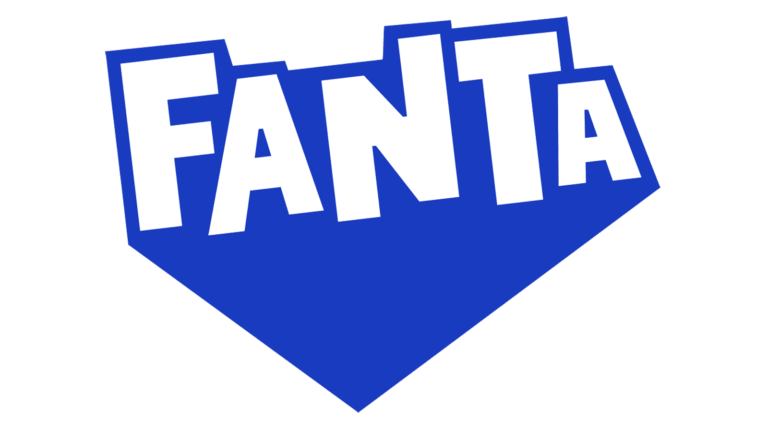
The 2023 redesign dropped the orange circle and leaf entirely, leaving a white uppercase wordmark outlined in blue with a bold triangular shadow, reserving the brighter flavor colors for packaging instead of the logo itself.
Quick facts
| Created | 1940, Germany, by Max Keith at Coca-Cola GmbH |
| Reason | WWII trade embargo cut off Coca-Cola syrup supply |
| Original ingredients | Sugar beet, whey, apple pomace |
| Wartime production stopped | 1949 |
| Orange relaunch | 1955, Naples, Italy |
| Owned by | The Coca-Cola Company |
Related reading
Further reading
FAQ
Why was Fanta invented?
A US trade embargo and British naval blockade cut off Coca-Cola’s syrup supply to Germany during World War II, so Coca-Cola GmbH’s Max Keith created a substitute drink from available ingredients in 1940.
What was Fanta originally made from?
Sugar beet, whey, and apple pomace, which Keith described as “the leftovers of the leftovers.”
Where does the name Fanta come from?
From a brainstorming session where Keith asked his team to use their “Fantasie” (imagination); a salesman shouted “Fanta!” and it stuck.
When did orange-flavored Fanta appear?
In 1955, when Coca-Cola relaunched the brand in Naples, Italy, reformulated around real oranges.
Is Fanta owned by Coca-Cola?
Yes, Fanta is part of The Coca-Cola Company’s portfolio.