
Zillow Logo History: Meaning, Symbolism & Brand Heritage
Zillow reshaped the way people interact with real estate long before online property platforms became an industry standard. What started as a data-driven experiment evolved into one of the most influential digital real estate ecosystems in the United States, offering transparency in a field historically dominated by closed information and intermediaries. Today, Zillow Group is not just a listing website but a reference point for how homes are evaluated, compared, and discussed in the digital age.
At the center of this transformation stands a visual identity built on immediate recognition and functional symbolism. The Zillow logo does not rely on abstraction or metaphor-heavy design. Instead, it communicates its purpose directly, using architectural form and restrained typography to express trust, structure, and authority. This approach aligns Zillow with other category-defining platforms explored in Realtor.com logo history and Redfin logo history, where clarity and credibility matter more than decorative complexity.
The evolution of the Zillow logo history mirrors the platform’s growth from a simple real estate database into a nationwide market intelligence tool. Each redesign reflects shifts in digital behavior, data consumption, and user expectations, while preserving a consistent visual core. Within the broader context of real estate logo heritage, Zillow stands out as a case study in how strong logo meaning and symbolism can reinforce transparency and long-term brand trust in a high-stakes industry.
Meaning and History: The Origin of the Zillow Identity
Zillow was founded in 2004 with the goal of democratizing real estate information. By aggregating data on more than 100 million U.S. homes and introducing value estimates over time, the company positioned itself as both a research tool and a decision-making platform. From the beginning, its identity needed to communicate reliability and relevance in a sector traditionally dominated by intermediaries.
Early branding focused on legibility rather than symbolism, reflecting the experimental nature of online property databases in the mid-2000s. As Zillow’s audience expanded and its Zestimate feature became widely referenced, the brand required a stronger visual shorthand that could immediately signal real estate expertise.
This shift led to the introduction of the house-and-lettermark concept, which became the foundation of Zillow’s logo meaning. From that point onward, every redesign refined the same idea rather than replacing it, reinforcing continuity and long-term brand trust.
Logo Symbolism: Home, Data, and Authority
Zillow logo symbolism is direct and functional. The house silhouette communicates the category instantly, eliminating ambiguity. Inside it, the letter “Z” serves a dual role, functioning both as a brand initial and as a structural divider that resembles architectural framing.
The square enclosing the house reinforces stability and order, qualities essential for a platform dealing with property valuation and long-term financial decisions. Unlike rounded or playful forms, Zillow’s geometry suggests structure, measurement, and reliability.
Color choices reinforce this symbolism. Blue dominates the logo description, signaling trust, professionalism, and analytical credibility. Earlier green accents introduced warmth and growth, but over time the palette shifted toward cleaner blues to emphasize authority and neutrality.
Zillow Logo History Timeline
2004–2006: Early Neutral Identity
The original Zillow logo was purely typographic and lacked symbolic elements. While it offered good legibility and ease of reproduction, it did not visually communicate the platform’s focus on real estate. This version functioned as a placeholder identity during Zillow’s formative years.
2006–2008: Introduction of the House Symbol
In 2006, Zillow introduced the defining element of its visual identity: the house-shaped emblem containing the letter “Z.” The house was divided into two color zones, blue on top and green on the bottom, visually separating structure and growth.
The wordmark expanded to include “beta” and the tagline “Your Edge in Real Estate,” emphasizing Zillow’s positioning as an emerging data advantage. This version marked the true beginning of Zillow’s recognizable logo heritage.
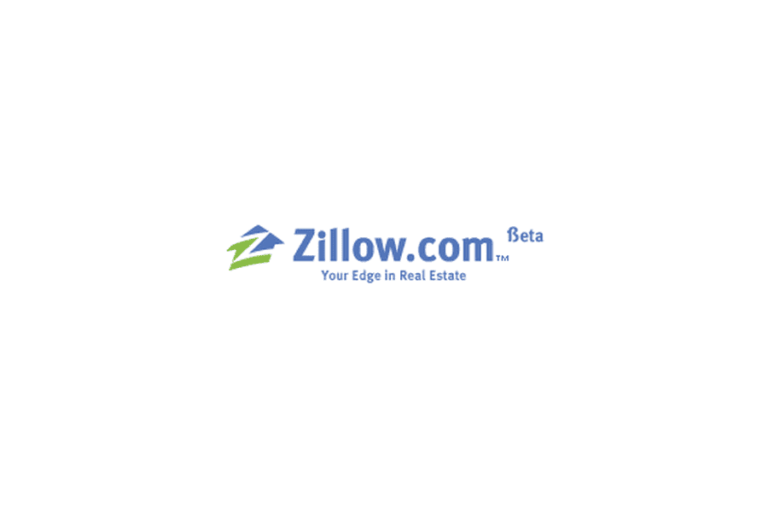
2008–2019: Simplification and Market Maturity
By 2008, Zillow removed secondary elements such as “.com” and “beta,” resulting in a cleaner, more confident logo. The core house-and-“Z” symbol remained intact, while the wordmark became easier to scan and reproduce.
This iteration accompanied Zillow’s rise to mainstream recognition and established the logo as a trusted reference point in real estate discussions and media coverage.
2019–2024: Color Unification and Structural Refinement
The 2019 redesign simplified the palette, replacing green and muted blue with a single, brighter blue tone. The house icon was straightened, reinforcing symmetry and balance. Typography became more restrained, with diagonal cuts removed from letters such as “i” and “l,” enhancing legibility across digital platforms.
This version aligned Zillow’s identity more closely with modern data-driven brands while preserving its real estate symbolism.
2024–Today: Contrast, Confidence, and Typographic Precision
The most recent redesign refined rather than reimagined the logo. The house emblem adopted a deeper, more saturated blue, while the wordmark shifted to black, increasing contrast and authority. Subtle typographic adjustments, particularly in the lowercase “w,” introduced a more stable and grounded appearance.
This update reflects Zillow’s current role as an established industry reference rather than a disruptive newcomer.
Premier Agent Symbol: Sub-Brand Continuity
Zillow’s Premier Agent program uses a modified version of the core emblem. The house shape remains, but the “Z” is replaced by a “P,” which visually intersects with the numeral “1,” emphasizing exclusivity and ranking. This adaptation maintains visual continuity while clearly differentiating the professional sub-brand.
Earlier Premier Agent badges relied on seal-like designs with decorative borders. The transition to a simplified emblem mirrored Zillow’s broader branding strategy: clarity over ornamentation.
Typography and Color: Recognition Through Restraint
Zillow’s typography appears neutral at first glance but gains distinctiveness through angular details on the “Z,” the verticals of the “l,” and the dot of the “i.” These subtle features support recognition without sacrificing readability.
Color remains central to Zillow’s logo meaning. Blue conveys trust and analytical rigor, while white space ensures clarity. Secondary green tones appear occasionally in sub-brands, reinforcing associations with growth and opportunity without diluting the core identity.
Zillow Logo Heritage and Real Estate Transparency
The Zillow logo history demonstrates how consistency and incremental refinement can build authority in a data-sensitive industry. By anchoring its identity to a clear real estate symbol and refining it over time, Zillow established a logo heritage that communicates trust, accessibility, and expertise.
Within the broader context of logo heritage in digital marketplaces, Zillow stands out for choosing meaning over abstraction. Its logo meaning remains immediately legible, proving that in industries built on trust and long-term decisions, clarity is the most powerful branding tool.
FAQ: Zillow Logo Meaning and History
What does the Zillow logo represent?
The logo represents real estate expertise, using a house symbol combined with the letter “Z” to signal home data and property insights.
Why does Zillow use a house in its logo?
The house instantly communicates the platform’s focus on homes, real estate values, and property research.
Has the Zillow logo changed over time?
Yes, the logo evolved through multiple refinements, but the core house-and-“Z” concept has remained consistent since 2006.
What do the colors in the Zillow logo mean?
Blue represents trust and professionalism, while earlier green accents symbolized growth and opportunity.