Trivago Logo History
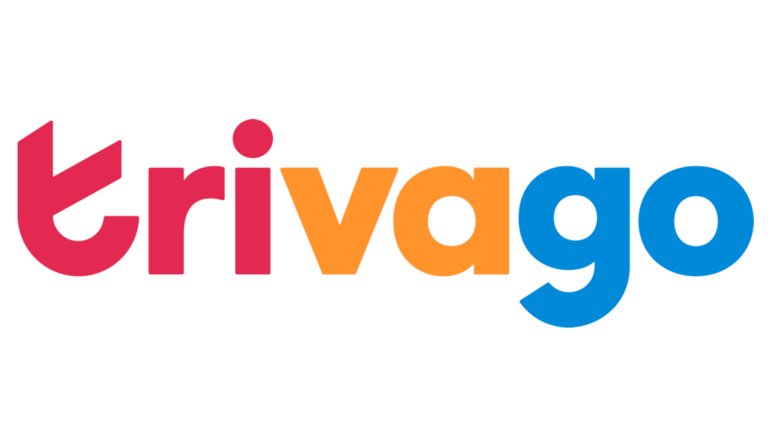
Trivago built its name on a simple pitch: search once, compare hotel prices across hundreds of booking sites, and pick the best deal. That promise, and the legal trouble it later caused the company, shaped the Trivago logo far more than any design trend did. The brand has stuck with a plain wordmark since 2005, long after most travel companies added icons, mascots, or abstract symbols to their marks.
The Trivago logo history below covers the real founders, the Expedia buyout, the 2016 stock market listing, and the price comparison rulings that followed the brand into regulators’ offices in Australia and the United Kingdom. A plain text comparison like Booking.com’s logo history follows a similar pattern of putting the brand name first and skipping the imagery.
Who Started Trivago and Why?
Trivago was founded in January 2005 in Dusseldorf, Germany, by Rolf Schromgens, Malte Siewert, Peter Vinnemeier, and Stephan Stubner. The four had worked together before and noticed that hotel search online was scattered across dozens of individual booking sites with no easy way to compare rates. They built what is generally credited as Germany’s first hotel metasearch engine, with roughly 1 million euros in early funding from investors including the Samwer brothers, Florian Heinemann, and Christian Vollmann. Stubner left his role as managing director not long after launch, while Schromgens, Siewert, and Vinnemeier stayed on to grow the company. Schromgens served as CEO for years afterward, stepped away from the role in 2019, and returned to the company in an advisory capacity in 2023.
Expedia Group’s involvement began in December 2012, when it announced a deal to buy a 61.6 percent equity stake in Trivago for about 477 million euros, roughly 632 million US dollars at the time, combining cash and Expedia stock. The deal closed in 2013. Trivago then held its own initial public offering on the NASDAQ exchange on December 16, 2016, under the ticker symbol TRVG, while Expedia retained a majority of the voting power even after the listing. The logo stayed stable through all of this corporate change, which is part of why the brand reads as consistent despite the ownership shifts underneath it.
What Does the Trivago Logo Symbolize?
The Trivago logo skips pictures entirely and puts the full weight on the brand name itself. For most of its history the wordmark split into colored segments, a small visual nod to the idea of comparison and sorting that sits at the center of what the site actually does. There is no suitcase, no airplane, no globe, just the name rendered in a clean sans-serif. That restraint has carried through several redesigns, even as the specific colors and letter spacing changed.
Trivago Logo History Timeline
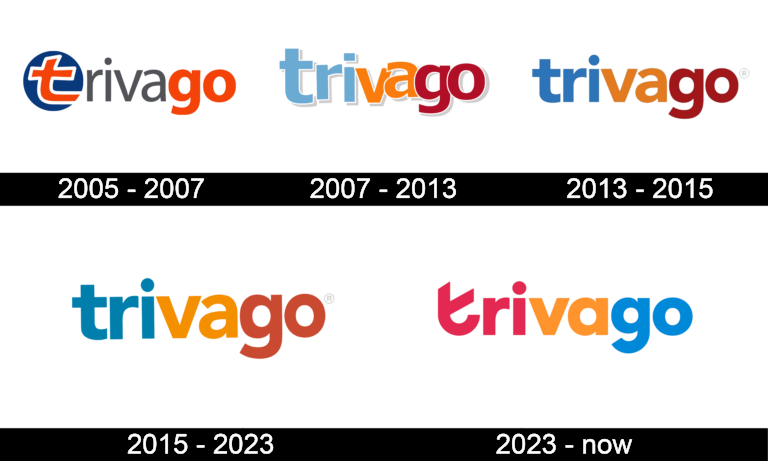
2005-2007: The First Trivago Wordmark
Trivago launched in 2005 with a lowercase wordmark built around a stylized letter “t” set inside a solid blue circle, with the “t” itself rendered in orange and outlined in white. The rest of the name split into a dark gray “riva” and a bold orange “go.” No image from this exact earliest version remains correctly labeled in the site’s media library, so it is described here rather than shown, but the circle-and-wordmark combination is well documented as the brand’s starting point.
2007-2013: A Wordmark Without the Circle
In 2007 Trivago dropped the circular emblem and let the wordmark carry the whole identity. Each portion of the name took on its own color, light blue for “tri,” yellow for “va,” and red for “go,” set in a bold sans-serif with a thin white outline and a soft gray shadow beneath the letters.
2013-2015: A More Restrained Palette
The 2013 revision pulled the color palette back to mainly blue and red, with less contrast between the segments than the 2007 version had. The overall shape of the letters stayed close to the prior design, but the mark read as calmer and less busy.
2015-2023: Two Versions of the Same Refinement
Trivago refined its wordmark again starting in 2015, keeping the established color logic but tightening the letter spacing and aligning the name on a single baseline for a cleaner, more modern look. The media library holds two files from this stretch, suggesting the company made at least one further adjustment within the same general period rather than a single one-off change.
2023-Today: A Rebrand With a Hidden Symbol
Trivago unveiled a brand refresh in December 2023, developed with the agency DesignStudio. The update kept the lowercase wordmark but added a small mark combining a checkmark and a smile into the shape of a lowercase “t,” meant to suggest both smart searching and a positive travel experience. The company also adopted a custom typeface called Savvy Grotesk, built to support a wide range of languages, alongside a brighter set of colors drawn from different holiday destinations.
What Typeface Does Trivago Use?
Trivago’s earlier wordmarks used a bold, modern sans-serif close in weight to Avenir Pro’s heavier cuts. The 2023 rebrand replaced this with Savvy Grotesk, a custom typeface built specifically for the brand and designed to render consistently across the many languages Trivago’s sites operate in.
Is There a Separate Trivago Corporate Logo?
Trivago also uses a corporate mark for investor communications and official company materials. It pairs the lowercase wordmark, usually shown in dark gray or black, with an open ring rendered in blue, orange, and red that sits slightly rotated beside the text. The ring is not used on the consumer-facing site or apps, where the plain wordmark and the 2023 checkmark symbol do the work instead.
Has the Trivago Logo Faced Any Legal Controversy?
The brand name and its promise of unbiased price comparison became a legal liability more than once. The UK’s Competition and Markets Authority investigated the hotel booking sector starting in 2019 and named six companies, including trivago, Booking.com, Expedia, Agoda, Hotels.com, and ebookers, over concerns about pressure selling, misleading discount claims, and rankings that could be skewed by commission payments. All six firms formally committed to change their sites as a result.
Separately, Australia’s Competition and Consumer Commission sued Trivago in 2018 over its price rankings. In January 2020, the Federal Court of Australia ruled that Trivago had engaged in misleading or deceptive conduct, finding that the site often ranked offers by which advertiser paid the highest fee rather than by price, and that it used comparisons between different room types to create a false impression of savings. In April 2022, the court ordered Trivago to pay a fine of 44.7 million Australian dollars.
Quick Facts
| Founded | January 2005, in Dusseldorf, Germany |
| Founders | Rolf Schromgens, Malte Siewert, Peter Vinnemeier, and Stephan Stubner |
| Headquarters | Dusseldorf, Germany |
| Majority owner | Expedia Group, which bought a 61.6 percent stake for about 632 million US dollars in a deal announced in December 2012 |
| Stock listing | NASDAQ, ticker TRVG, IPO on December 16, 2016 |
| 2023 rebrand agency | DesignStudio |
| Custom typeface | Savvy Grotesk, introduced with the 2023 rebrand |
| Scale | More than 50 localized websites and apps, with over 600 employees as of late 2025 |
FAQ
Who founded Trivago?
Trivago was founded in January 2005 in Dusseldorf, Germany, by Rolf Schromgens, Malte Siewert, Peter Vinnemeier, and Stephan Stubner.
What does the Trivago logo represent?
The logo relies entirely on the brand name rather than a picture symbol. Through most of its history the wordmark was split into colored segments as a quiet reference to the site’s comparison function, and since 2023 it has included a small checkmark and smile symbol built into the lowercase “t.”
Why did Trivago face legal action over its price rankings?
Regulators in the United Kingdom and Australia both found issues with how Trivago ranked hotel offers. The UK’s Competition and Markets Authority named Trivago among six booking sites investigated in 2019 over misleading practices, and Australia’s Federal Court ruled in January 2020 that Trivago had misled consumers by ranking some offers based on advertiser fees rather than price, resulting in a 44.7 million Australian dollar fine in 2022.
When did Trivago go public?
Trivago listed on the NASDAQ stock exchange on December 16, 2016, under the ticker symbol TRVG, several years after Expedia Group bought a majority stake in the company.
What font does Trivago use in its logo?
Trivago’s earlier logos used a bold sans-serif similar in weight to Avenir Pro’s heavier styles. The 2023 rebrand introduced a custom typeface called Savvy Grotesk, designed to work across the many languages Trivago’s platforms support.
Further Reading
- Expedia Buys Majority Stake In European Hotel Search Site Trivago For $632 Million, TechCrunch
- Trivago IPO opens at $11.20 after pricing at $11, below its expected range, CNBC
- DesignStudio revives Trivago’s unique and charming spirit with new identity, Design Week
- Major overhaul of hotel booking sector after CMA action, GOV.UK
- Trivago Mislead Consumers On Hotel Pricing, Channel News Australia