
The Weather Network Logo History: Meaning, Symbolism & Brand Heritage

The Weather Network is one of the most recognizable media brands in Canada, occupying a unique position at the intersection of broadcasting, science, and everyday life. Since its launch in the late 1980s, the network has become a trusted source for forecasts, climate information, and real-time weather alerts. Its visual identity has played a crucial role in establishing credibility and instant recognition, especially in a category where clarity and authority are essential.
The The Weather Network logo history is remarkably focused and restrained. Unlike many media brands that frequently reinvent their visual language, The Weather Network has relied on a strong core concept refined over time. This approach mirrors the long-term consistency seen in the BBC logo history and the data-driven clarity emphasized in the National Geographic logo history, while fitting naturally within the broader media brand logo heritage centered on trust and information reliability.
Meaning and History: The Origin of The Weather Network Identity
The Weather Network was launched in 1988, with its first on-air broadcasts beginning in 1989. From the outset, the brand positioned itself not as entertainment, but as an essential public service. This positioning strongly influenced the logo meaning, which prioritized neutrality, professionalism, and scientific credibility over emotional or decorative elements.
The original logo introduced in 1989 reflected this philosophy. Rather than using literal weather icons such as clouds or lightning, the brand adopted an abstract graphic symbol paired with a clear wordmark. This decision aligned the network with data visualization and meteorological modeling, reinforcing its authority in weather reporting. The core concept proved so effective that it remained fundamentally unchanged for more than two decades.
Logo Symbolism: Atmosphere, Motion, and Data
The Weather Network logo symbolism is built around abstraction rather than illustration. The spiral-like graphic element suggests atmospheric circulation, wind patterns, and global weather systems without depicting any single phenomenon directly. This abstraction allows the logo to represent all forms of weather rather than one specific condition.
The circular motion implied by the symbol communicates continuity, prediction, and constant change—core ideas in meteorology. Paired with a restrained typographic system, the emblem positions the brand as analytical and dependable. The absence of aggressive angles or sharp contrasts reinforces calm authority, an important psychological factor for a service that often communicates critical information.
The Weather Network Logo History Timeline
1989–2011: Blue Spiral Emblem Establishing Scientific Authority
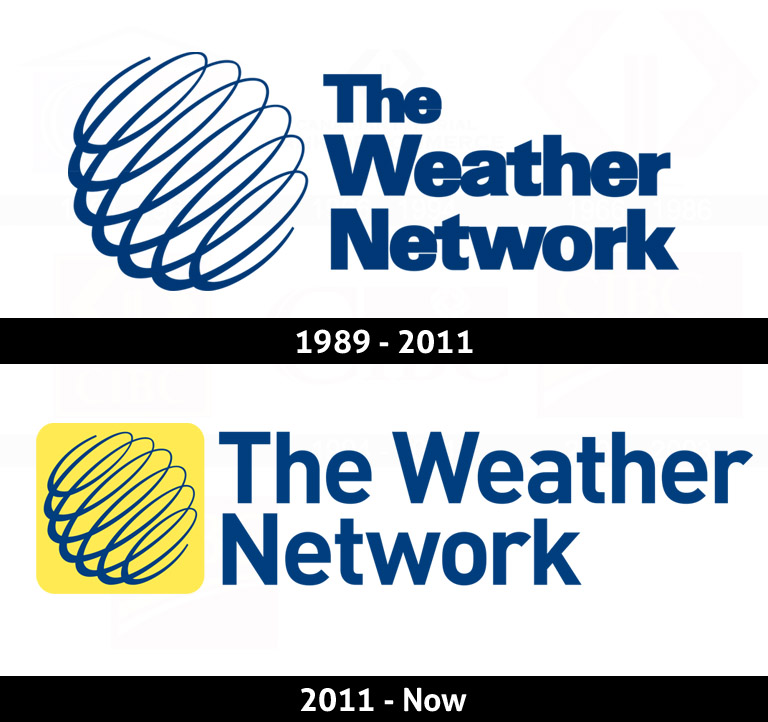
The original The Weather Network logo, used from 1989 to 2011, featured a monochromatic blue color scheme. The emblem consisted of a hand-drawn spiral composed of overlapping curved lines, evoking atmospheric motion and global circulation patterns. To the right, the name “The Weather Network” appeared in a clean, sans-serif typeface, stacked across multiple lines.
This version emphasized credibility and neutrality. Blue, traditionally associated with trust, data, and science, reinforced the network’s role as an authoritative information source. The abstract spiral avoided literal imagery, allowing the logo to remain timeless and adaptable across broadcast graphics, print materials, and early digital platforms.

2011–Today: Refined Identity with Yellow Accent and Digital Focus
In 2011, The Weather Network introduced a refreshed visual identity that modernized the original concept without abandoning it. The spiral emblem was retained but placed inside a rounded yellow square, increasing contrast and visibility, particularly on digital screens and mobile devices. The wordmark remained largely unchanged, preserving brand continuity.
The addition of yellow introduced warmth and accessibility, balancing the analytical tone of blue. This update reflected the network’s evolution into a multi-platform digital brand while maintaining the logo heritage established over two decades earlier. The symbol became more icon-friendly, suitable for apps, notifications, and social media, without sacrificing recognition.
Typography and Color Palette
The Weather Network wordmark uses a modern sans-serif typeface designed for clarity and legibility across screens. Its straightforward construction avoids stylistic excess, ensuring readability in fast-paced information environments such as live broadcasts and mobile alerts.
The color palette centers on blue and yellow. Blue represents trust, accuracy, and scientific rigor, while yellow adds visibility and approachability. Together, they create a balanced identity that feels both authoritative and user-friendly, supporting the brand’s dual role as an information service and a daily-use media platform.
Conclusion: The Weather Network Logo as a Model of Consistent Evolution
The Weather Network logo history demonstrates the power of disciplined refinement. By preserving its core symbol while adapting presentation to new technologies, the brand maintained continuity without stagnation. Its logo heritage shows that abstraction, when grounded in clear meaning, can remain relevant across decades of technological and cultural change.
In a media landscape defined by constant reinvention, The Weather Network stands as an example of how consistency, clarity, and symbolic restraint can build lasting trust.
FAQ: The Weather Network Logo Meaning and History
What does The Weather Network logo represent?
The logo represents atmospheric motion, global weather systems, and continuous data flow through an abstract spiral symbol.
Why did The Weather Network change its logo in 2011?
The logo was updated to improve digital visibility and adaptability while preserving the original symbolic concept.
What do the blue and yellow colors mean in the logo?
Blue symbolizes trust and scientific accuracy, while yellow adds visibility and warmth for modern digital use.
Has The Weather Network logo changed significantly over time?
No, the core symbol has remained consistent since 1989, with refinements made to support new platforms and technologies.