
Vespa Logo History: Meaning, Symbolism & Brand Heritage

Few two-wheeled brands have achieved the cultural status of Vespa. More than just a scooter manufacturer, Vespa represents a lifestyle shaped by post-war optimism, urban freedom, and Italian design elegance. In the broader context of Piaggio Logo History and Lambretta Logo Meaning, Vespa stands as the most iconic expression of scooter culture worldwide.
Within Automotive Logos, the Vespa logo history is a perfect example of consistency. Instead of constant redesign, the brand built recognition through a single visual idea—refined but never replaced. Its identity reflects not only engineering but also fashion, movement, and lifestyle.
Vespa Logo Meaning and History: The Origin of an Iconic Scooter Brand
Vespa was introduced in 1946 by Piaggio, with the first model designed by aeronautical engineer Corradino D’Ascanio. The name “Vespa,” meaning “wasp” in Italian, was inspired by the scooter’s narrow waist and buzzing engine sound.
In its earliest stage, Vespa did not have its own logo. Scooters carried the Piaggio badge, a shield-shaped emblem reflecting the parent company’s industrial identity. However, as Vespa gained popularity, it quickly developed its own visual identity—one that focused less on industry and more on lifestyle.
The Vespa logo meaning evolved around simplicity and personality. Instead of complex symbols, the brand adopted a handwritten-style wordmark that captured motion, elegance, and individuality. This approach helped Vespa stand apart from more technical automotive branding, positioning it as both a product and a cultural icon.
Vespa Logo Symbolism: Freedom, Motion, and Italian Elegance
Vespa logo symbolism is deeply tied to movement and style.
The diagonal wordmark creates an immediate sense of motion, as if the logo itself is moving forward. This reflects the essence of the scooter—light, agile, and designed for urban mobility.
The custom lettering plays a crucial role in the logo meaning. Its flowing, hand-drawn lines evoke craftsmanship and personality, aligning with Italian design traditions. The distinctive “V,” with its curved shape, subtly echoes the silhouette of the scooter and even hints at the wasp-like inspiration behind the brand’s name.
The underline adds stability and confidence, grounding the otherwise dynamic script. It reinforces the idea that Vespa is not just playful, but also reliable and established.
Color variations have evolved over time. Early versions used monochrome, followed by deep blue tones associated with tradition and trust. Modern executions often feature mint green backgrounds paired with white lettering, introducing freshness and a youthful tone while preserving the brand’s identity.
Vespa Logo History Timeline: From Piaggio Roots to a Timeless Wordmark
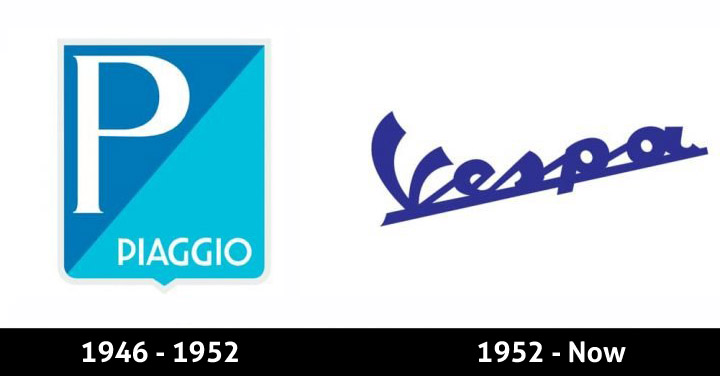
1946–1952: Piaggio Shield and Industrial Identity.
In its earliest years, Vespa scooters carried the Piaggio logo—a shield divided into blue tones with a prominent “P.” This phase reflects the brand’s origin within a larger industrial company, before Vespa established its own identity.
1952–Today: The Diagonal Script Wordmark and Iconic Brand Identity.
In 1952, Vespa introduced its own logo—a stylized, italic wordmark with flowing lines and a distinctive underline. This design became one of the most recognizable emblems in automotive history. While colors and minor details have been refined over time, the core structure has remained unchanged. This consistency defines Vespa’s logo heritage, proving that a strong concept can endure for decades without losing relevance.
Vespa Logo Heritage: A Timeless Symbol of Style and Mobility
The Vespa logo history is a story of restraint and confidence. Rather than chasing trends, the brand committed to a single visual identity that perfectly captured its essence.
The logo meaning reflects freedom, individuality, and elegance. Its logo symbolism—expressed through flowing typography and dynamic composition—aligns with the experience of riding a Vespa itself. As a result, Vespa’s logo heritage extends beyond branding, becoming a symbol of lifestyle, culture, and timeless design.
Vespa Logo History FAQ: Meaning, Symbolism, and Origin
What does the Vespa logo represent?
The Vespa logo represents freedom, movement, and Italian design elegance through its flowing script and dynamic composition.
Why is it called Vespa?
“Vespa” means “wasp” in Italian, inspired by the scooter’s shape and sound.
When was the Vespa logo created?
The Vespa logo was introduced in 1952, replacing the earlier use of the Piaggio emblem.
Why is the Vespa logo italic and diagonal?
The diagonal and italic style symbolizes motion and speed, reflecting the scooter’s lightweight and agile nature.
Has the Vespa logo changed over time?
The core design has remained consistent since 1952, with only minor refinements in color and execution.