Amgen Logo History: Meaning, Symbolism & Brand Heritage

In the world of modern biotechnology, few corporate identities are as closely associated with scientific rigor and long-term innovation as Amgen. Since its emergence at the dawn of the biotech revolution, the company has positioned itself at the intersection of advanced molecular science and real-world patient care. Unlike consumer-facing brands that rely on emotional storytelling, Amgen’s identity has been shaped by credibility, precision, and consistency—qualities that are directly reflected in its logo design.
The Amgen logo is not merely a corporate wordmark but a visual statement of confidence in science. Similar to the restrained authority visible in the Pfizer logo history or the disciplined corporate identity explored in the Biogen logo heritage, Amgen’s visual language prioritizes trust and permanence. Within the broader biopharmaceutical logo history, Amgen stands as a textbook example of how minimal design can support complex scientific ambition.
Meaning and History: The Origin of the Amgen Identity
Amgen was founded in 1980 under the name Applied Molecular Genetics, a title that clearly articulated its scientific focus during a period when biotechnology was still an emerging discipline. The company was established by George Rathmann, William Bowes, and a group of investors who recognized the potential of recombinant DNA technology to transform medicine. From the beginning, Amgen’s mission centered on discovering, developing, and delivering innovative human therapeutics for serious and life-threatening diseases.
As the company expanded globally across the Americas, Europe, and the Asia-Pacific region, the abbreviated name “Amgen” became the primary identifier. This simplification reflected both practical branding considerations and the company’s growing confidence as an industry leader. Today, Amgen is publicly traded and widely held by institutional and individual shareholders, reinforcing its status as a global biopharmaceutical powerhouse.
The logo meaning has consistently aligned with this trajectory. Rather than signaling warmth or emotional appeal, the Amgen identity emphasizes authority, reliability, and scientific advancement. This approach supports a logo heritage rooted in long-term trust rather than frequent reinvention.
Amgen Logo History Timeline
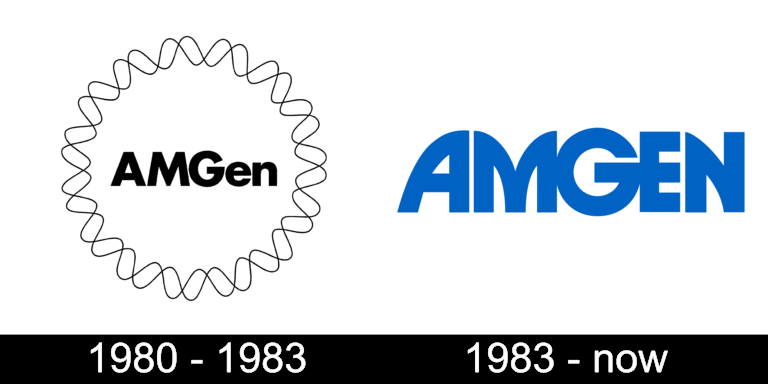
1980–1983: Scientific Motion and Early Biotechnology Identity
The original Amgen logo introduced shortly after the company’s founding featured the word “AMGen” enclosed within an organic, wavy circular form. This surrounding shape evoked movement and adaptability, often interpreted as a visual reference to biological processes such as DNA sequencing or oscilloscopic readings. The contrast between the solid typography and the fluid perimeter suggested a company grounded in structure yet responsive to constant scientific change. Executed in a monochromatic palette, the logo emphasized form and concept over decoration, reinforcing Amgen’s early positioning as a research-driven organization.

1983–Today: Corporate Stability and Global Recognition
In 1983, Amgen adopted a new logo that has remained largely unchanged ever since. The revised wordmark removed the surrounding shape entirely, focusing on bold, uppercase lettering. Rendered in blue, the logo conveyed stability, professionalism, and institutional trust—qualities essential for a company operating in highly regulated medical environments. The typography features subtle curvature and precise spacing, with the stylized “G” serving as a distinctive anchor within the wordmark. This design marked Amgen’s transition from a pioneering startup to an established global leader in biotechnology.
Logo Symbolism: Science, Trust, and Precision
The symbolism of the Amgen logo is intentionally understated. By relying exclusively on typography, the brand avoids visual metaphors that could dilute its scientific authority. The bold letterforms communicate strength and confidence, while the clean geometry reflects precision and control—core values in biopharmaceutical research.
Blue plays a central symbolic role in the logo. Widely associated with trust, intelligence, and reliability, the color reinforces Amgen’s credibility among healthcare professionals, regulators, and patients alike. The absence of additional symbols ensures that the logo remains timeless and adaptable across research publications, clinical materials, and corporate communications.
Typography and Color Palette
Typography defines the Amgen logo description. The custom sans-serif wordmark is engineered for clarity and balance, ensuring legibility across digital and physical environments. Its slightly rounded forms prevent the design from appearing overly rigid, subtly humanizing the brand without compromising professionalism.
The blue color palette further strengthens this balance. While visually restrained, it conveys confidence and authority, aligning with expectations placed on a company responsible for developing therapies that address severe and chronic illnesses. This disciplined use of color and form supports a cohesive and enduring visual system.
Amgen Logo Heritage and Cultural Impact
Over more than four decades, the Amgen logo has become synonymous with innovation in biotechnology. Its consistency mirrors the company’s long-term commitment to research, from early breakthroughs in biologics to its leadership in biosimilar development. Unlike brands that frequently refresh their identities to signal change, Amgen has relied on continuity to communicate reliability and scientific depth.
Within the context of biotechnology logo heritage and pharmaceutical corporate branding history, Amgen demonstrates how visual restraint can reinforce authority. The logo’s longevity reflects the company’s confidence in its mission and its belief that trust is built through sustained performance rather than visual novelty.
Amgen Logo Heritage: A Biopharmaceutical Identity Built on Science and Stability
The Amgen logo history illustrates how a carefully considered wordmark can encapsulate decades of scientific progress and corporate integrity. From its early experimental identity to its current globally recognized form, the logo has evolved alongside the company while remaining true to its core values. By emphasizing clarity, trust, and precision, Amgen has established a visual identity that supports its role as one of the world’s leading biopharmaceutical innovators.
FAQ: Amgen Logo Meaning and History
What does the Amgen logo represent?
The Amgen logo represents scientific authority, reliability, and innovation, communicated through bold typography and a restrained color palette.
Why did Amgen simplify its logo after 1983?
The simplified wordmark reflected the company’s maturation into a global biopharmaceutical leader, emphasizing stability and trust over experimental symbolism.
What does the blue color in the Amgen logo symbolize?
Blue conveys trust, professionalism, and intelligence, aligning with Amgen’s role in highly regulated medical and scientific fields.
Has the Amgen logo changed significantly over time?
Yes, but only once. The transition in 1983 established the logo still used today, with no major structural changes since.