Knorr Logo History: Meaning, Symbolism & Brand Heritage
With roots reaching back to the early industrial age, Knorr stands among the oldest continuously operating food brands in the world. Established in 1838 in Germany, Knorr built its reputation on practicality, taste, and accessibility—qualities that later made its instant soups and bouillons staples in kitchens across continents. Today, as part of Unilever, Knorr operates globally while maintaining a visual identity deeply anchored in its origin.
Unlike many mass-market food brands that periodically reinvent themselves, Knorr’s logo history is defined by loyalty to a single core element: the founder’s handwritten signature. This commitment to continuity transformed the logo into a powerful symbol of authenticity and trust, forming a strong and easily traceable logo heritage.
Meaning and History: The Origin of the Knorr Logo
Knorr was founded in 1838 by Carl Heinrich Theodor Knorr in Heilbronn, Germany. From the beginning, the brand focused on preserving flavor and nutrition through dehydration—an innovation that allowed food to be stored longer without sacrificing quality.
The logo origin is unusually personal. Rather than commissioning an abstract emblem or typographic mark, the company adopted Carl Knorr’s own signature as its visual identifier. This choice was deliberate. At a time when food production was becoming increasingly industrial, the handwritten logo conveyed care, craftsmanship, and a sense of homemade reliability.
This philosophy carried forward as Knorr expanded internationally. Even as ownership structures evolved and the brand joined the Unilever portfolio, the original signature remained central to its identity, reinforcing continuity across nearly two centuries.
Knorr Logo History Timeline
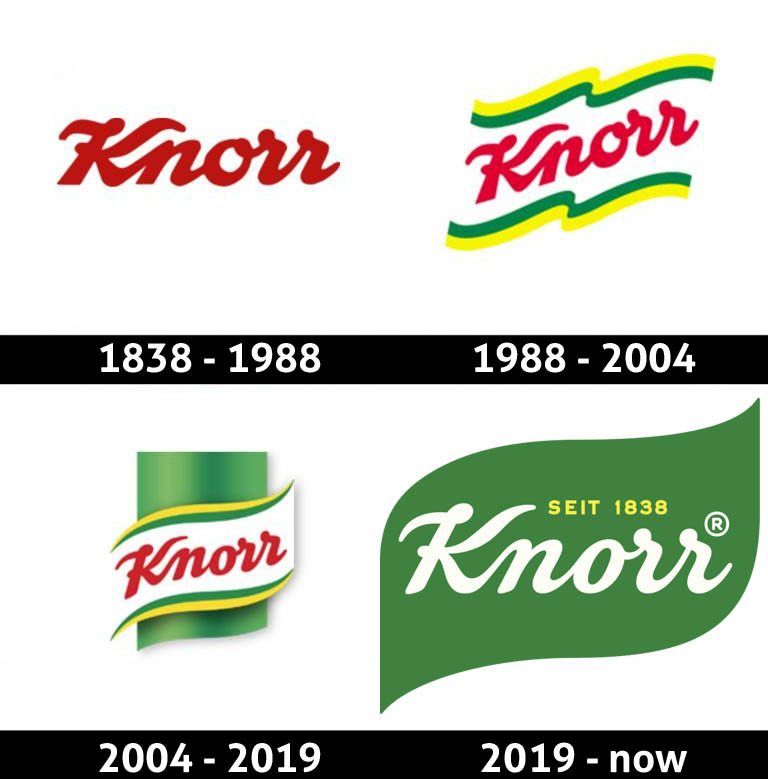
1838: The Founder’s Signature
The first Knorr logo, introduced in 1838, was a direct reproduction of Carl Knorr’s handwritten signature. Executed in a smooth, bold cursive style, it immediately distinguished the brand from competitors using rigid serif or block lettering.
The distinctive capital “K,” with its curved upper strokes, became a defining feature. The handwritten effect was intended to evoke handwritten recipes and home cooking, positioning Knorr as a trusted kitchen companion rather than a faceless manufacturer.
This signature-based logo established the foundation for all future iterations.
1988: Dynamic Composition and the Flag Motif
In 1988, Knorr introduced its first major visual update. The signature wordmark was preserved but rotated slightly—approximately 30 degrees counterclockwise—creating a sense of motion and optimism.
Behind the red script appeared a white banner edged with green and yellow accents. This “flag” motif added structure and contrast, making the logo more adaptable for modern packaging and global distribution. The color palette reinforced freshness and quality, while the handwritten lettering maintained emotional continuity.
2004: Refinement and the Natural Cue
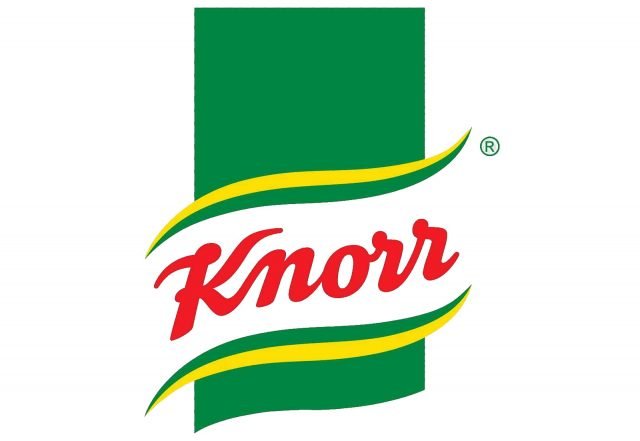
The 2004 redesign focused on subtle refinement rather than change. The script was carefully adjusted, with minor alterations to letter connections—most notably between the “K” and “n,” and in the shape of the “o.” These tweaks improved legibility without disrupting familiarity.
The flag element became more minimalist, and a green stem was introduced behind it. This addition subtly communicated natural ingredients and plant-based origins, aligning the logo with evolving consumer expectations around food transparency and health.
Notably, this version proved so effective that it continues to be used in certain markets today.
2019–Present: Leaf Symbol and Heritage Emphasis
The most recent update replaced the flag entirely with a stylized leaf shape. This change strengthened Knorr’s association with natural ingredients and sustainability, themes increasingly central to the brand’s messaging.
The signature lettering, now rendered in white, sits prominently against the green leaf background. Above it, the small inscription “Since 1838” appears in yellow, explicitly reinforcing the brand’s long history and origin.
Despite these additions, the core identity—the founder’s handwritten name—remains unchanged, ensuring visual continuity across generations.
Logo Symbolism: Authenticity, Nature, and Trust
The symbolism of the Knorr logo is rooted in authenticity. The handwritten signature represents personal accountability, tradition, and craftsmanship—values that resonate strongly in food branding.
The evolution of background elements reflects changing priorities. The flag symbolized global reach and quality assurance, while the later leaf motif emphasizes natural sourcing and freshness. Importantly, these symbols support the wordmark rather than compete with it.
By consistently centering the signature, Knorr communicates that innovation and expansion never came at the expense of its original values.
Typography and Color in the Knorr Logo
Typography is the defining element of Knorr’s visual identity. The cursive script, derived from Carl Knorr’s handwriting, balances elegance with approachability. Its bold strokes ensure visibility, while its fluid motion conveys warmth and familiarity.
Color usage evolved over time but remained purposeful. Red traditionally signaled appetite and energy, green introduced associations with nature and vegetables, yellow added warmth, and white improved clarity. Together, these colors created a system adaptable across cultures while remaining instantly recognizable.
Knorr Logo Heritage and Global Recognition
Knorr’s logo heritage is built on preservation rather than reinvention. Few global brands can claim a visual identity so directly connected to their founder and so consistently applied over nearly 200 years.
As Knorr expanded into markets worldwide, the unchanged signature served as a unifying symbol, bridging cultural differences through familiarity. Even under Unilever’s corporate umbrella, the logo retained its independence and historical character.
Knorr Logo Meaning and Evolution: Conclusion on Brand Heritage
The Knorr logo history illustrates how restraint and respect for origin can create enduring brand equity. Its meaning—rooted in homemade quality, trust, and natural nourishment—has remained relevant from the 19th century to the present day.
By evolving its supporting elements while preserving its handwritten core, Knorr built a logo heritage that feels both timeless and contemporary. The result is a visual identity that reassures consumers that, regardless of scale or ownership, the essence of the brand remains unchanged.
FAQ: Knorr Logo Meaning, Symbolism, and History
What does the Knorr logo represent?
The logo represents authenticity, home-style cooking, and trust through a handwritten signature.
Why is the Knorr logo handwritten?
It is based on the founder Carl Knorr’s signature, symbolizing personal care and tradition.
Has the Knorr logo changed significantly over time?
No, the core signature has remained since 1838, with only supporting elements evolving.
What does the leaf in the modern Knorr logo symbolize?
The leaf represents natural ingredients and sustainability.
Who owns the Knorr brand today?
Knorr is owned by Unilever.