
Hulu Logo History: Meaning, Symbolism & Brand Heritage

Launched at a moment when online video streaming was still an emerging concept, Hulu positioned itself as a modern alternative to traditional television. Founded in 2007 and later becoming part of Disney’s digital ecosystem, Hulu evolved from a content distribution experiment into a major streaming platform offering on-demand series, films, and live television.
From the very beginning, Hulu’s brand identity was designed to feel accessible, contemporary, and distinctly digital. Unlike legacy media brands that relied on symbols or illustrative emblems, Hulu chose a typographic logo as its primary identifier. This decision reflected confidence in the service itself and a belief that clarity and consistency would age better than ornamentation.
Meaning and History: The Origin of the Hulu Logo
The Hulu logo origin is closely tied to the platform’s mission of growth and accessibility. At a time when streaming services were still defining their visual languages, Hulu opted for a clean, lowercase wordmark that immediately felt friendly and modern.
The choice of green as the brand’s signature color was intentional. Green is traditionally associated with progress, balance, and renewal—qualities that aligned well with a platform aiming to redefine how audiences consume television. Rather than reinventing its identity repeatedly, Hulu focused on refining its original concept, allowing the logo to mature alongside the service.
Hulu Logo History Timeline: Refinement Over Reinvention
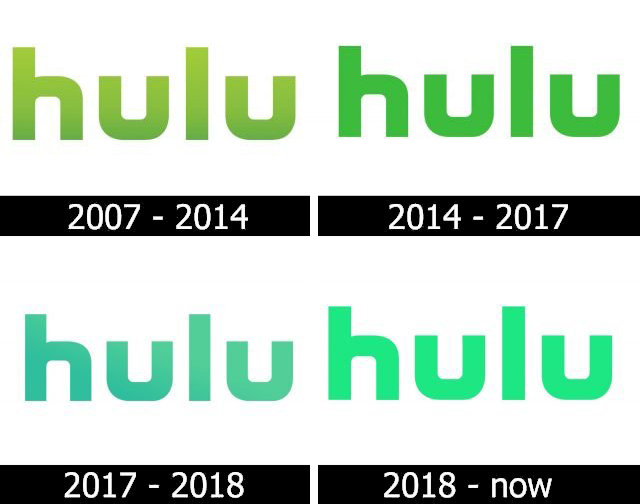
2007–2014: The Original Gradient Wordmark
The first Hulu logo, introduced in 2007, featured a lowercase wordmark set in a custom geometric sans-serif typeface. Rendered in a calm green gradient, the letters appeared lighter at the top and darker at the bottom, creating subtle depth and a sense of movement.
This version established the foundational elements of Hulu’s visual identity: lowercase typography, rounded geometry, and a green color palette. The gradient added a slightly dramatic, digital feel that suited the early era of online streaming.
2014–2017: Flat Design and Confident Simplicity
In 2014, Hulu refined its logo by removing the gradient and introducing a flat, vivid green. The letterforms remained unchanged, signaling continuity and brand confidence.
This update aligned Hulu with broader design trends favoring flat identities optimized for digital interfaces. The brighter, grass-green tone emphasized growth and momentum, reinforcing the platform’s expanding content library and user base.
2017–2018: Subtle Color Experimentation
Following changes in corporate ownership, Hulu briefly adjusted its color palette again in 2017. A turquoise-green tone with gentle gradient elements was introduced, adding a slightly cooler, more relaxed mood to the logo.
While short-lived, this iteration reflected Hulu’s willingness to experiment within a controlled visual framework, without disrupting brand recognition.
2018–Today: Mature Minimalism and Brand Stability
The 2018 redesign brought Hulu’s logo to its current form. The gradient was fully removed, and the green shade was lightened and refined. The result is a flat, bright, and elegant wordmark that feels both friendly and authoritative.
This version reflects Hulu’s maturity as a global streaming platform. The logo no longer needs visual effects to signal innovation; its simplicity communicates confidence and stability.
Logo Symbolism: Why Simplicity Works
The symbolism of the Hulu logo lies in restraint rather than metaphor. There are no icons, frames, or abstract shapes—only a wordmark. This minimalism reflects the platform’s role as a gateway to content rather than a brand that competes visually with it.
The lowercase letters soften the brand’s tone, making it approachable and human. Rounded contours remove sharpness and tension, reinforcing a sense of ease and accessibility. The logo does not demand attention; it invites engagement.
Typography and Color: Digital-First Design Language
Hulu’s custom typeface is futuristic yet friendly. Despite the relatively thick strokes, the spacing and proportions keep the logo feeling light and breathable. The design draws inspiration from geometric sans-serif fonts such as Good Timing Heavy and Zekton Extended Black, while remaining fully proprietary.
Green remains central to Hulu’s logo meaning. Beyond symbolizing growth and success, it also conveys harmony and balance—qualities essential to a platform designed for everyday entertainment. The current bright green shade communicates progressiveness and adaptability, reinforcing Hulu’s ability to evolve with user preferences.
Hulu Logo Heritage and Controlled Evolution
The Hulu logo heritage is defined by consistency and thoughtful refinement. Rather than pursuing radical redesigns, Hulu invested in perfecting a strong original concept. Each update strengthened clarity, improved digital performance, and reflected the platform’s growing confidence.
In an industry where visual identities often chase novelty, Hulu’s logo stands as an example of how simplicity, when guided by purpose, can become timeless.
FAQ: Hulu Logo Meaning and History
What does the Hulu logo represent?
The Hulu logo represents growth, accessibility, and digital confidence through its clean typography and green color palette.
Why is the Hulu logo written in lowercase?
Lowercase lettering creates a friendly, approachable tone and reinforces the platform’s user-centric identity.
Has the Hulu logo changed significantly over time?
No. Hulu’s logo has evolved through refinements, but its core structure has remained consistent since 2007.
Why is green used in the Hulu logo?
Green symbolizes growth, harmony, and progress, aligning with Hulu’s role as an evolving streaming service.