YouTube Logo History & Heritage: Meaning, Evolution & Cultural Impact
YouTube‘s founding story is less settled than it’s usually told. Chad Hurley and Steve Chen have said the original idea was a video-based dating site inspired by Hot or Not, but co-founder Jawed Karim has publicly disputed that account, saying it was more of a marketing-friendly narrative and that his own inspiration came from struggling to find video clips of the 2004 Indian Ocean tsunami and the 2004 Super Bowl halftime show. What’s well documented is that YouTube was founded on 14 February 2005, the first video, “Me at the zoo,” was uploaded by Karim on 23 April 2005, and Google announced its acquisition of the company on 9 October 2006, closing on 13 November 2006 for $1.65 billion in stock. In July 2019, YouTube and Google paid a then-record $170 million to settle FTC and New York Attorney General allegations that YouTube illegally collected children’s personal data without parental consent, in violation of COPPA, none of which the old article mentioned at all.
How did YouTube actually start, and what was its biggest controversy?
Chad Hurley, Steve Chen, and Jawed Karim, all former PayPal employees, founded YouTube on 14 February 2005. Hurley and Chen have described the original concept as a video version of an online dating site, modeled loosely on Hot or Not, but Karim has since disputed that version of events, attributing the platform’s real origin to the difficulty of finding shareable video clips online at the time. The first video ever uploaded, “Me at the zoo,” showing Karim at the San Diego Zoo, went up on 23 April 2005 and remains viewable on the platform today. Google announced its acquisition of YouTube on 9 October 2006 and closed the deal on 13 November 2006 for $1.65 billion in Google stock, one of the most consequential acquisitions in internet history. As of January 2024, YouTube reported about 2.7 billion monthly active users, and the platform generated $31.5 billion in advertising revenue in 2023.
The single biggest gap in the old version is YouTube’s largest regulatory penalty to date. In July 2019, YouTube and parent company Google agreed to pay $170 million to settle Federal Trade Commission and New York Attorney General allegations that the platform had illegally collected personal data from children under 13 without parental consent, a violation of the Children’s Online Privacy Protection Act (COPPA). YouTube also won a major legal fight in 2011 when a US court ruled in its favor in a long-running copyright infringement lawsuit brought by Viacom, a decision upheld on appeal.
YouTube Logo Evolution: A Complete Logo History
2005-2011: the original TV-style badge
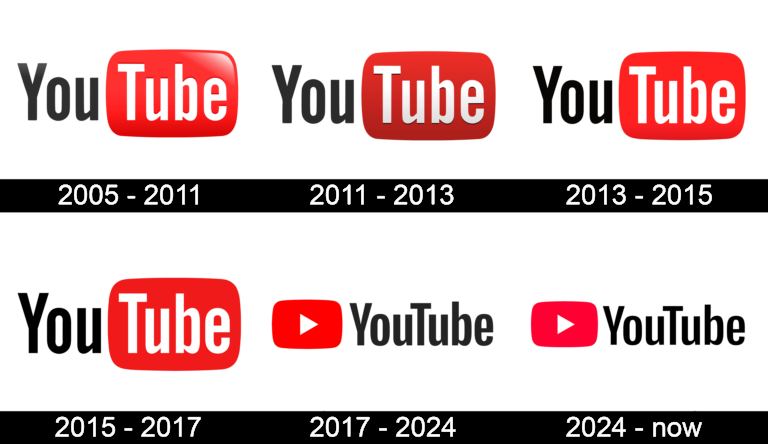
The first YouTube logo, introduced in 2005, paired the word “You” in black with “Tube” in white set inside a glossy, rounded red rectangle styled after a vintage television screen. The 3D, glossy treatment reflected the visual style common on the early web, and the red “Tube” shape quickly became the brand’s defining element.
2011-2013: a flatter, matte red
In 2011, YouTube removed the glossy highlights from the red rectangle in favor of a flat matte red, a change that gave the logo a more serious, contemporary look as the platform shifted toward professionally produced content alongside user uploads.
2013-2015: lighter and flatter
The 2013 update brightened and simplified the red panel further, removing remaining shadow effects in line with the broader flat-design trend across the web and mobile apps at the time.
2015-2017: a deeper red
A 2015 refinement deepened the red tone while keeping the typography unchanged, giving the mark a slightly more premium feel as YouTube continued expanding its advertising business.
2017-today: the standalone play button
The most significant redesign arrived in 2017, when YouTube detached the red shape from the wordmark entirely, turning it into a standalone icon: a red rounded rectangle containing a white right-facing play triangle. The move created a scalable icon suited to app grids and small mobile screens, paired with a simplified black wordmark for full-logo use. A secondary black-and-white version is also used for formal documents and, at times, for moments calling for a more restrained tone.
Logo symbolism
The white triangle in the play button is a widely recognized symbol for playback across media devices, reinforcing YouTube’s identity as a video-first platform. The rounded red rectangle behind it echoes the shape of an early television screen, a visual callback that has carried through every version of the logo since 2005.

Typography and color
YouTube used a Helvetica-style sans-serif wordmark for its first logo era, switching in 2017 to a narrower, custom sans-serif typeface designed for the detached-icon layout. Red has anchored the brand since 2005, now paired with a black-and-white secondary palette used for formal or restrained contexts.

Quick facts
| Founded | 14 February 2005, by Chad Hurley, Steve Chen, and Jawed Karim |
| First video uploaded | 23 April 2005, “Me at the zoo” |
| Google acquisition | Announced 9 October 2006, closed 13 November 2006, $1.65 billion in stock |
| Monthly active users | About 2.7 billion (January 2024) |
| 2023 ad revenue | $31.5 billion |
| FTC/COPPA settlement | $170 million, July 2019 |
Related reading
Further reading
FAQ
Was YouTube originally meant to be a dating site?
That’s the account Chad Hurley and Steve Chen have given, but co-founder Jawed Karim has disputed it, saying his own motivation came from the difficulty of finding shareable video clips online in 2004.
When did Google buy YouTube, and for how much?
Google announced the acquisition on 9 October 2006 and closed the deal on 13 November 2006 for $1.65 billion in stock.
What was YouTube’s largest regulatory penalty?
In July 2019, YouTube and Google paid $170 million to settle FTC and New York Attorney General allegations that the platform illegally collected children’s personal data without parental consent, violating COPPA.
When did the play button become YouTube’s standalone icon?
The red rounded rectangle with the white play triangle was detached from the wordmark and made a standalone icon in the 2017 redesign.