Turkish Airlines Logo: The Wild Goose Explained
Turkish Airlines’ own account of its history reads as an unbroken climb from a small 1930s state carrier to a global network leader, but the old article never mentioned the airline’s deadliest accident: on 3 March 1974, Flight 981, a McDonnell Douglas DC-10, crashed near Paris after a faulty cargo door blew open in flight, killing all 346 people on board, at the time the deadliest single-aircraft accident in aviation history. The old article also skipped the airline’s partial privatization entirely, describing it only as a steady state project rather than the publicly traded company it has been since 2004.
When was Turkish Airlines founded, and what was its deadliest crash?
Turkish Airlines began on 20 May 1933 as Turkish State Airlines (Devlet Hava Yollari), a department of the Ministry of National Defense, with an initial fleet of just five aircraft: two Curtiss Kingbirds, two Junkers F13s, and one Tupolev ANT-9. International service started in 1947 with flights linking Ankara, Istanbul, and Athens. In 1956 the carrier was reorganized as Turk Hava Yollari A.O., the company structure that still operates the airline today.
The single biggest gap in the old version is the airline’s worst accident. On 3 March 1974, Flight 981 crashed into the Ermenonville forest near Paris shortly after takeoff, killing all 346 people aboard after a cargo door failure caused a rapid decompression; it remained the deadliest single-aircraft accident in aviation history for several years afterward. The airline has recorded 19 incidents and accidents since its founding, 15 of them fatal, including a 2009 crash at Amsterdam Schiphol that killed 9 people after a faulty radar altimeter triggered an aerodynamic stall.
Is Turkish Airlines still a state-owned carrier?
Not entirely. In 2004, Turkish Airlines sold 20% of its shares in a public offering on the Istanbul Stock Exchange that raised about $170 million, cutting the government’s stake from roughly 98% to 75%. Today the Turkey Wealth Fund holds 49.12% of the airline, with the remaining 50.88% publicly traded on Borsa Istanbul under the ticker THYAO. The airline joined Star Alliance on 1 April 2008, and in December 2024 Guinness World Records recognized it for serving more countries, 131, than any other airline. Ahmet Bolat was named CEO in April 2026; the company also weathered a 2016 setback when the US FAA temporarily suspended flights between Turkey and the US after that July’s coup attempt, lifting the suspension on 18 July 2016.
Logo Symbolism and Design
The current abstract bird mark is generally read as a reference to flight, built from a curved wing stroke and a diagonal body bar rather than any literal bird illustration. The bold, uppercase, geometric wordmark is paired with a palette of red, white, and black, colors the airline’s own marketing associates with passion, clarity, and seriousness, though these are brand associations rather than confirmed design-brief facts.
Turkish Airlines Logo History Timeline
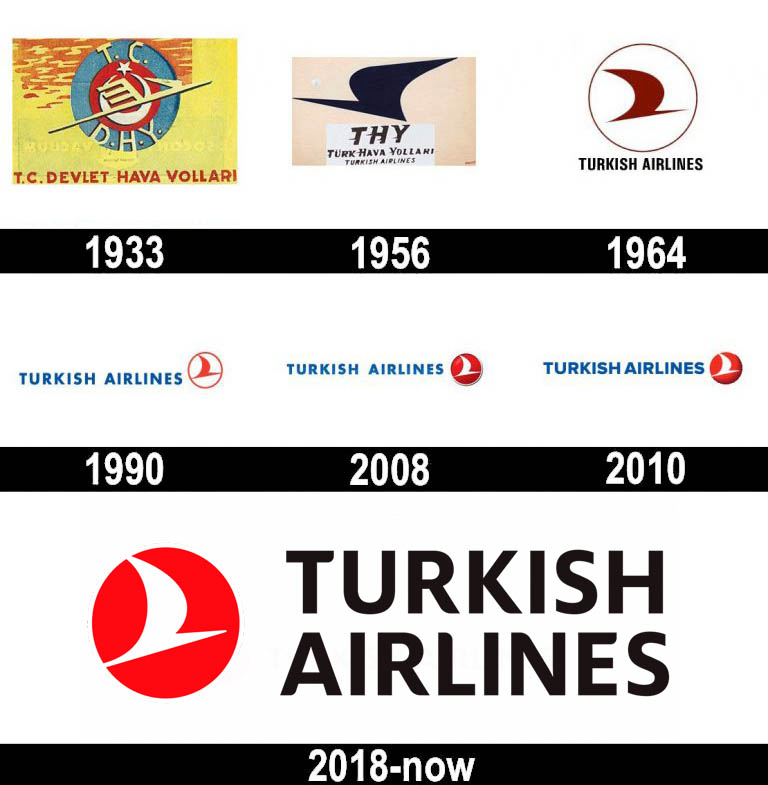
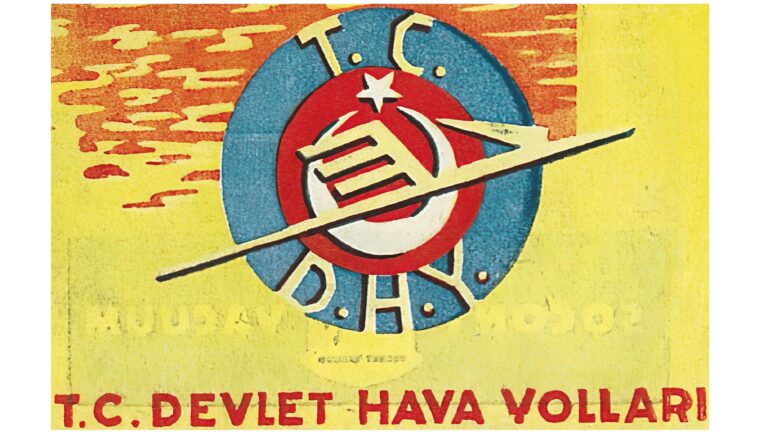
1933-1956: State Identity Emblem
The first Turkish State Airlines emblem used yellow, blue, and red, with the inscription “T.C. Devlet Hava Yollari,” identifying the carrier as a direct arm of the Turkish state rather than a standalone brand.
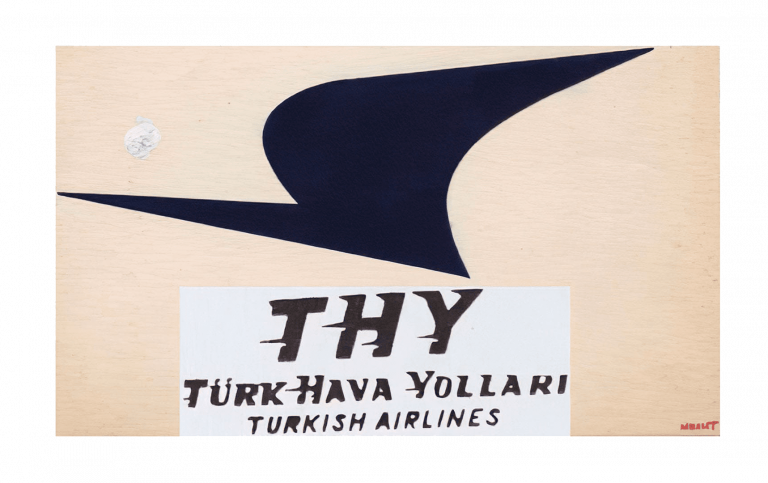
1956-1964: First Abstract Bird
Following the 1956 reorganization as Turk Hava Yollari A.O., the airline introduced its first bird motif, rendered in dark blue, cream, and pink tones, moving away from the purely bureaucratic look of the state emblem.
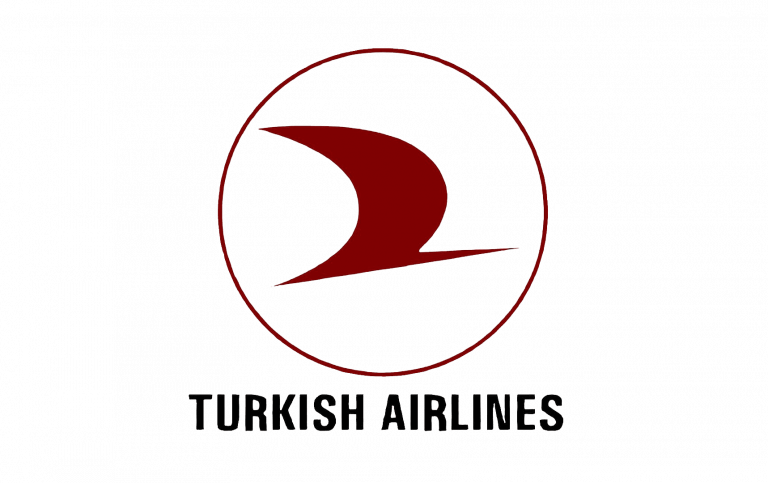
1964-1990: Circular Bird Emblem
The 1964 version placed the bird, facing right, inside a thin circular frame rendered in burgundy and black, paired with a shortened “Turkish Airlines” wordmark that stayed in use for roughly 26 years.
1990-2008: Enlarged Logotype
The 1990 redesign enlarged the wordmark and shifted the palette to blue and scarlet on white, reducing the bird to a smaller supporting element rather than the focal point of the mark.
2008-2010: 3D Gradient Version
A short-lived 2008 redesign experimented with 3D effects and color gradients, a style common in mid-2000s corporate branding generally, before being replaced within two years.
2010-2018: Return to Flat Design
The 2010 update dropped the gradient treatment and the circular framing used since 1964, moving to a flat design that anticipated the broader industry shift away from skeuomorphic branding.
2018-Today: Fully Abstract Bird
The current logo, introduced in 2018, reduced the bird to two shapes, a curved wing stroke and a diagonal body bar, paired with a clean sans-serif wordmark, the most abstract version of the mark in the airline’s history.
Quick facts
| Founded | 20 May 1933, as Turkish State Airlines (Devlet Hava Yollari) |
| Reorganized as Turk Hava Yollari A.O. | 1956 |
| Deadliest accident | 3 March 1974, Flight 981 near Paris, 346 killed |
| Partial privatization | 2004 IPO, 20% sold; government stake fell from ~98% to 75% |
| Star Alliance member since | 1 April 2008 |
| Current ownership | Turkey Wealth Fund 49.12%; remainder publicly traded (Borsa Istanbul: THYAO) |
| 2024 record | Guinness World Records: most countries served by an airline (131) |
Related reading
Further reading
FAQ: Turkish Airlines Logo Meaning and History
When was Turkish Airlines founded?
Turkish Airlines began on 20 May 1933 as Turkish State Airlines, a department of Turkey’s Ministry of National Defense, with an initial fleet of five aircraft.
What was Turkish Airlines’ deadliest accident?
On 3 March 1974, Flight 981 crashed near Paris after a cargo door failure, killing all 346 people on board, at the time the deadliest single-aircraft accident in aviation history.
Is Turkish Airlines still government-owned?
Partly. Since a 2004 public offering, the Turkey Wealth Fund has held 49.12% of the airline, with the rest publicly traded on Borsa Istanbul.
What does the Turkish Airlines logo represent?
The current mark is an abstract bird built from a curved wing stroke and a diagonal body bar, generally read as a reference to flight.