Halliburton Logo History Since 1919
Halliburton‘s history includes far more than engineering-inspired letterforms. Dick Cheney served as the company’s chairman and CEO from 1995 to 2000, leaving with a $36 million severance package before becoming US vice president in 2001, a tenure during which Halliburton subsidiary KBR won large no-bid Iraq War reconstruction contracts that drew sustained conflict-of-interest scrutiny. The company later pleaded guilty in 2013 to destroying evidence related to the 2010 Deepwater Horizon oil spill and agreed to pay $1.1 billion in 2014 to settle most of the resulting civil claims, none of which the old article mentioned at all.
How did Halliburton actually grow, and what is its biggest controversy?
Erle P. Halliburton founded the company in 1919 in Duncan, Oklahoma, originally as the New Method Oil Well Cementing Company, after developing and patenting a cement jet-mixing method in 1921 that improved how oil wells were sealed. The business grew over the following century into one of the world’s largest oilfield services companies, now operating in dozens of countries.
Dick Cheney led Halliburton as chairman and CEO from 1995 to 2000, departing with a $36 million severance package shortly before becoming vice president of the United States in 2001. During his time in office, Halliburton’s then-subsidiary Kellogg Brown & Root (KBR) received large no-bid contracts for Iraq War reconstruction and logistics work, a connection that drew years of political scrutiny over potential conflicts of interest, since Cheney continued receiving deferred compensation from Halliburton while serving as vice president. Halliburton spun KBR off as an independent public company on 5 April 2007, after beginning the divestiture the previous November.
Halliburton’s other major controversy involved the 2010 Deepwater Horizon disaster: the company had completed cementing work on BP’s Macondo well roughly 20 hours before the rig exploded on 20 April 2010. In July 2013, Halliburton pleaded guilty to a criminal charge of destroying evidence, specifically computer simulations relevant to the investigation, and was fined $200,000 with three years of probation. In September 2014, the company agreed to pay $1.1 billion to settle the majority of civil claims stemming from the spill. As of 2024, Halliburton employed about 48,000 people and reported $22.9 billion in annual revenue.
Halliburton Logo History Timeline
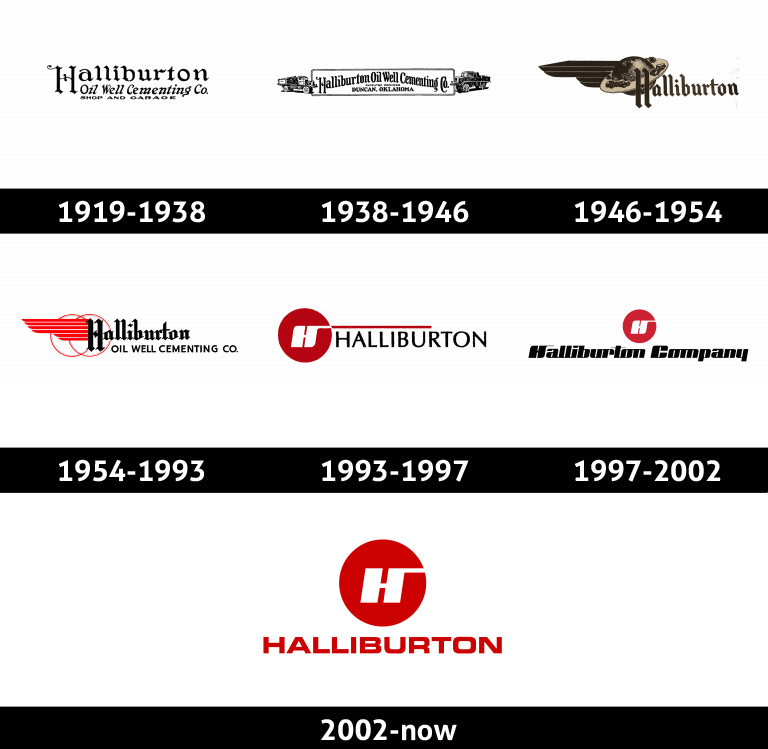
1919-1938: the foundational wordmark
Halliburton’s earliest logo, used while the company was still known as the Halliburton Oil Well Cementing Company, paired a decorative capital “H” with a classical serif wordmark and a secondary line reading “Oil Well Cementing Co. Shop and Garage,” a straightforward design for a young Oklahoma firm.
1938-1946: trucks and operational imagery
The 1938 logo kept the serif wordmark but added illustrations of vintage trucks along with the phrases “Patented Process” and “Duncan, Oklahoma,” tying the brand to its fieldwork and its Oklahoma origins.
1946-1954: wings and a globe
Following World War II, Halliburton adopted a bolder, block-style wordmark above a winged motif incorporating a globe and vehicles, the company’s first logo to explicitly signal international expansion.
1954-1993: red circles and a streamlined mark
The 1954 redesign intersected the serif wordmark with geometric red circles and a refined wing motif, moving away from illustrative detail toward a cleaner, more corporate look that lasted nearly four decades, spanning the period that included Cheney’s later tenure as CEO.
1993-1997: the circular H emblem
In 1993, Halliburton introduced a bold white “H” set inside a red circle beside a sans-serif wordmark, dropping the earlier illustrative elements for a cleaner, more scalable mark suited to digital use.
1997-2002: an italicized update
A 1997 refinement kept the red circular “H” but updated the wordmark into a bold, italicized sans-serif font, a change made as Halliburton expanded its oilfield technology business during the Cheney years.
2002-today: the modern wordmark
The current logo, in use since 2002, simplifies the mark to a bold “H” inside a red oval above an uppercase red wordmark, a design that has remained unchanged through the company’s KBR spinoff and the Deepwater Horizon litigation.
Logo symbolism
The squared letterforms in Halliburton’s wordmark are generally read as referencing the geometry of industrial equipment and tools, reinforcing an engineering-driven identity. Red has remained constant across most versions since 1954, chosen for visibility and association with energy and industrial strength, a common choice across the oilfield services sector rather than something unique to Halliburton.
Typography and color
Halliburton uses a custom industrial-style sans-serif typeface with slightly squared letterforms, designed for legibility in both field and digital contexts. Red remains the defining color, set against white for high contrast, a palette the company has used with only minor adjustments since the 1950s.
Quick facts
| Founded | 1919, Duncan, Oklahoma, by Erle P. Halliburton |
| Dick Cheney as chairman/CEO | 1995-2000, left with $36 million severance |
| KBR spinoff | 5 April 2007 |
| Deepwater Horizon guilty plea | July 2013, $200,000 fine, 3 years probation |
| Deepwater Horizon civil settlement | $1.1 billion, September 2014 |
| 2024 scale | About 48,000 employees, $22.9 billion revenue |
Related reading
Further reading
FAQ
Was Dick Cheney the CEO of Halliburton?
Yes. He served as chairman and CEO from 1995 to 2000, leaving with a $36 million severance package before becoming US vice president in 2001.
What was the Iraq War controversy involving Halliburton?
Halliburton’s then-subsidiary KBR received large no-bid contracts for Iraq War reconstruction and logistics work, drawing scrutiny over potential conflicts of interest tied to Cheney’s vice presidency.
What was Halliburton’s role in the Deepwater Horizon spill?
Halliburton had completed cementing work on the Macondo well about 20 hours before the April 2010 explosion, later pleaded guilty to destroying related evidence in 2013, and paid $1.1 billion in 2014 to settle most civil claims.
When did Halliburton spin off KBR?
KBR became an independent public company on 5 April 2007, after Halliburton began divesting its stake in November 2006.