Dickies Logo: The Horseshoe and Its Texas Roots
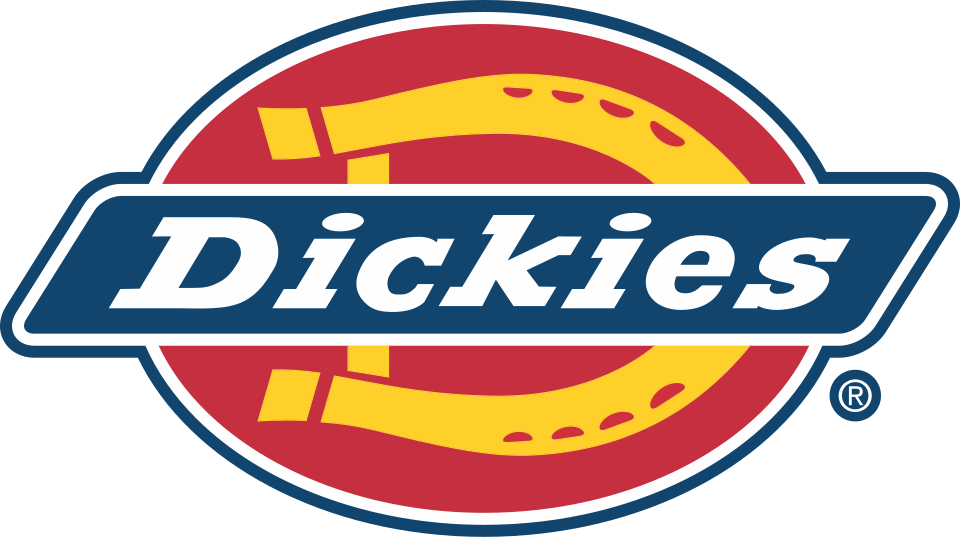
Two Texas cousins who had spent a quarter of a century selling hats across the Southwest bought out a small Fort Worth overall maker in 1922 and put their surnames on it, and the Williamson-Dickie Manufacturing Company went on to clothe farmhands, oil workers, soldiers and, decades later, a whole generation of skateboarders. The red oval with the yellow horseshoe that sits on every pair of Dickies today is the fourth logo in that century-long run, and it now belongs to Bluestar Alliance, which bought the brand from VF Corporation in late 2025.
What does the Dickies logo mean?
The current Dickies emblem, in use since 2005, is built from two shapes. A red oval holds a yellow horseshoe laid on its side, a shape that also reads as a belt buckle, and across it runs a blue parallelogram outlined in white with the word “Dickies” set in a bold, italic serif. The company’s own trademark notices refer to it as the “Horseshoe Device.”
The horseshoe points straight back to where the brand started: bib overalls sold to ranch hands and farm workers around Fort Worth. The buckle reading fits just as well for a company whose belts and work pants have always sold side by side. The forward slant of the lettering keeps the mark from looking static, and the red, yellow and blue palette makes it easy to spot on a back pocket or a jacket chest from across a job site, which is exactly where the logo was meant to be seen.
Who founded Dickies?
C. N. Williamson and his cousin E. E. “Colonel” Dickie were already seasoned salesmen when, in 1918, they and a few friends set up the U.S. Overall Company in Fort Worth, Texas. In 1922 the Colonel, Williamson and Williamson’s son C. D. Williamson bought the whole business on a one-third-each basis and renamed it Williamson-Dickie Manufacturing Company.
Growth was steady apart from the Great Depression. During World War II the factories turned out millions of uniforms for the US armed forces, and after the war C. Don Williamson pushed the company into new production sites and sales territories across the country. By the late 1950s Dickies had reached Europe and the Middle East, where Texas oilmen working the oil fields brought the brand with them. Its US footprint is still visible at home: the company holds the naming rights to Dickies Arena in Fort Worth and supplies the oversized clothes worn by Big Tex, the State Fair of Texas mascot.
Has the Dickies logo changed over time?
It has, four times. The earliest mark, used from the 1920s into the 1930s, read “Dickie’s Best” in a cursive script, with “Dickie’s” in indigo and “Best” in a lighter sky blue over a reddish, textured background.
From the 1930s into the 1940s the company switched to a hand-painted look: a sunflower-yellow oval on black, with “Dickie’s” in rustic red brush lettering and “FORT WORTH” printed underneath, a direct nod to the home city.
The version that lasted longest ran from the 1940s until 2005. It dropped the apostrophe, set “Dickies” in a heavy curving script inside an ornamental rope-style border, and added the word “Guaranteed” beneath the name, a quality promise that suited a workwear maker in the postwar years.
In 2005 Dickies moved to the horseshoe-and-parallelogram emblem described above. It is the first of the four to rely on a symbol rather than lettering alone, and it works at small sizes on labels and tags, something the ornate older scripts never did well.
Why do skateboarders wear Dickies?
The answer is mostly one pair of trousers. The 874 twill work pant came out in 1967, made from a 65% polyester and 35% cotton blend that earned a reputation for being close to indestructible, and it is still the brand’s best-selling work pant. When skateboarding moved from ramps to the street in the 1990s, skaters wanted cheap, tough trousers that could survive concrete, and the 874 fit the bill without any marketing push. Hip-hop artists and musicians took to the same pants and work shirts around the same time.
That crossover is why Dickies now sits between workwear brands like Carhartt and Wrangler on one side and skate and street labels like Vans and Supreme on the other. The company eventually formalized the link by sponsoring its own skate team, with riders such as Ronnie Sandoval and Jamie Foy.
Who owns Dickies today?
The Williamson-Dickie company stayed independent for 95 years, buying Canada’s Kodiak Group in 2008 and Walls Industries in 2013, before VF Corporation, owner of Vans and The North Face, acquired it for $820 million in cash in 2017. Under VF the brand announced in November 2024 that it would leave Texas, and its headquarters moved to Costa Mesa, California, in 2025.
VF did not keep Dickies for long after that. In September 2025 it agreed to sell the brand to Bluestar Alliance for $600 million in cash, well below the 2017 price, and the deal closed on November 12, 2025. Bluestar, founded in 2006 by Joseph Gabbay and Ralph Gindi, is a brand-management firm whose portfolio already included Off-White, and it has said it sees Dickies as a platform for growth in both workwear and lifestyle clothing. Dickies is sold in around 55 countries.
Quick facts
| Founded | 1922 (as U.S. Overall Company in 1918) |
| Founders | C. N. Williamson, E. E. “Colonel” Dickie, C. D. Williamson |
| Original home | Fort Worth, Texas, USA |
| Headquarters | Costa Mesa, California, USA (since 2025) |
| Industry | Workwear and casual apparel |
| Signature product | 874 work pant (1967) |
| Owner | Bluestar Alliance (since November 2025) |
| Current logo | Red oval with yellow horseshoe and blue wordmark, since 2005 |