
ESPN Logo History: Meaning, Symbolism & Brand Heritage

Since the late 1970s, ESPN has fundamentally changed how sports are consumed, analyzed, and experienced. Launched as a bold experiment in round-the-clock sports broadcasting, the network quickly evolved into a global authority on athletic competition, live events, and sports journalism. Headquartered in Bristol, Connecticut, ESPN operates at the intersection of media, technology, and sport, shaping not only how games are watched but how sports culture itself is narrated.
Owned by The Walt Disney Company in partnership with Hearst, ESPN represents scale, immediacy, and competitive intensity. These qualities are distilled into one of the most recognizable logos in broadcast history. The ESPN logo is not decorative, symbolic, or metaphorical—it is fast, direct, and unmistakably engineered for motion.
ESPN Logo Meaning and Brand Identity
The ESPN logo meaning is rooted in energy and momentum. Designed to be read instantly on screens large and small, the logo reflects the network’s core promise: speed, action, and authority. Unlike entertainment brands that rely on icons or mascots, ESPN communicates through typography alone.
Its wordmark feels mechanical and aerodynamic, mirroring the aesthetics of stadium graphics, scoreboards, and broadcast overlays. The logo does not suggest sports—it performs them visually, evoking movement even when static.
ESPN Logo History Timeline: From Cable Startup to Global Sports Icon
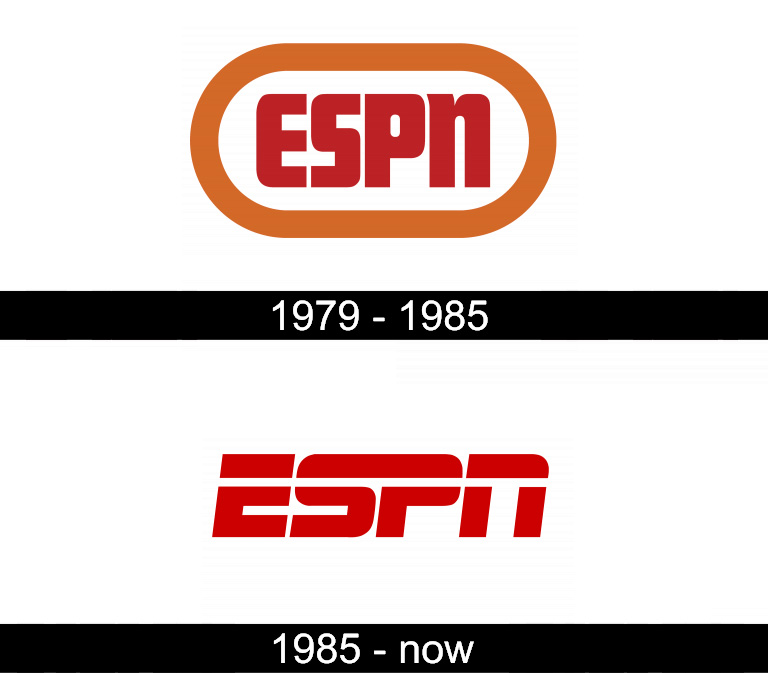
1979–1985: The First ESPN Logo and Experimental Identity
The original ESPN logo was introduced in 1979, shortly after the network began broadcasting. This first emblem bore little resemblance to the mark known today. It featured dark red, stylized lettering with rounded angles and straight cuts, enclosed within a horizontally stretched white oval outlined in a thick terracotta-colored border.
The design reflected the experimental nature of early cable television. While visually distinctive, it leaned more toward traditional broadcasting aesthetics than the high-energy sports identity ESPN would later embrace. The oval frame gave the logo a contained, almost badge-like appearance, signaling legitimacy but limiting dynamism.

1985–Today: The Iconic ESPN Wordmark and Visual Breakthrough
In 1985, ESPN unveiled a complete redesign that would define its visual identity for decades. The oval was removed entirely, freeing the wordmark and allowing it to stand on its own. The new logo introduced bold, futuristic sans-serif lettering, slightly slanted to the right to suggest speed and forward motion.
The most distinctive feature was the horizontal white cut slicing through the upper portion of each letter. This line became the logo’s defining characteristic, functioning as both a unifying element and a visual metaphor for velocity and broadcast signal flow.
Rendered most often in bright red on a white background—or reversed in white on red—the logo achieved immediate clarity and impact. More than three decades later, this design remains unchanged, a testament to its effectiveness.
ESPN Logo Symbolism Explained
The symbolism of the ESPN logo lies in abstraction rather than imagery. There are no balls, fields, or athletes depicted. Instead, the logo relies on typographic tension and interruption.
The white horizontal cut suggests motion, interruption, and transition—key concepts in live sports broadcasting. It can be read as a finish line, a broadcast signal, or a streak of speed passing through the letters. The slight forward slant reinforces momentum, while the heavy letterforms communicate strength and authority.
This symbolic restraint allows the logo to function seamlessly across every sport, from football and basketball to tennis and motorsports.
ESPN Logo Typography and Font Heritage
The ESPN logo was inspired by Stop, a typeface designed in 1971 by Aldo Novarese for the Nebiolo type foundry. Rather than using the font directly, the designer extracted its most impactful element—the bold horizontal stroke—and built the entire logo concept around it.
Each glyph was customized to support the continuous white line, resulting in a proprietary wordmark rather than a simple typographic application. The final design feels industrial, engineered, and purpose-built for broadcast environments.
ESPN Logo Colors and Visual Psychology
Color plays a critical role in ESPN logo meaning. Red is the dominant hue, chosen for its association with passion, intensity, and competition. It mirrors the emotional stakes of sports and the adrenaline of live events.
White provides contrast and clarity, ensuring legibility across screens and print formats. In print-only applications, ESPN also authorizes a black-and-white version, maintaining the logo’s integrity even without color.
This disciplined color system ensures consistency across television graphics, digital platforms, merchandise, and editorial materials.
ESPN Logo Heritage and the Power of Motion
The ESPN logo heritage is a rare example of a media identity that achieved near-perfection early in its life. Since 1985, the logo has required no structural redesign, adapting instead through context and application rather than reinvention.
By prioritizing motion, clarity, and strength, ESPN created a logo that feels as current today as it did nearly forty years ago. It is not merely a brand mark—it is a visual extension of sport itself, engineered for speed, competition, and spectacle.
ESPN Logo FAQ: Common Questions About the Sports Network Identity
What does the ESPN logo represent?
The ESPN logo represents speed, energy, and authority, reflecting the dynamics of live sports broadcasting.
Why does the ESPN logo have a white line through it?
The white horizontal line symbolizes motion, broadcast flow, and visual continuity across the wordmark.
Has ESPN ever changed its logo since 1985?
No. The core ESPN logo introduced in 1985 remains in use today.
Who owns ESPN?
ESPN is owned by The Walt Disney Company, with Hearst Corporation holding a minority stake.