Energie Logo History
Energie started in 1983 as a clothing shop in Rome, where Wichy Hassan sold hard-to-find imported brands, and it grew into one of the Italian denim labels of the club-going 1990s once Hassan and his partner Renato Rossi built the Sixty group around it and its sister brand Miss Sixty. The brand’s logo, a blocky wordmark in which one “E” was turned into an arrow pointing forward, matched the name: energy, speed and a bit of noise.
What does the Energie logo mean?
The name is simply the Italian (and French) word for “energy,” and the logo has always tried to look the part. The early wordmark used heavy, angular capitals in black, with red and yellow accents and an arrow built into one of the letters “E,” aimed to the right as if the word were moving forward. Around 2001 the colors were cut back so that the bright tones appeared only in the second “E,” drawn as a yellow arrow inside a red circle.
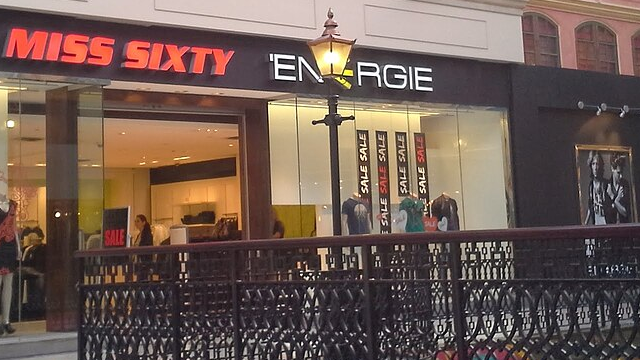
From about 2003 the brand used a cleaner, more geometric wordmark, set in white or black capitals, which is the version that appeared over Energie shop fronts in the 2000s and 2010s. On the jeans themselves, the most recognizable mark was a stylized “E” stitched or printed on the lower right back pocket, and in those years it worked as the brand’s signature as much as the name did.
Has the Energie logo changed over time?
Yes, in three broad steps. The first logo, used until 2001, was the loudest: bold black letters with red and yellow arrow details. The 2001 to 2003 version kept the shape but put all the color into a single circled “E.” The version introduced in 2003 dropped most of the decoration in favor of plain, geometric capitals, part of a wider renewal of the brand’s logo, graphics and fits in the 2000s as it tried to move from 1990s streetwear toward a more grown-up premium denim label.

Who founded Energie?
Wichy (also spelled Wicky) Hassan was born in Tripoli in 1955 into a family of cloth merchants and moved to Rome with his family in 1967. After working in clothing retail, he opened his own shop and said he was among the first to bring brands like Timberland, Converse and Levi’s 501 into Italy. In 1983 he opened a store called Energie in Rome, and his habit of patching loud fabrics onto ripped jeans turned into a label of its own.
With Renato Rossi, Hassan set up the Sixty group in the late 1980s (sources give 1987 or 1989), based in Chieti in the Abruzzo region. Alongside Energie and Miss Sixty, the group later owned Killah, Murphy & Nye and RefrigiWear, and in 2008 it added the accessories house Roberta di Camerino. Energie’s bright colors and graffiti, skate and street-art references made it a clubbers’ favorite, in the same Italian denim wave as Diesel, and it sold through mono-brand stores in Europe and North America. In 2010 the Indian company Arvind took a license to make and sell Energie jeans in India, pitching them above Levi’s and below Diesel on price. Hassan died in December 2011.
What happened to Energie?
The Sixty group ran into trouble at the end of the 2000s. Its sales fell from around 500 million euros to about 300 million in two years, and in May 2012 the group was sold to Crescent HydePark, a pan-Asian investment firm. By December 2012 Sixty was in a creditor arrangement procedure in Italy, its French subsidiary had been put into liquidation, and only a few dozen of the roughly 400 staff at the Chieti headquarters remained.
The new owners concentrated their revival plans on Miss Sixty, which reopened a redesigned Rome flagship in late 2014 and later returned to German-speaking markets. Energie has kept a much lower profile since then, and today its old logo pieces are traded mainly as 1990s and 2000s vintage, alongside other denim names of the era such as True Religion and Wrangler. Fans of Italian club wear from the same period will also know Byblos.
Quick facts
| Origin | Energie store, Rome, 1983 |
| Founder | Wichy Hassan, with partner Renato Rossi |
| Parent company | Sixty group, Chieti, Italy |
| Sister brands | Miss Sixty, Killah, Murphy & Nye, RefrigiWear |
| Known for | Colorful premium denim and 1990s club wear |
| Logo | Wordmark with an arrow “E”; simplified geometric version from 2003 |
| Owner | Crescent HydePark (Sixty group acquired 2012) |