Byblos Logo: The Italian Fashion House
A group of designers launched Byblos in Italy in 1973 as a division of Genny SpA, naming the label after a hotel in Saint-Tropez rather than after any one person — though a young Gianni Versace briefly designed for the brand from 1975 to 1976, years before he built his own namesake empire. The label found its defining voice a few years later under British designers Alan Cleaver and Keith Varty, whose vivid, art-inspired color sense carried Byblos through a fifteen-year run from 1981 to 1996 before the brand passed through American designers Richard Tyler and John Bartlett and was ultimately absorbed into Swinger International Co. in 2002.
Meaning and History
Byblos was founded in 1973 in Italy by a group of designers operating as a division of Genny SpA, taking its name from a hotel in Saint-Tropez, France. A young Gianni Versace designed for the label briefly from 1975 to 1976, followed by Guy Paulin from 1979 to 1982, before British designers Alan Cleaver and Keith Varty took over in 1981 and stayed until 1996, becoming the brand’s most transformative and longest-serving creative team. Former students of Dorothée Bis in Paris, Cleaver and Varty built their reputation on vibrant, saleable clothing inspired by art, landscapes, and nature, aimed squarely at a young, fashion-forward customer.
During their tenure the brand expanded into a family of related lines, including Byblos Uomo, Byblos USA, Options Donna in 1985, Vis à Vis Byblos in 1986, and Options Uomo in 1988. Richard Tyler brought a more sophisticated design sensibility to the house in 1997, followed by John Bartlett from 1998 to 2000, who blended the brand’s playful heritage with modern elegance, and then Martine Sibton and Dandy Dalal from 2000 to 2002. Byblos was absorbed by Swinger International Co. in 2002, joining Versus and Rocco Barocco under the same ownership group, and the brand today operates under Managing Director Mathias Facchini and Art Director Manuel Facchini.
Logo Symbolism Analysis
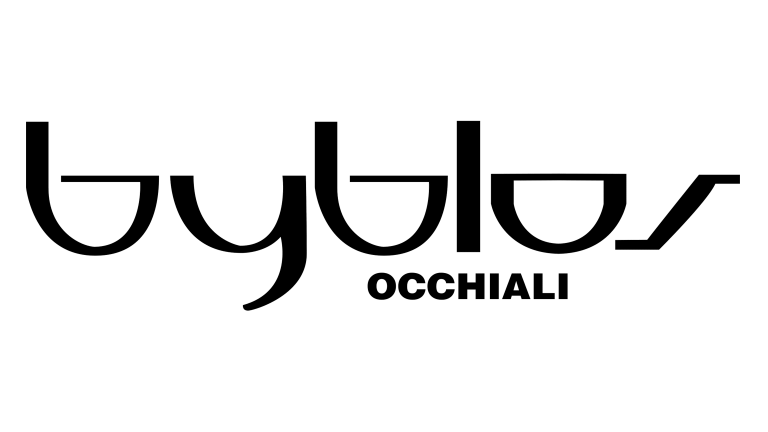
Byblos’s identity rests entirely on its wordmark, distinguished by flattened tops on the “b,” “o,” and “s” that give those letters a subtle resemblance to cups — an unusual typographic quirk that makes the name instantly recognizable even at a glance. Alongside the full wordmark, the brand also uses a standalone pictogram built from a single stylized “b,” rendered in the same distinctive letterform as the one found in the main logo.
Logo History Timeline
1973–earlier version: The wordmark’s “y” ended in a slightly curved tail, and the “o” was formed from a single continuous line.
Current version: The “y” now ends in a straight line rather than a curve, and the “o” has a small gap at its top right corner.
Typography and Visual Construction
The flattened letter tops that define the Byblos wordmark create a distinctive rhythm across the name, with the “b,” “o,” and “s” all sharing that same cup-like flattened profile while the rest of the letterforms stay comparatively conventional. The shift between the original and current versions is subtle rather than dramatic — a straightened “y” tail and a small gap introduced into the “o” — but it’s enough to give the modern wordmark a slightly cleaner, more contemporary edge than its 1970s original.
Colors
Byblos’s wordmark itself is typically rendered in a simple, restrained palette, letting the unusual letterforms rather than color carry the brand’s visual identity. That relative restraint in the logo stands in some contrast to the brand’s design history under Cleaver and Varty, whose runway collections were known for bold, art-inspired color choices even as the logo itself stayed comparatively understated.
Heritage and Brand Positioning
Byblos has changed creative hands more often than most fashion houses of its size, moving from an early, brief Versace connection through the long, defining Cleaver and Varty era into a series of American designers before eventually landing under Swinger International’s ownership. Through all of that turnover, the wordmark’s flattened, cup-shaped letters have stayed the one constant thread connecting the current, Facchini-led version of the brand back to its 1973 origins as a Genny SpA division named after a French Riviera hotel.
Frequently Asked Questions
Who founded Byblos?
Byblos was founded in 1973 in Italy by a group of designers as a division of Genny SpA.
Did Gianni Versace design for Byblos?
Yes, a young Gianni Versace designed for Byblos from 1975 to 1976, before founding his own namesake fashion house.
Who are the designers most associated with Byblos?
British designers Alan Cleaver and Keith Varty led Byblos from 1981 to 1996, defining its signature vibrant, art-inspired style.
What does the Byblos logo look like?
The logo is a wordmark with flattened tops on the “b,” “o,” and “s” letters, giving them a cup-like appearance, alongside a standalone “b” pictogram.