
PayPal Logo History: Meaning, Heritage & Symbol Explained

The PayPal brand has shaped the digital economy more than almost any other financial technology company of the modern era. What began in the late 1990s as a scrappy startup born from the merger of Confinity and X.com evolved—rapidly—into the most trusted online payments platform in the world. And throughout this transformation, one constant has anchored its identity: the PayPal logo.
More than a mark of speed and convenience, the PayPal logo represents security, technological progress, and the birth of online money transfer as we know it. Its evolution mirrors the rise of e-commerce itself—a visual journey through early internet aesthetics, web 2.0, mobile-first design, and today’s minimalist fintech landscape.
This is the complete story of the PayPal logo history and logo heritage, from its 1999 debut to the dramatic reinvention of 2024.
The Origins of PayPal: A Brief Brand History
Before PayPal became a global marketplace essential, it started life under a different identity. Confinity, founded in 1998, initially focused on developing security software. After merging with Elon Musk’s online banking startup X.com in 2000, the company pivoted entirely to digital payments—a revolutionary idea at the time.
The new system soon exploded in popularity thanks to its integration with eBay auctions, growing so fast that eBay acquired PayPal in 2002 for $1.5 billion. In 2015, PayPal spun off again as an independent company and has since expanded into cryptocurrency, mobile payments, point-of-sale systems, and financial services worldwide.
Across all these chapters, PayPal’s logo remained an essential trust marker—one that millions of people relied on before entering their credit card details on an unfamiliar website.
PayPal Logo Evolution: A Complete Timeline
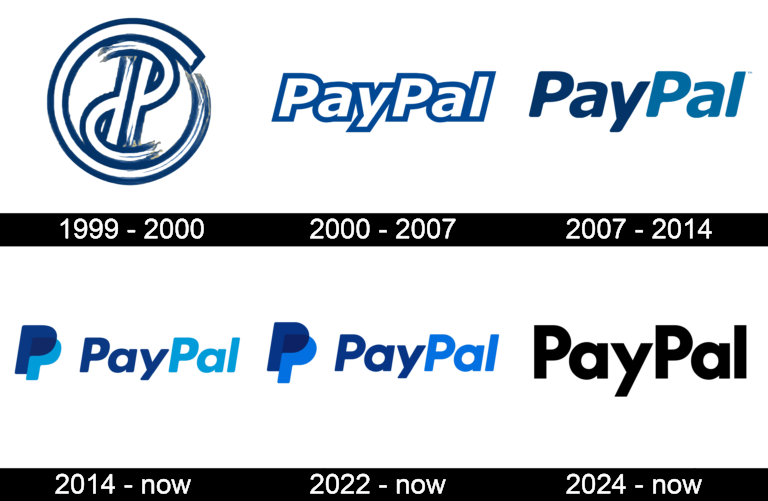
1999 – The Original Double-P Symbol
The very first PayPal logo was minimalist and experimental—a small circular emblem containing two mirrored “P”s, one flipped upside down. Drawn in white with bold navy outlines, the design leaned into symmetry and movement, with a hazy motion effect suggesting speed.
It reflected the company’s early emphasis on utility: simple, functional, and instantly recognizable even in low-resolution web environments.

2000 – The First PayPal Wordmark
With the brand now called PayPal, the first full wordmark arrived: white letters outlined in thick navy blue, italicized and tightly spaced.
This early design communicated stability and protection—critical for convincing early internet users that online payments were safe. The bold outline helped the logo remain visible across the vibrant, cluttered websites of the era.
2007 – A Cleaner, More Modern Identity
In 2007 PayPal refreshed its visual identity dramatically. The angular outlines softened, spacing increased, and the logo adopted a dual-blue palette: a deep navy for “Pay” and a lighter sky blue for “Pal.”
This version embraced the emergence of Web 2.0 aesthetic—friendly, approachable, and digitally native. In 2012 the wordmark was subtly refined again, smoothing the curves and rounding the geometry.
2014 – The Iconic “Double P” Monogram
The 2014 redesign marked a turning point and remains one of PayPal’s most successful identities. Created by Fuseproject under the direction of Yves Béhar, the logo introduced overlapping “P” initials forming a standalone monogram.
The wordmark was also refreshed to a wider, cleaner sans-serif, preserving familiarity while modernizing the brand.
This update focused on:
• Connection – the overlapping Ps symbolized partnership and digital exchange
• Forward motion – reinforced through italicized forms and tightened geometry
It was optimized for app icons, mobile screens, social media, and global brand expansion.
2022–2023 – Sharper Blues and Stronger Balance
In North America and Europe, PayPal updated the logo again with more saturated, energetic shades of blue. The vertical bar of the lower “P” in the monogram was slightly lengthened to create a more balanced shape.
This version refined—not reinvented—the 2014 system, keeping the logo fresh without disrupting global recognition.
2024 – A Bold New Era (United States)
2024 brought the most dramatic shift in PayPal’s logo history.
For the first time, the monogram was removed entirely.
The italic style disappeared.
And the familiar blues gave way to an ultra-modern monochrome black wordmark.
The 2024 PayPal logo features:
-
A bold, geometric sans-serif
-
Sharply angled characters inspired by the early 2000s aesthetic
-
A strictly black palette to signal authority, simplicity, and universality
This redesign reflects PayPal’s new strategic direction—more financial services, more global reach, and a more confident, inclusive visual identity purpose-built for the fintech era.
Symbolism Behind the PayPal Logo
Even as the logo changed over the decades, its underlying meaning remained consistent:
Security
Blue has long been associated with trust and reliability—essential traits for a payments platform.
Connection
The overlapping monogram (2014–2023) visually represented peer-to-peer exchanges and global digital connectedness.
Innovation
The italic lean in earlier logos signaled speed, forward motion, and technological progress.
Modernity
The 2024 black wordmark embraces the new minimalist fintech aesthetic: efficient, adaptable, and device-friendly.
Typography: A Story of Confidence
Across its evolution, PayPal has refined its typography to increase clarity and impact:
-
2000s: tight, angular italics with heavy outlines
-
2007–2014: cleaner, rounder, more legible forms
-
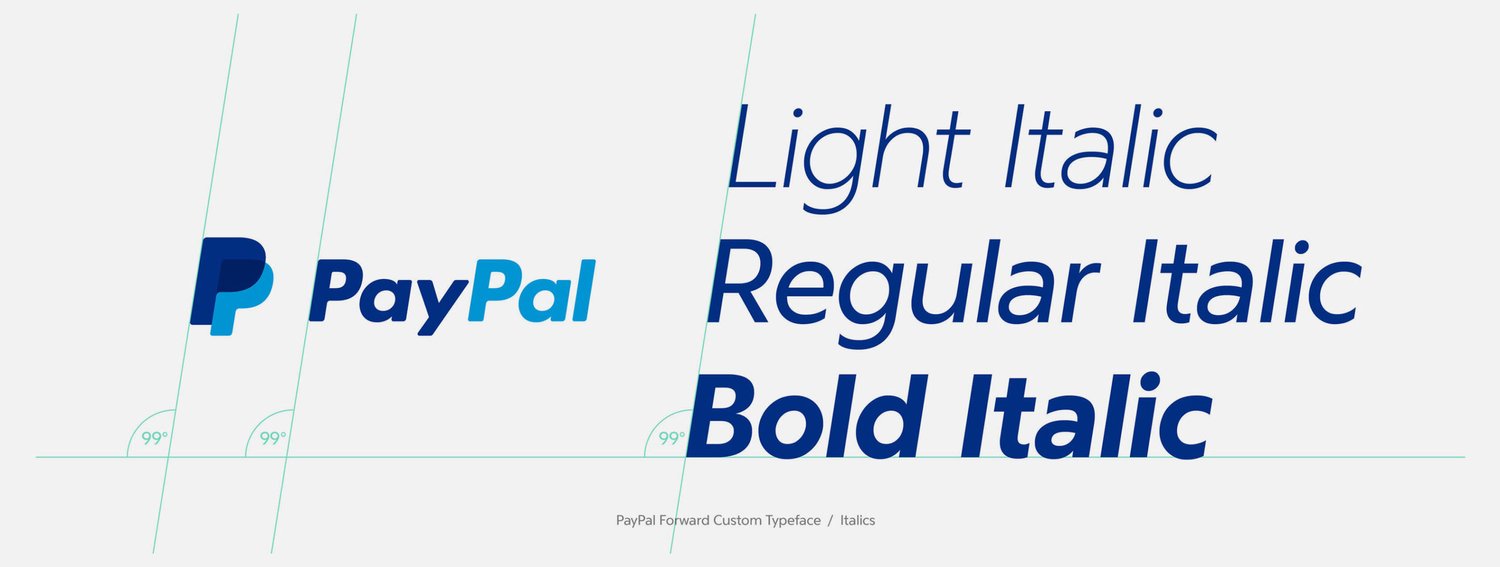
2014–2023: a friendly geometric sans-serif, wide spacing
-
2024: bold, rigid geometry, reflecting strength and maturity
The letter “a” in particular became a signature of the 2014 redesign—instantly recognizable and warmly modern.
Color Palette: From Deep Blues to Monochrome
For most of its history, PayPal defined its identity through layered shades of blue—colors chosen to signal trust, security, and digital reliability. As the brand grew, these tones became instantly recognizable across websites and apps worldwide.
In 2024, PayPal moved in a new direction, replacing its familiar blues with a bold monochrome black. The shift created a cleaner, more modern aesthetic, reflecting the company’s evolution into a broader, more sophisticated fintech ecosystem. It’s a palette that feels confident, simplified, and built for the future.
A Logo That Evolved With the Internet Itself
The PayPal logo is more than a graphic symbol—it’s a timeline of the internet’s evolution. From early web aesthetics to mobile-first interfaces and today’s minimalist fintech design, each iteration has mirrored the needs of its users and the digital landscape of its era.
Its logo heritage demonstrates how a trusted payments brand must balance innovation with stability. And as PayPal moves into new frontiers—cryptocurrency, global finance, AI-driven payments—the 2024 redesign marks a bold step into its next chapter.
One thing is clear: the PayPal logo will continue to evolve, just as money itself does.