Talbot Car Logo History Since 1903
The old version of this article listed a “Pentastar Influence” logo era in Talbot’s own timeline but never explained what that meant: the symbol described is Chrysler’s own Pentastar emblem, used because Chrysler owned the Rootes Group (the company behind Talbot and Sunbeam) through most of the 1960s and 1970s. Chrysler is never named anywhere in the old text. The old article also closed with a vague line about Talbot “disappearing in the 1990s” after “restructuring under Peugeot-Citroen,” without ever explaining that Peugeot-Citroen bought the loss-making Chrysler Europe operation in 1978, revived the dormant Talbot name for the ex-Chrysler cars, ended Talbot passenger car production by 1986-1987, and kept the name alive only on commercial vans into the mid-1990s. This rewrite fills in that chain of ownership and corrects the end dates.
Talbot Logo Meaning and History
Talbot traces back to 1903, when French industrialist Adolphe Clement-Bayard and British aristocrat Charles Chetwynd-Talbot, the 20th Earl of Shrewsbury, set up Clement-Talbot in London to build and sell cars. Early vehicles carried the Clement-Talbot name and the brand built a reputation in motorsport, later reinforced by its association with Sunbeam and with Talbot-Lago in France.
Ownership changed hands repeatedly over the following decades. Clement-Talbot was absorbed into Darracq in 1919, forming STD Motors (Sunbeam-Talbot-Darracq), which collapsed in the mid-1930s. The Rootes Group bought the London Talbot business out of that collapse and eventually folded the name into the Sunbeam-Talbot badge, then dropped “Talbot” altogether by the mid-1950s.
Why does Talbot’s own logo timeline include a Chrysler-style Pentastar symbol?
Because Chrysler Corporation ended up owning Rootes. Chrysler began buying into Rootes Group in 1964, taking roughly 30 percent of ordinary shares that October, then increased its stake through 1966 and 1967 until it held a controlling interest. The British operation was formally renamed Chrysler United Kingdom (Chrysler UK) in 1970. That is why a “Pentastar”-style geometric symbol, the actual Chrysler corporate emblem, shows up in this brand’s own logo history during the 1962-1977 window: for most of that period the company behind the badge was Chrysler, not an independent Talbot or Rootes entity. The “Talbot” name itself was not in active use on cars during these years; it had been shelved by Rootes/Chrysler in the 1950s and only returned after Chrysler left Europe.
How did Talbot come back after Chrysler left Europe?
By the late 1970s, Chrysler’s European division (Chrysler UK plus Chrysler France, the former Simca) was losing money heavily, and Chrysler wanted out. In August 1978, PSA Peugeot-Citroen agreed to buy Chrysler Europe for a nominal sum, widely reported as one US dollar, while taking on the operation’s substantial debts, factories and model range. The deal took effect on 1 January 1979.
Rather than keep paying to license the Chrysler name, or sell the cars under the Peugeot or Citroen badges right away, PSA revived the dormant “Talbot” name and applied it to the former Chrysler/Rootes and Simca lineup from 1979. Models sold as Talbots included the Horizon, Alpine, Solara, Samba and the short-lived, large Tagora. This is the “revival” the old article gestured at without ever naming the Chrysler connection that made it necessary.
When did Talbot passenger cars actually end, and is the old “1995” end date for the final logo correct?
No. Most sources place the effective end of Talbot passenger cars in 1986: the Samba, the last model developed under the Talbot name, ended production in May 1986, and PSA withdrew the Talbot brand from passenger cars in most markets that year. A small tail continued into 1987, when the last Horizon, built at a Finnish plant, came off the line. PSA had already decided in 1985 to badge the 309, a car originally planned as a Talbot (reportedly to be called the Talbot Arizona) and developed to replace the Horizon, as a Peugeot instead once it reached production.
The Talbot name did not disappear completely in 1986, though. It stayed in use in Britain on a badge-engineered commercial van, the Talbot Express (built on the Peugeot J5/Fiat Ducato platform shared across several manufacturers), into the mid-1990s. Several sources put the final retirement of the Talbot name on this van at 1994, with at least one source citing 1992 and another 1995; the exact year is not fully consistent across references, but 1994 is the most commonly cited date. By any of these accounts, the final “T”-emblem logo era described below outlasted Talbot passenger cars by several years but did not run all the way to 1995 on cars, as the old article claimed.
Talbot Logo Symbolism
Talbot’s early badges drew on British heraldry, with lions and crowns reflecting the Earl of Shrewsbury’s family history. Designs became simpler and more mechanical through the middle of the twentieth century, then fully geometric once Rootes and Chrysler took over, culminating in the bold “T” set inside a circular frame used during the PSA-owned Talbot years.
Talbot Logo History Timeline
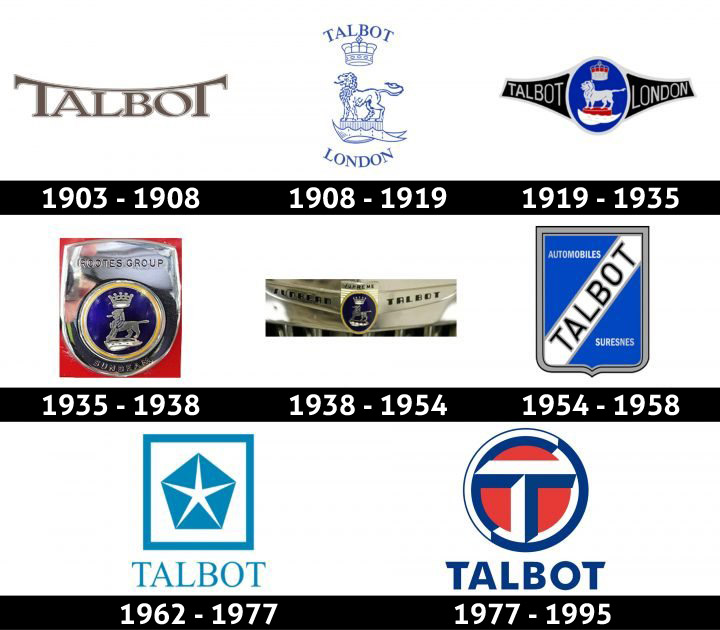
1903-1908: A decorative wordmark with extended “T” characters forming a roof-like structure over the brand name, from the earliest Clement-Talbot cars.
1908-1919: A heraldic crest featuring a lion and a crown, with “London” placed below the brand name to mark its home city.
1919-1935: A blue oval badge with a silver lion and more structured typography, used during the STD Motors (Sunbeam-Talbot-Darracq) period.
1935-1938: A streamlined emblem that kept the central medallion from earlier designs but simplified the surrounding frame, dating to Rootes Group’s early ownership.
1938-1954: A winged silver emblem paired with bold lettering, used on Sunbeam-Talbot models and tied to the brand’s racing results of the era.
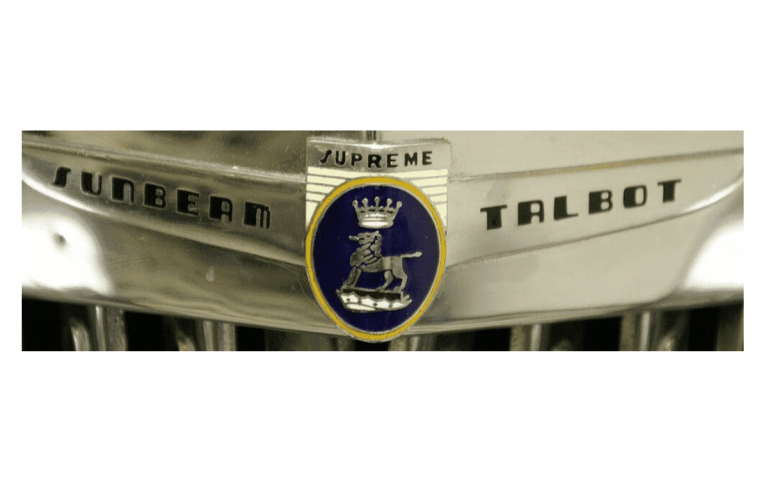
1954-1958: A simplified blue shield with a diagonal banner, marking the last badge to carry the Talbot name before Rootes dropped it from production cars for several years.
1962-1977: A geometric, star-like symbol set inside a square frame. This is the Chrysler Pentastar emblem, used during the years Chrysler Corporation controlled Rootes and then Chrysler United Kingdom; the Talbot name itself was not on cars at this point, which is why this entry belongs to the company’s ownership history rather than an active “Talbot” badge.
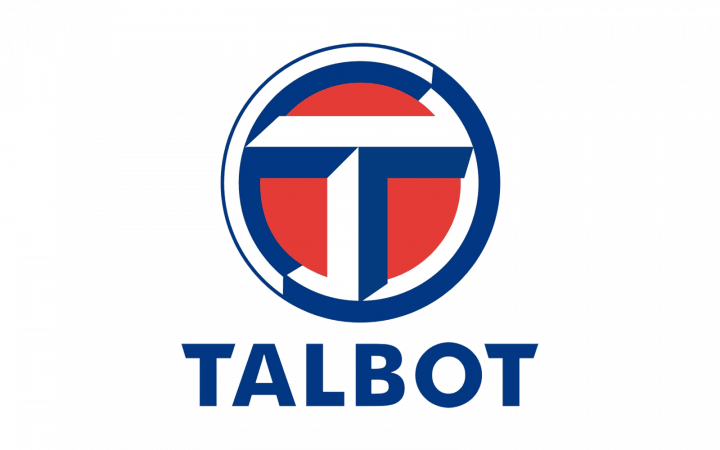
1977-1986 (passenger cars), continuing on vans into the mid-1990s: The final Talbot emblem, a bold “T” inside a circular frame with a clean uppercase wordmark, introduced after PSA Peugeot-Citroen revived the Talbot name in 1979. It appeared on passenger cars until production ended around 1986-1987, then continued on the Talbot Express commercial van in Britain until the brand was retired entirely, most sources say in 1994.
Quick facts
| Founded | 1903, as Clement-Talbot, London |
| Founders | Adolphe Clement-Bayard and Charles Chetwynd-Talbot, Earl of Shrewsbury |
| Merged into STD Motors | 1919 (with Sunbeam and Darracq) |
| Acquired by Rootes Group | Mid-1930s, after STD Motors’ collapse |
| Talbot name dropped by Rootes | Mid-1950s |
| Chrysler acquires stake in Rootes | 1964 (about 30 percent), rising to majority control by 1967 |
| Rootes renamed Chrysler United Kingdom | 1970 |
| PSA Peugeot-Citroen buys Chrysler Europe | August 1978 (effective 1 January 1979), for a nominal sum plus assumed debt |
| Talbot name revived by PSA | 1979, applied to former Chrysler/Rootes and Simca models |
| Talbot passenger car production ends | 1986 (Samba), with the Horizon’s Finnish-built run ending 1987 |
| Talbot name retired entirely (commercial vans) | Most sources cite 1994 (Talbot Express); some give 1992 or 1995 |
Further reading
FAQ
When was Talbot founded?
Talbot was founded in 1903 as Clement-Talbot in London, a joint venture between French industrialist Adolphe Clement-Bayard and Charles Chetwynd-Talbot, the Earl of Shrewsbury.
Why does the Talbot logo timeline include a star symbol that looks like a car brand other than Talbot?
That 1962-1977 symbol is Chrysler’s own Pentastar emblem. Chrysler bought into the Rootes Group (Talbot’s parent) starting in 1964 and controlled it as Chrysler United Kingdom through the 1970s, so the Pentastar appears in this brand’s own ownership history even though Talbot itself was not being used as a car badge at the time.
Why did Peugeot-Citroen bring back the Talbot name?
When PSA Peugeot-Citroen bought the loss-making Chrysler Europe operation in 1978, it did not want to keep paying to license the Chrysler name. It revived the dormant Talbot badge instead and applied it to the former Chrysler/Rootes and Simca models, including the Horizon, Alpine, Solara, Samba and Tagora.
When did Talbot stop making cars?
Talbot passenger car production effectively ended in 1986, when the Samba (the last car developed under the Talbot name) was discontinued and PSA withdrew the brand from most passenger-car markets. A Finnish-built run of the Horizon continued into 1987.
Did the Talbot name survive after cars stopped?
Yes, on commercial vehicles. The Talbot Express, a badge-engineered panel van sold mainly in Britain, kept the Talbot name into the 1990s. Most sources say the Talbot brand was fully retired in 1994, though a few give 1992 or 1995.