Tatra Logo History Since 1850
Tatra is one of the oldest vehicle manufacturers in the world still in operation. The company traces its roots to 1850, when Ignac Sustala began building horse-drawn carriages in the town of Nesselsdorf, in what was then Austria-Hungary and is now Koprivnice, Czech Republic. The firm reorganized as a joint-stock company in 1891 under the name Nesselsdorfer Wagenbau-Fabriks-Gesellschaft, often shortened to NW, and it was under that name that the company built the Prasident in 1897, widely cited as the first factory-produced, petrol-engined automobile made in Central and Eastern Europe. The Prasident was developed by engineers Hans Ledwinka and Edmund Rumpler, working under Hugo Fischer von Roslerstamm, and it drew on a Benz automobile the company had purchased for study.
The company kept the Nesselsdorfer name through the First World War. In 1919, as Czechoslovakia emerged as an independent state, the firm adopted the name Tatra, after the Tatra mountain range along the border between Slovakia and Poland. The new name first appeared on vehicles that year, and the logo went through its own changes as the brand established itself under the new identity.
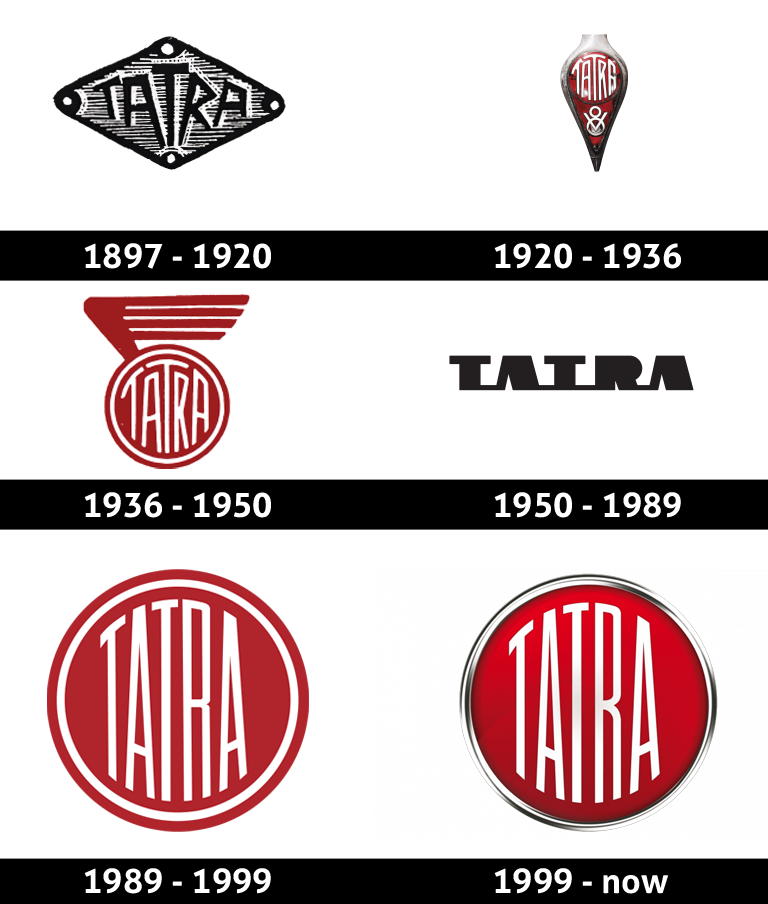
1897-1920: The Rhombus Metallic Plaque
In the Nesselsdorfer era, before the Tatra name existed, vehicles carried a rhombus-shaped metal plaque rather than a printed badge. This diamond-shaped marker was fitted to the company’s early carriages and then to its first automobiles, including the Prasident, as a maker’s mark rather than a developed brand symbol.
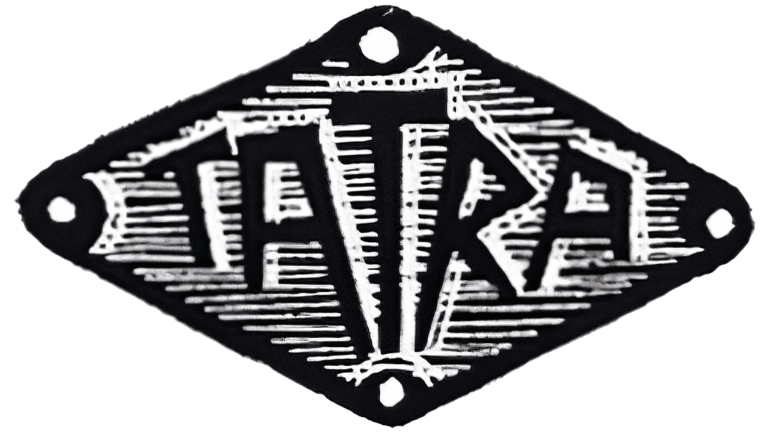
1920-1936: The Red Circular Badge
Following the 1919 rename, Tatra introduced a red circular badge with white lettering. This period coincided with the company’s rise as a serious engineering outfit under chief designer Hans Ledwinka, who returned to the firm in 1921 after several years at Steyr-Werke in Austria. Ledwinka’s backbone chassis, a central tubular frame with independent suspension on swing axles, first appeared on the Tatra 11 in 1923 and became the mechanical foundation for the cars and trucks that followed.
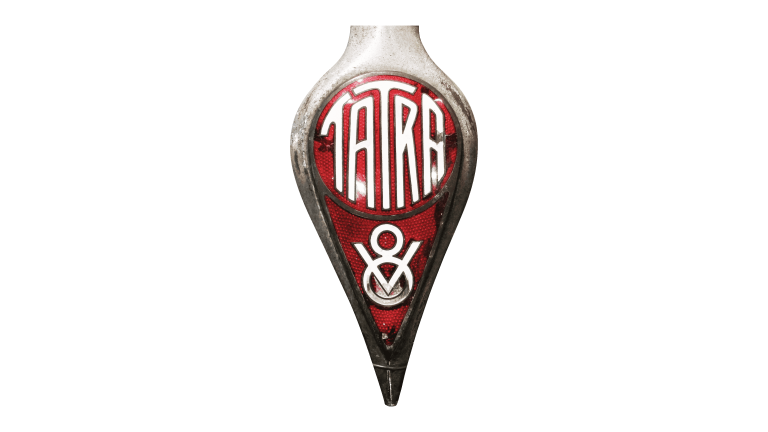
1936-1950: The Circle With Wing Detail
By the mid-1930s Tatra was producing some of the most advanced cars in Europe. The Tatra 77, released in 1934, is widely described as the first mass-produced streamlined car, with a rear-mounted, air-cooled V8 engine and a body shaped with input from aerodynamicist Paul Jaray. The Tatra 87 followed in 1936 and stayed in production until 1950. The logo mark from this era kept the circular form but added a wing-like detail, a nod to the aerodynamic focus of the cars it represented.
This same period produced one of the more contested chapters in automotive history. Ledwinka and Ferdinand Porsche met and corresponded regularly through the 1930s while each worked on rear-engine, air-cooled designs, Porsche on what became the Volkswagen Beetle and Ledwinka on the Tatra V570 prototype and the production Tatra 97. Porsche is reported to have remarked that the two men occasionally looked over each other’s shoulders during that period. Tatra sued over the resemblance between the Beetle and its own designs; the case was interrupted by the German occupation of Czechoslovakia and the outbreak of war, then resumed afterward. Accounts of the final settlement differ slightly on who received the payment, but sources agree that Volkswagen paid Tatra’s interests the sum of one million Deutsche marks in 1965 to close the matter.
1950-1989: The Abstract Mechanical Wordmark
Under postwar Czechoslovakia’s state-run industry, Tatra shifted its passenger car output toward larger models like the Tatra 603 while steadily building out its truck and heavy-vehicle line. The company’s branding moved away from the circular badge toward an abstract wordmark built from blocky, mechanical-looking letterforms. The change reflected the industrial, state-enterprise identity of the era rather than the earlier badge-style marks.

1989-1999: Return to the Classic Circular Badge
After the fall of Czechoslovakia’s communist government in 1989, Tatra moved back toward its earlier circular badge format as the company reoriented itself for a market economy. Passenger car production, by then a small part of the business, ended in 1999, after which Tatra became a dedicated maker of heavy trucks and off-road vehicles.

1999-Present: The Modernized Red Circle
The current mark refines the circular badge with a cleaner red circle and a silver outline, a version built to work across the heavy trucks, off-road vehicles, and specialty chassis that make up Tatra’s modern product line, including models such as the Tatra 815 and the Tatra Force and Phoenix series used by militaries and civilian fleets.
Tatra Today
Tatra Trucks still operates from Koprivnice, Czech Republic, the same town where Ignac Sustala started the company in 1850. The firm faced bankruptcy risk in the early 2010s, and in March 2013 a majority stake was acquired by Czechoslovak Group and Promet Group, which together hold the company today. Tatra’s product line is built around heavy-duty and off-road trucks for military, construction, and specialty civilian use, a far cry from the passenger cars that made the brand famous under Hans Ledwinka, but a direct continuation of the backbone-chassis engineering he developed nearly a century ago. For readers interested in another European manufacturer with its own long design history, see Mercedes-Benz.
Quick Facts
| Founded | 1850 (as a carriage works); incorporated 1891 as Nesselsdorfer Wagenbau-Fabriks-Gesellschaft |
| Renamed Tatra | 1919, after the Tatra mountain range |
| Key engineer | Hans Ledwinka, chief designer, backbone chassis and rear-engine air-cooled layout |
| Landmark models | Prasident (1897), Tatra 77 (1934), Tatra 87 (1936-1950), Tatra 97 (1936-1939) |
| Current focus | Heavy trucks and off-road vehicles, built in Koprivnice, Czech Republic |
Further Reading
- Tatra (company), Wikipedia
- Hans Ledwinka, Wikipedia
- Tatra 97, Wikipedia
- Tatra Trucks, Production History
FAQ
What was Tatra called before it was named Tatra?
The company was originally a carriage works founded by Ignac Sustala in 1850, incorporated in 1891 as Nesselsdorfer Wagenbau-Fabriks-Gesellschaft. It kept the Nesselsdorfer name until 1919, when it was renamed Tatra after the Tatra mountains.
What was Tatra’s first automobile?
The Prasident, built in 1897 under the Nesselsdorfer name, is regarded as the first factory-produced, petrol-engined car built in Central and Eastern Europe.
Who was Hans Ledwinka and why does he matter to Tatra’s history?
Ledwinka was Tatra’s chief design engineer across two stints, including from 1921 to 1937. He developed the backbone chassis and the rear-mounted, air-cooled engine layout used in the Tatra 77, 87, and 97, designs that shaped both the company’s cars and, later, its trucks.
Is it true that the Volkswagen Beetle was influenced by Tatra’s designs?
Ferdinand Porsche and Hans Ledwinka were in contact during the 1930s while each developed rear-engine, air-cooled cars, and the resemblance between the Tatra 97 and the Volkswagen Beetle led Tatra to sue over the design. The case was interrupted by the war and resumed afterward, ending in 1965 when Volkswagen paid roughly one million Deutsche marks to settle it.
Does Tatra still make cars?
No. Tatra ended passenger car production in 1999 and now builds heavy-duty and off-road trucks from its historic home in Koprivnice, Czech Republic. The company has been majority owned by Czechoslovak Group and Promet Group since 2013.