
Signal Logo History: Meaning, Symbolism & Brand Heritage
Signal is one of the rare modern platforms whose identity feels instantly familiar yet quietly distinctive. In a crowded era of chat apps, the brand has built recognition without visual noise, relying on a single, disciplined idea that never needed to be overexplained. The Signal logo history sits naturally alongside WhatsApp logo history and Telegram logo meaning, but its visual language is more restrained, built to suggest trust and privacy without looking technical or intimidating. Within Communication Software Logos, Signal’s logo heritage stands out because it has always prioritized clarity, consistency, and an unmistakable icon that works at a glance.
From its earliest public identity to its most recent refinements, Signal has treated branding the same way it treats product design: reduce friction, remove distractions, keep the promise obvious. That philosophy shapes every part of the logo meaning, from the speech bubble to the protective dashed perimeter.
Signal Logo Meaning and History: The Origin of a Privacy-First Messenger
Signal emerged in the mid-2010s as an American messaging platform built around private communication. While many competitors positioned themselves through social features, Signal’s identity was anchored in a simple message: your conversations should feel normal, but remain protected.
That promise influenced the logo description from the start. The brand chose the universal symbol for messaging—the speech bubble—because it communicates function instantly across languages and markets. But Signal needed something more specific than “chat.” The dashed outline, tracing the bubble’s shape, became the brand’s defining detail. It added a second layer of meaning without turning the icon into a lock, shield, or other heavy-handed security symbol.
As the platform grew into a widely recognized service, the logo heritage matured with it. The icon evolved from an app-first mark designed for mobile screens into a broader identity system that can hold up across web, desktop, and brand materials. Still, the origin idea never shifted: conversation, surrounded by protection.
Signal Logo Symbolism: Conversation Protected by Design
The Signal logo symbolism works because it communicates two ideas at the same time.
The speech bubble represents what users do every day: send messages, share media, talk in groups, and communicate instantly. It’s friendly, familiar, and intentionally uncomplicated.
The dashed outline is where Signal becomes Signal. It reads like a boundary around the conversation—an implied perimeter that suggests privacy without shouting about it. This is the most important piece of the logo meaning, because it turns a common messaging icon into a distinct symbol of protected communication.
Signal’s color strategy supports the same tone. The strong blue feels calm and dependable, while the white space keeps the mark clean and readable. Across different versions, the icon remains built for clarity at small sizes, which is crucial for any brand whose logo is most often seen as a tiny square on a screen.
Signal Logo History Timeline: Evolution of the Icon and Identity System
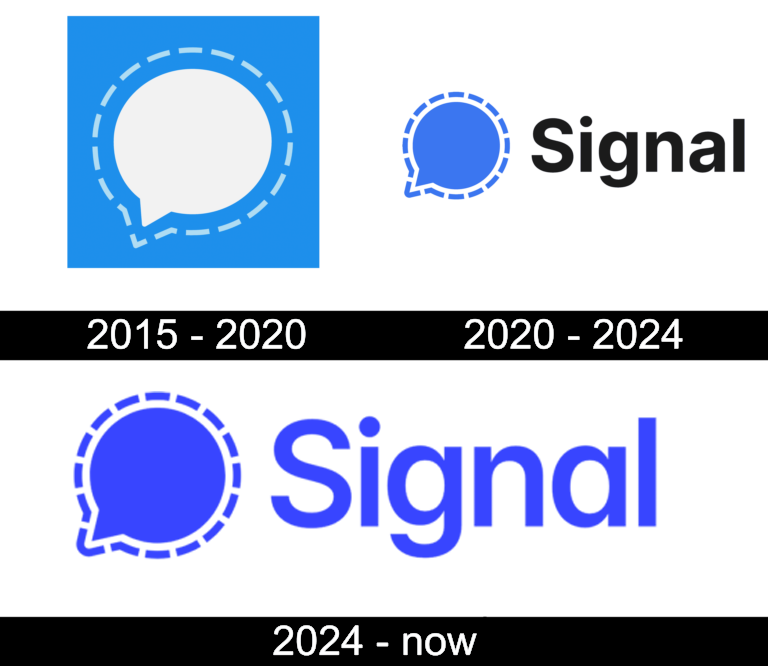
2015–2020: The App Icon Foundation That Defined Signal Recognition
Signal’s earliest widely recognized identity centered on a white speech bubble placed on a bold blue background. A subtle dashed outline echoed the bubble shape, introducing the “protected conversation” idea visually. This era established the core logo description and locked in the icon’s primary structure, even without a wordmark.

2020–2024: Softer Geometry and a Stronger Privacy Outline
In the next phase, the speech bubble became rounder and more approachable. The dashed perimeter became more intentional and legible, reinforcing the logo symbolism of an added security layer. The overall design felt friendlier while also improving visibility across devices and interface contexts.
2024–Today: Refined Branding for Modern Screens and System Consistency
The most recent era focuses on refinement rather than redesign. The core composition remains unchanged, but proportions, spacing, and contrast are optimized for modern UI environments. This stage also reflects a more system-level approach, where the icon and wordmark can work together cleanly across brand surfaces while preserving the icon’s standalone recognition.
Signal Logo Heritage: Minimalism That Built Trust
The Signal logo history is proof that a modern brand can grow through consistency instead of constant change. From its origin as a privacy-first messenger to its present-day identity, Signal has protected its core visual idea: a conversation bubble with a protective perimeter.
That discipline is what gives Signal its logo heritage. The logo meaning remains stable, the logo symbolism stays readable, and the logo description stays instantly recognizable. In a space where many products chase trends, Signal’s identity communicates something rarer—quiet confidence and long-term trust.
Signal Logo History FAQ: Meaning, Symbolism, and Origin
What does the Signal logo represent?
The logo represents protected conversation. The speech bubble shows messaging, and the dashed outline suggests a privacy boundary around communication.
Why does the Signal logo use a dashed outline?
The dashed outline is a core element of the logo symbolism, implying a protective layer without using obvious security icons like locks or shields.
Has the Signal logo changed over time?
Yes. The Signal logo history includes gradual refinements, but the central concept—speech bubble plus dashed perimeter—has remained consistent.
What is the main symbol in the Signal logo?
The main symbol is a speech bubble, chosen for universal recognition and clarity across markets.
What makes Signal’s logo different from other messaging apps?
Signal’s dashed perimeter creates a distinctive visual cue tied to privacy-first branding, giving the icon a unique identity among communication software logos.