
Belgian Air Component Logo History: Meaning, Symbolism & Brand Heritage
The visual identity of Belgian Air Component represents far more than a military insignia. It is a heraldic emblem rooted in centuries of national history, adapted to the modern realities of air power and multinational defense. Unlike commercial airline branding, the Belgian Air Component logo heritage is defined by continuity, authority, and symbolism rather than marketing evolution.
Within military aviation logo history, the Belgian Air Component belongs to the same tradition as the Royal Air Force insignia history and French Air and Space Force emblem meaning, where heraldry, sovereignty, and institutional stability take precedence over stylistic trends. Its logo stands as a visual bridge between medieval symbolism and contemporary air defense.
Meaning and History: The Origin of the Belgian Air Component Identity
The Belgian Air Component was officially formed in 1946 through the merger of the Belgian Army Air Corps and Belgian Naval Aviation. However, the roots of Belgian military aviation stretch back to 1909, when the country began developing its first air units. This long institutional lineage explains why the logo meaning draws heavily from historic heraldry rather than abstract aviation motifs.
As part of the Belgian Armed Forces, the Air Component was never intended to adopt a changing visual identity. Instead, its emblem functions as a state symbol, representing authority, continuity, and national defense. Over decades of NATO integration, peacekeeping missions, and modernization, the core visual elements have remained unchanged, reinforcing institutional legitimacy.
Logo Symbolism: Heraldry, Sovereignty, and Air Power
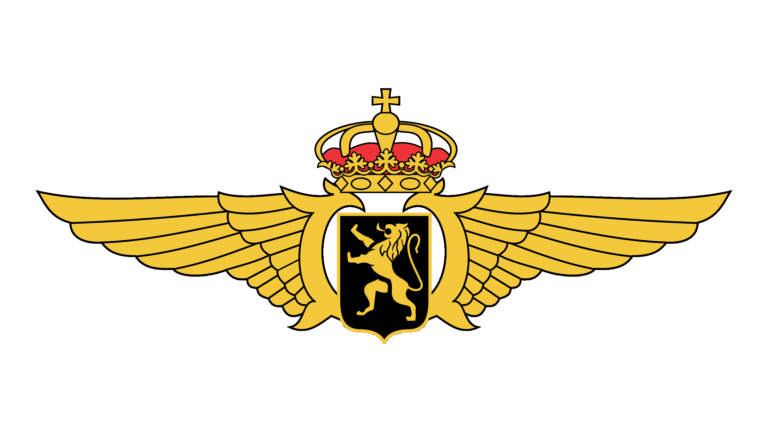
The symbolism of the Belgian Air Component logo is deeply heraldic. At its center is a black shield bearing a golden lion rampant, a symbol historically associated with the Duchy of Brabant and widely recognized as an emblem of courage, vigilance, and strength within Belgian state symbolism.
Flanking the shield are two stylized golden wings. These wings represent mastery of the air domain, speed, and operational reach. Their segmented construction evokes feathers while maintaining a mechanical precision appropriate to modern military aviation.
Above the shield rests a golden crown, symbolizing sovereignty and the constitutional monarchy of Belgium. Its presence emphasizes that the Air Component operates under state authority and serves national and allied interests rather than commercial or symbolic branding goals.
The color palette of black and gold reinforces gravity and authority. Gold signifies honor, excellence, and tradition, while black conveys seriousness, discipline, and permanence.
Belgian Air Component Logo History Timeline
1909–Present: Heraldic Continuity and Military Authority
The Belgian Air Component emblem has remained fundamentally consistent since the early development of Belgian military aviation. While aircraft liveries and roundels have been adapted for operational visibility and NATO standards, the core emblem — featuring the shield, lion, wings, and crown — has endured without conceptual redesign.
This uninterrupted use reflects the emblem’s role as a state and military symbol rather than a brand identity subject to redesign cycles. Its longevity reinforces trust, hierarchy, and institutional memory within both national and international defense contexts.
Belgian Air Component Logo Heritage in the NATO Context
Within NATO military aviation, the logo heritage of the Belgian Air Component is notable for its restraint and historical depth. While some air forces have modernized or simplified their insignia for digital applications, Belgium has preserved its heraldic core.
When compared with identities discussed in German Air Force emblem history or Italian Air Force insignia symbolism, the Belgian Air Component stands out for the strong integration of monarchical and regional heraldry. This approach reinforces continuity between the nation’s medieval past and its modern defense commitments.
Belgian Air Component Logo as a Symbol of Continuity and Authority
The Belgian Air Component logo history exemplifies how military visual identity operates beyond branding trends. Through heraldic symbolism, disciplined color use, and institutional continuity, the emblem communicates authority, sovereignty, and operational readiness. Within military aviation logo history and broader logo heritage analysis, it stands as a model of enduring state symbolism adapted to the air power domain.
FAQ: Belgian Air Component Logo Meaning and History
What does the Belgian Air Component logo represent?
It represents sovereignty, courage, and air power through heraldic symbolism.
Why does the logo feature a lion?
The lion is a historic symbol of strength associated with Belgian regional and national heraldry.
Have there been major redesigns of the logo?
No, the emblem has remained conceptually unchanged for over a century.
Is the Belgian Air Component part of NATO?
Yes, it operates as part of NATO’s collective defense structure.