Aeroperú Logo History: Meaning, Symbolism & Brand Heritage
The visual identity of Aeroperú represents one of the most complex and symbolically layered stories in Latin American aviation. As Peru’s former flag carrier, Aeroperú carried not only passengers but also national ambition, technological progress, and international visibility. Its logo history reflects shifting political priorities, modernization efforts, and the broader evolution of airline branding from the 1970s through the end of the 20th century.
Within airline logo history, Aeroperú belongs to the same historical category as Aerolíneas Argentinas logo history and Avianca logo heritage, where state involvement and national identity strongly shaped visual language. As part of the wider Latin American airline logo heritage, Aeroperú’s logos demonstrate how symbolism, typography, and abstraction were used to express authority, progress, and sovereignty.
Meaning and History: The Origin of the Aeroperú Identity
Aeroperú was founded in 1973 by the Peruvian government with the explicit goal of establishing a strong national airline capable of connecting Peru domestically and internationally. From the outset, the airline was positioned as a symbol of national development and global integration, which directly influenced its visual identity.
During the 1980s, Aeroperú became a technological leader in the region. In 1983, it made aviation history by becoming the first Latin American airline to operate the Boeing 767, reinforcing its image as a forward-looking carrier. This period marked a shift in logo meaning from decorative national symbolism toward modernity, efficiency, and international credibility.
Despite expansion and modernization, the airline encountered severe challenges in the late 1990s. Financial difficulties and the tragic 1996 crash accelerated its decline, and Aeroperú ceased operations in 1999. Nevertheless, its branding legacy remains deeply embedded in Peru’s aviation history.
Logo Symbolism: National Authority, Abstraction, and Flight
The symbolism of the Aeroperú logo evolved significantly over time, reflecting broader changes in airline branding philosophy. Early designs relied on strong color fields and emblematic shapes, signaling authority and official status. Red and white dominated the palette, referencing national identity while also ensuring high visibility.
Abstract emblems played a central role. Rather than literal wings or aircraft, Aeroperú favored geometric and symbolic forms that suggested motion, connectivity, and institutional strength. Over time, these forms became more stylized and minimal, aligning with global design trends of the 1990s.
Typography shifted from formal uppercase inscriptions to bold lowercase wordmarks, signaling a move away from rigid state symbolism toward contemporary international branding.
Aeroperú Logo History Timeline
1973–1985: Foundational Banner and Abstract Emblem
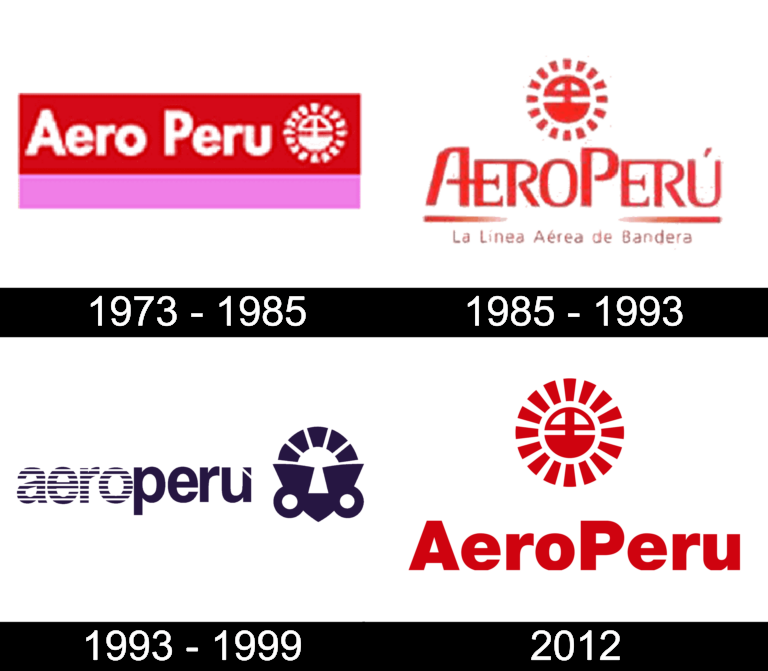
The original Aeroperú logo introduced in 1973 featured white lettering placed on a rectangular red-and-pink banner. To the right of the wordmark appeared an abstract white circular emblem composed of a central symbol enclosed by a ring of short strokes. This design conveyed institutional authority while incorporating modern abstraction typical of 1970s airline branding.

1985–1993: National Flag Carrier Identity
In 1985, Aeroperú adopted a more assertive visual identity. The color palette shifted fully to red on white, strengthening national association. A large emblem appeared above the wordmark, while two short horizontal lines underlined the name. A tagline reading “La Línea Aérea de Bandera” reinforced Aeroperú’s role as Peru’s official carrier.
1993–1999: Modern Geometric Wordmark Era
The 1993 redesign marked the airline’s most contemporary identity. The logo introduced bold lowercase lettering in a geometric sans-serif typeface. The first part of the wordmark featured striped detailing, while the latter half used solid strokes, including a distinctive triangular cut-out in the letter “u.” The emblem was refined into a hybrid form combining rounded and triangular elements, emphasizing motion and direction.
This identity aligned Aeroperú visually with global carriers during the jet-age modernization period.

2012: Post-Closure Heritage Revival
In 2012, long after the airline ceased operations, a revived Aeroperú logo appeared, returning to the original red-and-white palette. The early emblem was restored with strengthened contours, and the wordmark was rewritten in a bold geometric sans-serif. This version functioned primarily as a heritage mark, referencing historical continuity rather than active airline operations.
Aeroperú Logo Heritage and Regional Significance
Aeroperú’s logo heritage reflects the broader trajectory of state-owned airlines in Latin America, where branding often balanced national symbolism with international aspiration. Unlike purely commercial carriers, Aeroperú’s identity was deeply tied to government vision and public perception.
When compared with identities explored in LAN Airlines logo history or Copa Airlines logo symbolism, Aeroperú stands out for its bold experimentation with abstraction and typography. Even after its closure, the airline’s visual identity remains recognizable and historically relevant.
Aeroperú Logo as a Symbol of Peruvian Aviation Ambition
The Aeroperú logo history captures the rise, transformation, and legacy of Peru’s former flag carrier. From strong institutional beginnings to modern geometric abstraction, each iteration reflected changing ambitions and global positioning. Within airline logo history and broader logo heritage analysis, Aeroperú remains a powerful example of how visual identity can embody national progress, technological leadership, and historical memory.
FAQ: Aeroperú Logo Meaning and History
What did the Aeroperú logo represent?
The logo represented national authority, aviation progress, and Peru’s international connectivity.
When was Aeroperú founded?
Aeroperú was founded in 1973 by the Peruvian government.
Why did Aeroperú redesign its logo in 1993?
The redesign aligned the airline with modern international branding standards and reflected fleet modernization.
Is Aeroperú still operating today?
No, Aeroperú ceased operations in 1999, though its branding remains an important part of Peruvian aviation heritage.