
Virgin America Logo History: Meaning, Symbolism & Brand Heritage

The visual identity of Virgin America captured a rare moment in U.S. aviation when style, technology, and brand personality became central to the flying experience. From its earliest days, Virgin America positioned itself as a challenger brand, using design not as decoration but as a strategic tool to redefine domestic air travel. Its logo history reflects this ambition, evolving in parallel with the airline’s push toward innovation and customer-centric service.
Within airline logo history, Virgin America stands alongside brands such as American Airlines logo history and JetBlue logo meaning, where differentiation relied on clarity, confidence, and modern aesthetics rather than tradition alone. As part of the broader airline logo heritage, Virgin America demonstrates how a young carrier can build strong recognition through deliberate visual refinement rather than constant reinvention.
Meaning and History: The Origin of the Virgin America Identity
Virgin America was founded in 2004 as part of the Virgin Group, with the goal of bringing the group’s distinctive brand philosophy to the U.S. domestic market. After overcoming regulatory hurdles, the airline launched operations in 2007, immediately distinguishing itself through cabin design, onboard technology, and a relaxed yet premium atmosphere.
The logo meaning was closely tied to this positioning. Rather than emphasizing national symbolism or legacy motifs, Virgin America focused on modern typography, bold color, and the globally recognized Virgin emblem. This approach aligned with the airline’s promise of a fresh alternative to traditional U.S. carriers, appealing especially to design-conscious and tech-savvy travelers.
As the airline expanded its network across major American cities and built a strong reputation for service, its visual identity evolved to become more refined and confident, culminating in a clean, minimalist mark shortly before its merger with Alaska Airlines in 2018.
Logo Symbolism: Modernity, Confidence, and Brand Personality
The symbolism of the Virgin America logo is rooted in confidence and contemporary appeal rather than abstraction. The iconic Virgin emblem, long associated with innovation and disruption across industries, provided instant brand recognition and credibility. Its red-and-white palette conveyed energy, passion, and visibility, while also maintaining continuity with the broader Virgin brand family.
Typography played a decisive role in shaping perception. Early iterations used sharp, modern sans-serif letterforms to communicate progress and edge. Later refinements softened and simplified these forms, signaling maturity without sacrificing personality. The gradual reduction of visual complexity mirrored the airline’s transition from newcomer to established premium carrier.
Virgin America Logo History Timeline
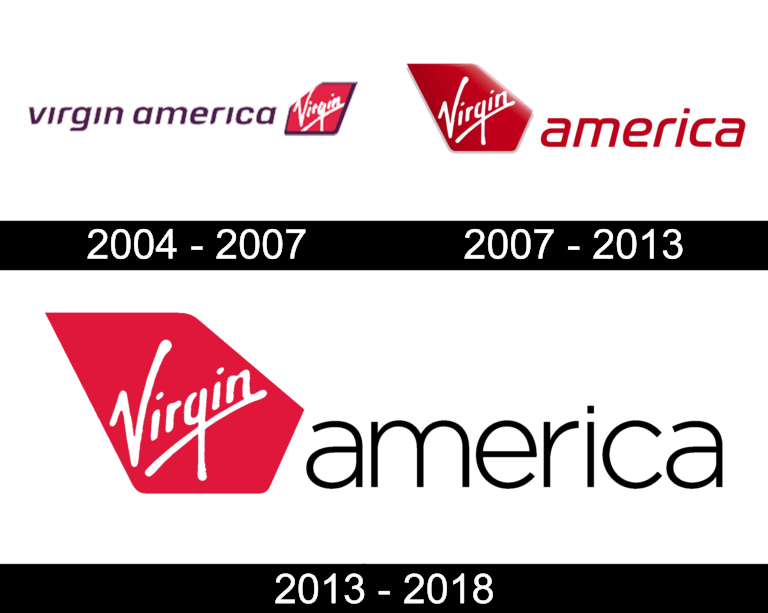
2004–2007: Foundational Wordmark and Virgin Emblem
The original Virgin America logo introduced in 2004 featured a lowercase wordmark spelling out the full airline name, paired with a compact Virgin emblem on the right. The typography appeared in a dark purple tone, projecting sophistication and differentiation, while the emblem retained the classic red-and-white Virgin palette. This design emphasized brand affiliation while establishing Virgin America as a distinct entity.

2007–2013: Emblem-Led Identity and Brand Confidence
Following the airline’s operational launch in 2007, the logo was restructured to highlight the Virgin emblem more prominently. The emblem moved to the left and was enlarged, gaining subtle gradients that added depth and presence. The wordmark was shortened to “America” and rendered in dark red, reinforcing brand cohesion while streamlining the composition.

2013–2018: Minimalist Refinement and Modern Clarity
In 2013, Virgin America adopted its most refined logo. The emblem was flattened into clean red-and-white shapes, aligning with contemporary design trends. The wordmark was simplified further, set in black with a straightforward sans-serif typeface. This version projected confidence, clarity, and modern elegance, remaining in use until the brand was retired following the Alaska Airlines merger in 2018.
Virgin America Logo Heritage and Industry Influence
Although Virgin America operated for just over a decade, its logo heritage left a lasting impression on U.S. airline branding. The carrier demonstrated that visual identity could be playful, stylish, and premium without sacrificing professionalism. Its influence extended beyond logos into cabin interiors, user interfaces, and customer experience design.
When compared with identities discussed in Delta Air Lines logo history or Southwest Airlines logo symbolism, Virgin America stands out for integrating lifestyle branding into aviation. Its logo became a symbol of a broader design philosophy that challenged industry norms.
Virgin America Logo as an Icon of Modern Airline Branding
The Virgin America logo history illustrates how a focused, design-driven identity can redefine expectations in a mature market. Through thoughtful evolution, the airline maintained strong brand recognition while adapting to changing design standards. Within airline logo history and broader logo heritage analysis, Virgin America remains a benchmark for how style, technology, and branding can converge to create a memorable airline identity.
FAQ: Virgin America Logo Meaning and History
What did the Virgin America logo represent?
The logo represented modernity, innovation, and confidence, aligned with the Virgin brand’s disruptive identity.
When was the Virgin America logo first introduced?
The original logo was introduced in 2004.
Why did Virgin America redesign its logo in 2013?
The redesign simplified the identity, improving clarity and aligning with contemporary flat design trends.
What happened to the Virgin America brand?
Virgin America merged with Alaska Airlines in 2018 and ceased operating as a separate brand.