
Thai Airways International Logo History: Meaning, Symbolism & Brand Heritage

As the national flag carrier of Thailand, Thai Airways International has developed a visual identity that blends cultural refinement with international aviation authority. Founded during a period of rapid global expansion in commercial air travel, the airline positioned itself not merely as a transport provider, but as a cultural ambassador of Thailand. The Thai Airways International logo history reflects this role clearly, combining traditional symbolism with disciplined corporate design. When examined alongside the heritage-driven evolution of the Japan Airlines logo history and the culturally expressive identity explored in the Singapore Airlines logo heritage, Thai Airways stands out within global airline logo history for its ability to translate national aesthetics into a modern brand system.
The Thai Airways logo meaning is deeply rooted in Thai art, hospitality, and grace. Rather than focusing on mechanical or technical aviation motifs, the airline chose to express elegance, warmth, and cultural continuity, values closely associated with Thailand’s international image.
Meaning and History: The Origin of the Thai Airways Identity
Thai Airways International was established in 1960 and launched its first commercial flight less than two months later, signaling strong governmental and strategic backing. As Thailand’s primary air carrier, the airline rapidly expanded its network and later became a founding member of the Star Alliance, reinforcing its position among the world’s leading airlines. Since 2006, its main hub has been Suvarnabhumi Airport in Bangkok, one of Asia’s most significant aviation centers.
From its inception, Thai Airways adopted a branding philosophy that emphasized cultural representation over technical abstraction. The logo origin was designed to communicate Thai identity, hospitality, and refinement rather than speed or machinery. This decision aligned closely with the airline’s service-driven positioning and its reputation for comfort and attentiveness.
The logo meaning evolved alongside the airline’s growth, but its foundation remained consistent: to serve as a visual embodiment of Thailand’s elegance and welcoming spirit on the global stage.
Logo Symbolism: Grace, Culture, and National Elegance
The Thai Airways logo symbolism draws heavily from traditional Thai visual language. Rather than depicting aircraft or wings, the airline embraced abstract forms inspired by classical art, dance, and architecture. These elements convey grace, balance, and fluid motion, qualities deeply embedded in Thai culture.
Color symbolism plays a central role in reinforcing this narrative. Purple represents royalty, dignity, and sophistication, while gold conveys prosperity, warmth, and cultural richness. Together, these colors establish an identity that feels both luxurious and culturally authentic, distinguishing Thai Airways from more utilitarian airline branding.
The emblem’s flowing shapes suggest movement and harmony rather than speed, aligning with the airline’s emphasis on comfort and refined service.
Thai Airways International Logo History Timeline
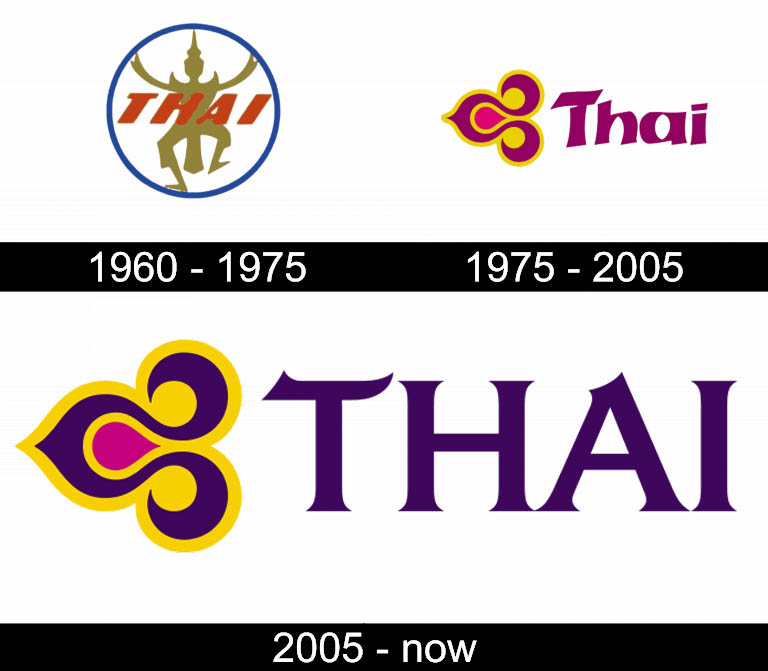
1960–1975: Cultural Emblem and National Representation
The original Thai Airways International logo introduced in the early years of the airline featured a traditional Thai dancer enclosed within a circular frame. Often referred to as the “Dancing Man,” the emblem depicted a gold figure set against a white background, framed by a thin blue outline. Across the dancer’s body, the word “THAI” appeared in bold, italicized uppercase lettering rendered in a sharp sans-serif typeface.
This logo clearly positioned the airline as a cultural representative of Thailand. By incorporating classical dance imagery, the brand communicated grace, hospitality, and national pride, establishing a strong emotional connection with international travelers.

1975–2005: Abstract Cultural Identity and Global Expansion
In 1975, as Thai Airways expanded its global footprint, the logo underwent a significant transformation. Developed by Walter Landor Associates, the new emblem replaced literal imagery with an abstract symbol inspired by traditional Thai motifs. The resulting mark, often described as a stylized “jumpee,” drew influence from temple architecture, orchids, and silk patterns.
Rendered in purple, magenta, and gold, the emblem conveyed luxury, elegance, and cultural depth. This version marked a shift from direct representation to symbolic abstraction, aligning the airline’s identity with international branding standards while preserving its cultural essence.

2005–Present: Refined Elegance and Contemporary Authority
The 2005 update refined the existing emblem rather than redefining it. The abstract symbol was simplified and sharpened for improved clarity and adaptability across digital and physical platforms. The color palette was deepened, with purple becoming darker and more restrained, reinforcing professionalism and confidence.
The wordmark was updated to uppercase lettering using a sophisticated typeface with slightly elongated and sharpened terminals. This adjustment enhanced legibility while maintaining the brand’s elegant character. The current logo reflects a mature identity that balances tradition with modern airline branding requirements.
Typography and Visual Construction
Typography plays a supporting but essential role in the Thai Airways logo meaning. The refined uppercase wordmark communicates authority and consistency, while its subtle sharpness echoes the precision of the emblem. The spacing and proportions are carefully controlled, ensuring harmony between symbol and text.
The emblem itself functions independently as a recognizable brand marker, allowing flexible application across aircraft liveries, uniforms, and digital interfaces without losing its cultural resonance.
Thai Airways Logo Heritage and Brand Positioning
The Thai Airways logo heritage is defined by continuity and cultural respect. Rather than abandoning its roots in pursuit of global uniformity, the airline refined its visual language gradually, preserving symbolic meaning while enhancing modern usability.
This approach positions Thai Airways as a carrier that values identity as much as operational excellence. The logo communicates warmth, refinement, and national pride, reinforcing the airline’s reputation as a premium Southeast Asian carrier with a distinct cultural voice.
Thai Airways International Logo History and Cultural Expression
The Thai Airways International logo history demonstrates how cultural symbolism can be successfully integrated into global airline branding. From its early figurative emblem to its refined abstract mark, the logo’s evolution mirrors the airline’s growth while remaining anchored in Thai heritage. Within the broader framework of airline logo heritage, Thai Airways stands as a compelling example of how elegance, tradition, and modernity can coexist in a timeless visual identity.
FAQ: Thai Airways International Logo Meaning and History
What does the Thai Airways logo represent?
The logo represents Thai culture, grace, and hospitality through abstract forms inspired by traditional art and design.
Why does Thai Airways use purple and gold in its logo?
Purple symbolizes dignity and sophistication, while gold represents warmth, prosperity, and cultural richness.
Has the Thai Airways logo changed significantly over time?
The logo evolved from figurative imagery to abstract symbolism, but its cultural foundation has remained consistent.
When was the current Thai Airways logo introduced?
The current refined version of the logo was introduced in 2005 and remains in use today.