
Royal Air Maroc Logo History: Meaning, Symbolism & Brand Heritage
As the national flag carrier of Morocco, Royal Air Maroc occupies a distinctive position within global aviation branding. Founded during a period of post-independence nation-building, the airline’s identity has always carried meaning beyond commercial air transport. The Royal Air Maroc logo history reflects this dual role, functioning both as a corporate emblem and as a visual expression of national heritage. When examined alongside the evolution of state-linked carriers explored in the Air France logo history and the monarchic symbolism present in the Saudia logo heritage, Royal Air Maroc reveals a branding approach rooted in sovereignty, continuity, and cultural symbolism. Within the broader landscape of airline logo history, the brand stands out for preserving its original visual concept while adapting it to modern aviation standards.
The Royal Air Maroc logo meaning is inseparable from Morocco’s political and cultural identity. Rather than following minimalist airline branding trends, the logo has consistently emphasized regal symbolism, national colors, and historical continuity, reinforcing its role as a carrier representing the country on a global stage.
Meaning and History: The Origin of the Royal Air Maroc Identity
Royal Air Maroc was established in 1957 by the Moroccan government, shortly after the country regained independence. From its inception, the airline was conceived not only as a transportation company but as a national institution tasked with connecting Morocco to the world. Headquartered at Mohammed V International Airport in Casablanca, Royal Air Maroc steadily expanded its route network, becoming Africa’s leading carrier by international reach.
This institutional origin shaped the airline’s visual identity from the very beginning. Unlike privately founded airlines that evolved branding through marketing cycles, Royal Air Maroc adopted a logo that embodied state authority, national symbolism, and royal patronage. The logo origin was therefore deeply intentional, designed to communicate legitimacy, stability, and cultural pride rather than commercial novelty.
The logo meaning reflects this foundation. Every major element, from the crown to the star and wings, carries symbolic weight tied to Moroccan identity and governance, making the logo a visual extension of national heritage rather than a purely corporate mark.
Logo Symbolism: Royal Authority, National Identity, and Flight
The Royal Air Maroc logo symbolism is constructed around three central themes: monarchy, nationhood, and aviation. The crown positioned above the emblem symbolizes the airline’s direct association with the Moroccan monarchy, signaling state authority and continuity. This element differentiates Royal Air Maroc from most global carriers, placing it firmly within the tradition of royal or state-sponsored airlines.
The five-pointed star represents Morocco’s national emblem, reinforcing the airline’s role as a flag carrier. Encircled within a thin ring, the star conveys unity and sovereignty, while the surrounding wings introduce the functional symbolism of flight and global connectivity.
Color plays a decisive symbolic role. The dominant red references the Moroccan flag and conveys power, vitality, and prestige. The restrained palette avoids excess decoration, allowing the symbolic elements themselves to carry the narrative of national identity and aviation purpose.
Royal Air Maroc Logo History Timeline
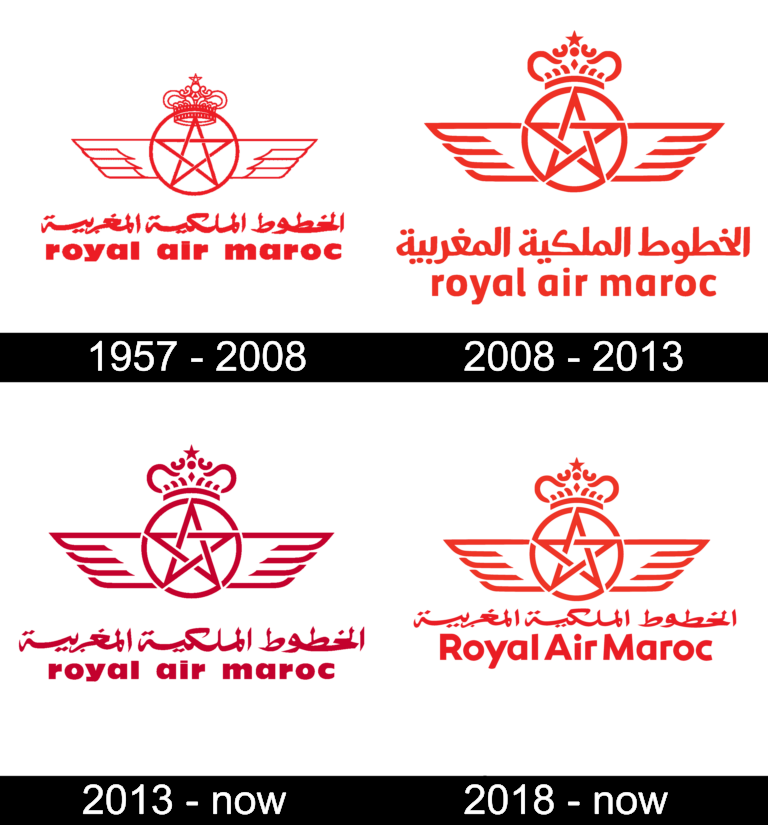
1957–2008: Foundational Emblem and National Identity
The original Royal Air Maroc logo was introduced in 1957, coinciding with the airline’s establishment. The design featured a refined emblem composed of a five-pointed star enclosed within a circular frame, flanked by stylized wings and topped with a crown. Beneath the emblem, Arabic script was positioned above the Latin wordmark, reinforcing bilingual identity and cultural authenticity.
This logo remained largely unchanged for over five decades, a rare occurrence in commercial aviation branding. Its longevity reflected the airline’s commitment to continuity and heritage, with only minor refinements applied to line weight and proportions over time.
2008–2013: Structural Refinement and Modernization
In 2008, Royal Air Maroc undertook a subtle redesign aimed at strengthening visual clarity without altering the core concept. The emblem’s lines were made bolder and more defined, enhancing visibility across aircraft liveries and digital platforms.
The Latin wordmark beneath the emblem was updated with a more contemporary sans-serif typeface. Slightly narrowed and bold, the new typography introduced a modern rhythm while preserving the formal tone of the original identity.
2013–2018: Alliance Era and Visual Maturity
The 2013 update coincided with Royal Air Maroc’s strategic integration into global aviation alliances, marking a significant milestone in its international positioning. While the overall composition remained unchanged, the color palette was deepened, resulting in a richer, more premium appearance.
The wordmark was refined once more, adopting a lowercase, extra-bold sans-serif typeface. This adjustment softened the visual tone while maintaining authority, creating a balance between tradition and contemporary airline branding.
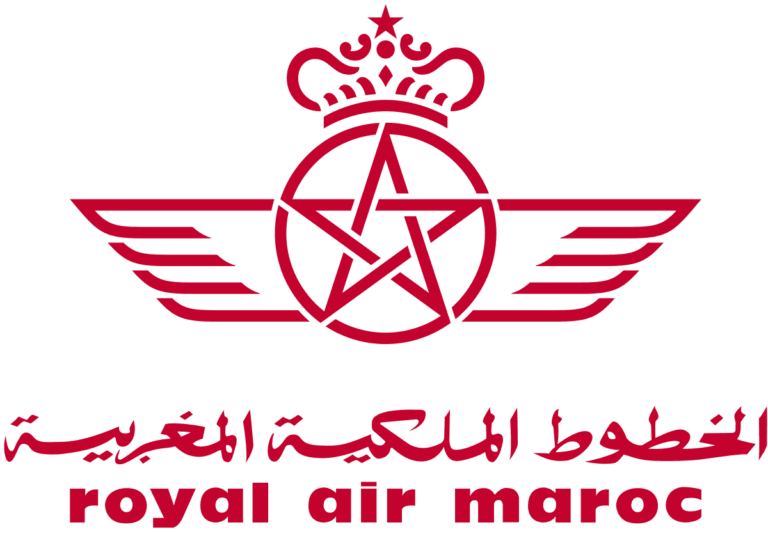
2018–Present: Heritage Preservation and Contemporary Application
Since 2018, the Royal Air Maroc logo has remained consistent, reflecting a mature identity that prioritizes heritage over trend-driven redesigns. The emblem continues to function as a recognizable symbol of Moroccan sovereignty, while its refined execution ensures relevance in modern aviation environments.
Typography and Visual Construction
Typography within the Royal Air Maroc logo balances formality and accessibility. The Arabic lettering reinforces cultural authenticity, while the Latin wordmark ensures international legibility. The chosen sans-serif typeface communicates stability and professionalism, avoiding decorative excess that could undermine the logo’s institutional authority.
The proportional relationship between emblem and wordmark has been carefully maintained across iterations, ensuring visual harmony and instant recognition across aircraft, signage, and digital media.
Royal Air Maroc Logo Heritage and Brand Positioning
The Royal Air Maroc logo heritage is defined by continuity rather than reinvention. While many airlines have abandoned national symbolism in favor of abstract minimalism, Royal Air Maroc has preserved its original visual narrative. This decision reinforces trust, institutional legitimacy, and cultural representation.
The logo positions the airline as a national ambassador rather than a lifestyle brand. Its restrained evolution reflects confidence in identity, allowing Royal Air Maroc to stand apart within the competitive global aviation market.
Royal Air Maroc Logo History and National Expression
The Royal Air Maroc logo history illustrates how visual identity can function as both corporate branding and national symbolism. From its 1957 origin to its modern refinements, the logo has remained faithful to its foundational message of sovereignty, heritage, and flight. In the context of airline logo heritage, Royal Air Maroc demonstrates that enduring identity is achieved not through constant redesign, but through thoughtful preservation and refinement of meaning.
FAQ: Royal Air Maroc Logo Meaning and History
What does the Royal Air Maroc logo represent?
The logo represents Moroccan sovereignty, national identity, and aviation, combining royal symbols with elements of flight.
Why does the logo include a crown and star?
The crown symbolizes the Moroccan monarchy, while the five-pointed star represents the national emblem of Morocco.
Has the Royal Air Maroc logo changed significantly over time?
The logo has evolved through subtle refinements, but its original concept from 1957 has been preserved.
Why does Royal Air Maroc use red as its primary color?
Red reflects the Moroccan flag and conveys power, heritage, and national pride.