Avianca Logo History: Meaning, Symbolism & Brand Heritage
Within global aviation logo history, Avianca occupies a uniquely influential position. As one of the oldest airlines in the world and the national carrier of Colombia, Avianca’s identity developed at the intersection of early aviation experimentation, regional symbolism, and modern airline branding. Few airline brands can claim a logo heritage shaped by more than a century of political, technological, and cultural change.
The Avianca logo history shares thematic parallels with the long institutional evolution explored in KLM logo and the national symbolism found in Air Canada logo history, while also reflecting the turbulent consolidation patterns typical of Latin American aviation. Across its many redesigns, Avianca transitioned from ornate emblems rooted in geography and heraldry to a contemporary, minimalist identity aligned with global airline branding standards.
Meaning and History: The Origin of the Avianca Logo
Avianca traces its origins to 1919, when it was founded as SCADTA (Sociedad Colombo-Alemana de Transportes Aéreos), a pioneering Colombo-German airline. From the beginning, flight symbolism was central to the brand. Birds, landscapes, and national references were used to communicate power, reliability, and connection in an era when aviation itself was still novel.
Following the merger of SCADTA with SACO in the early 1940s, Avianca emerged as Aerovías Nacionales de Colombia S.A., becoming Colombia’s flag carrier. Each stage of corporate transformation brought changes to the logo meaning, gradually shifting emphasis from national storytelling to clarity, legibility, and international competitiveness.
Avianca Logo History Timeline
1919–1928 (SCADTA): Early Aviation and National Symbolism
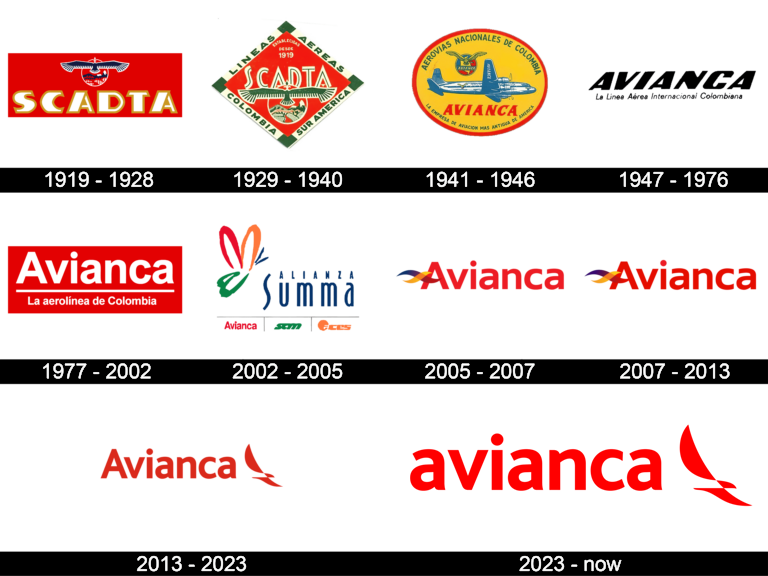
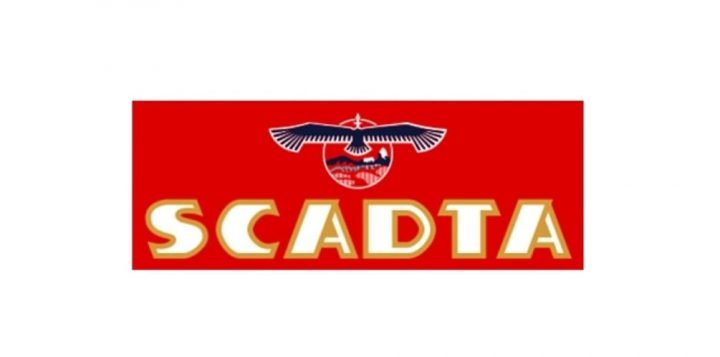
The earliest SCADTA logo featured a powerful bird with wings fully extended, positioned above the company name. The imagery strongly resembled the Andean condor, a national symbol of Colombia, reinforcing legitimacy and authority. Beneath the bird appeared a stylized local landscape, grounding the airline geographically.
This logo description reflected early aviation branding norms, where reassurance and symbolism were more important than simplicity.
1929–1940 (SCADTA): Ornamental Expansion and Detail
The 1929 redesign increased visual complexity. The bird and landscape moved below the SCADTA wordmark, while a circular border formed by the inscription “Lineas Aereas Colombia Sur America” surrounded the emblem. The palette lightened with the introduction of milk-white and light green tones.
While visually rich, this version sacrificed clarity for ornamentation, a common trait of early 20th-century corporate emblems.
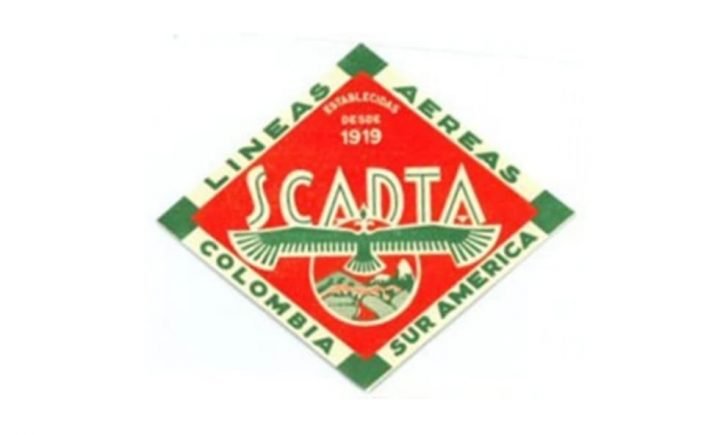
1941–1946 (Avianca): Transitional Complexity
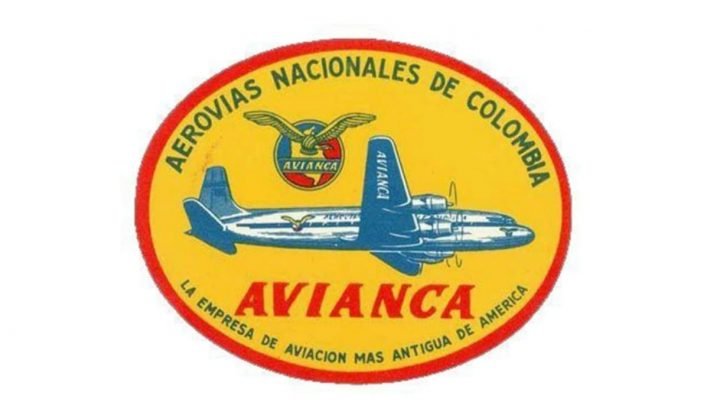
After merging with SACO, Avianca introduced its first logo under the new name. The bird motif remained but was redrawn with wings angled upward. Additional elements—including an aircraft silhouette, maps, and dense lettering—crowded the composition.
Although symbolically ambitious, this version proved visually overloaded, prompting a shift toward simplification.
1947–1976: Typographic Authority and Institutional Stability
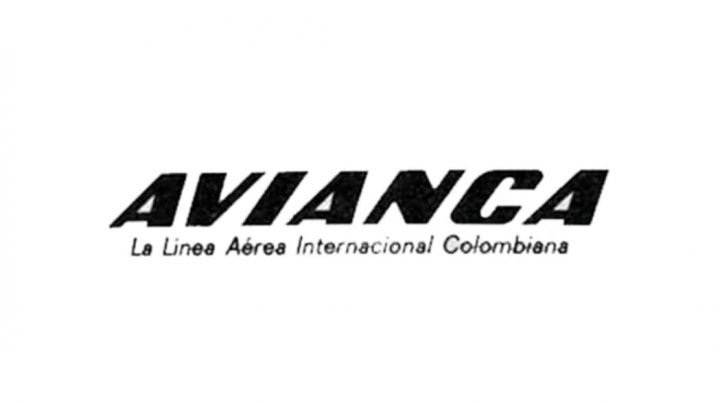
In 1947, Avianca stripped the logo down to typography. The emblematic bird disappeared, replaced by the company name and the inscription “La Línea Aérea Internacional Colombiana.” Italicized lettering preserved a sense of motion, while the removal of decorative elements restored legibility.
This period marked Avianca’s first mature corporate identity, focused on clarity and institutional presence.
1977–2002: Structure and Hierarchy
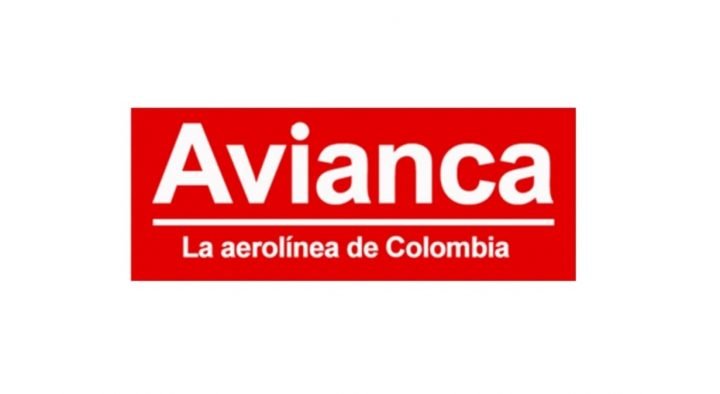
The 1977 redesign straightened the italics and introduced a horizontal divider separating “Avianca” from the tagline “La aerolínea de Colombia.” This added hierarchy and balance, aligning the brand with contemporary airline design practices.
The logo heritage during this era emphasized stability and national representation without excessive symbolism.
2002–2005: Alliance Identity and Visual Experimentation
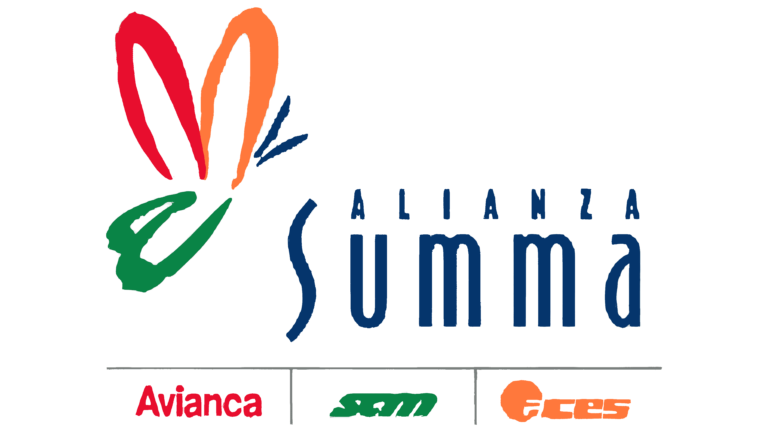
In 2002, Avianca joined the Summa Alliance and temporarily adopted a shared corporate logo. The design featured a multicolored butterfly-like emblem and multiple airline names. While visually striking, it diluted Avianca’s individual brand identity.
This phase illustrated the risks of alliance-driven branding in airline logo history.
2005–2007: Modern Rebirth and Abstract Motion
A major turning point came in 2005. Avianca introduced a bold geometric sans-serif wordmark accompanied by two semi-transparent, intersecting wave forms overlapping the capital “A.” Executed in deep blue, orange, burgundy, and yellow, the logo conveyed motion, connectivity, and renewal.
This redesign marked Avianca’s entry into modern airline branding.

2007–2013: Refinement and Confidence
The 2007 update refined letter contours and darkened the red tone. The abstract emblem’s lines became longer and more pronounced. The changes were subtle, reinforcing recognition while improving visual strength.

2013–2023: Red Minimalism and Brand Consolidation
In 2013, Avianca simplified further. The emblem moved to the left, and the color palette was reduced to red and white. This shift aligned the airline with global branding trends favoring minimalism and high contrast.
2023–Today: Friendliness and Contemporary Clarity
The 2023 redesign introduced a brighter red and converted the wordmark to lowercase. Retaining the same font family, the new logo feels more approachable and modern, signaling a customer-centric repositioning while preserving brand continuity.
Logo Symbolism: From Condor to Abstract Flight
The symbolism of the Avianca logo evolved dramatically over time. Early versions relied on literal representations of birds and landscapes, directly communicating flight and national pride. Modern iterations replaced literal imagery with abstract motion, using typography and color to convey speed, accessibility, and trust.
Red emerged as the dominant color, symbolizing energy, passion, and strength, while also enhancing visibility across digital platforms.
Typography and Color Philosophy
Avianca’s typographic evolution mirrors its corporate transformation. From decorative serif and italic scripts to clean, geometric sans-serif lettering, the brand steadily prioritized legibility and scalability.
The contemporary red-and-white palette reinforces confidence and immediacy, positioning Avianca as a modern Latin American carrier with global aspirations.
Avianca Logo History and Latin American Identity
The Avianca logo history tells a story of adaptation, resilience, and reinvention. From one of the world’s earliest airline emblems to a streamlined modern identity, Avianca’s logo heritage reflects both regional roots and global ambition.
Today, the Avianca logo stands as a testament to how a legacy airline can modernize without erasing its past, proving that logo heritage and contemporary branding can coexist successfully.
FAQ: Avianca Logo Meaning and History
What does the Avianca logo represent?
The logo represents flight, connectivity, and modern Latin American identity.
Why did Avianca remove bird imagery from its logo?
As branding evolved, abstract forms and typography provided greater versatility and global appeal.
When was the current Avianca logo introduced?
The latest redesign was introduced in 2023, featuring a brighter red and lowercase wordmark.
Is Avianca one of the oldest airlines in the world?
Yes, Avianca traces its origins to 1919, making it one of the world’s oldest airlines.