Pedigree Logo History: From a 1934 Chappie Dog Food Deal to a Global Brand
Pedigree started life selling dog food under a different name entirely, and the Pedigree brand most people recognize today didn’t reach American shelves until more than 50 years after Mars first entered the pet food business.
How did Pedigree actually start?
Mars Limited acquired Chappel Brothers of Manchester in 1934, a company that canned low-quality meat as dog food under the name “Chappie.” That brand continued in the UK market for decades. In 1957, Mars introduced the Pedigree name in Great Britain, building new dog food products on the Chappie formula. The Pedigree name comes from the Old French “pie de grue,” meaning “crane’s foot,” a reference to the branching lines of a family tree, chosen to suggest lineage and quality.
In the US, the path to the Pedigree name was different. Mars introduced separate dog food brands, Pal and Lassie, in the 1950s, then acquired Kal Kan Foods of Los Angeles in 1968. Kal Kan held the top-selling US dog food spot by 1998, but it wasn’t until 1988 that Kal Kan’s products were rebranded under the Pedigree name already used internationally, unifying the brand across markets. Pedigree’s product development has long drawn on research from the Waltham Petcare Science Institute, Mars’s in-house pet nutrition research center. In 2008, Mars established the Pedigree Foundation, which has raised more than $4 million for dog shelters and rescue organizations.
Logo evolution
1988-1992: the medal badge
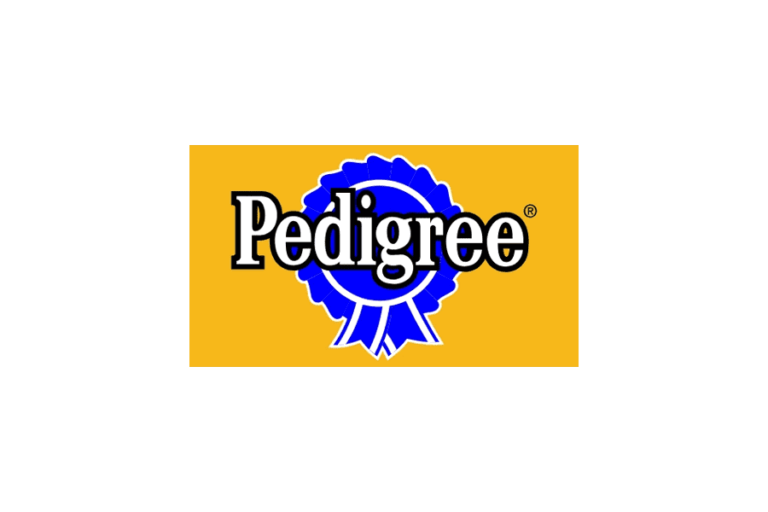
The first widely used international Pedigree logo paired a white serif wordmark outlined in black with a blue medal-ribbon badge, set against a gold background, establishing the medal motif that would anchor the brand’s identity for decades.
1992-2000: richer tones
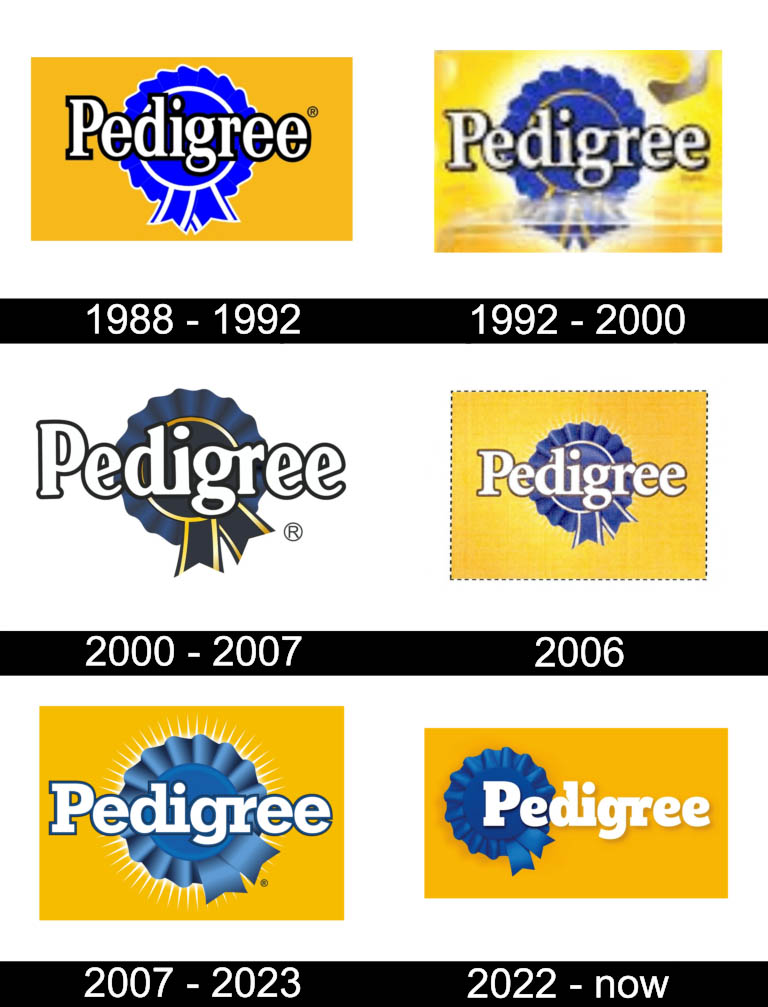
The 1992 update deepened the ribbon badge’s blue and gold detailing and brightened the yellow background, adding light effects for a more dimensional, premium look.
2000-2007: darker, more dramatic
The early 2000s version temporarily dropped the yellow background and darkened the ribbon badge with pronounced shadows and gold accents, while slanted “e” characters gave the wordmark subtle motion.
2006: a brief return
A 2006 version briefly moved back toward the 1992 look, replacing glow effects with light rays and reducing gold accents, serving as a bridge to the later redesign.
2007-2023: simplified and approachable
The 2007 redesign bolded the wordmark, streamlined the “g” tail, subtly linked several letters to suggest connection between pets, owners, and the brand, and replaced dark outlines with lighter blue trim for a brighter, more approachable feel.
2022-today: refined proportions
The current logo shifted the ribbon badge rightward to center the initial letter, replaced blue outlines with soft shadows, and removed decorative rays, while keeping the medal structure that has defined the brand since 1988.
Quick facts
| Mars acquires Chappel Brothers | 1934, Manchester, UK (“Chappie” brand) |
| Pedigree name introduced | 1957, Great Britain |
| Kal Kan Foods acquired | 1968, Los Angeles |
| US rebrand to Pedigree | 1988, from Kal Kan |
| Pedigree Foundation established | 2008; raised $4M+ for dog shelters |
Related reading
Further reading
FAQ
When did Pedigree start as a brand?
Mars introduced the Pedigree name in Great Britain in 1957, building on dog food it had sold since acquiring Chappel Brothers in 1934.
Why wasn’t Pedigree sold in the US earlier?
Mars sold separate US brands, including Kal Kan (acquired 1968), and didn’t rebrand Kal Kan’s products as Pedigree until 1988.
What does the Pedigree name mean?
It comes from the Old French “pie de grue,” or “crane’s foot,” a reference to the branching lines of a family tree, meant to suggest lineage and quality.
Who owns Pedigree?
Pedigree is owned by Mars, Incorporated, through its Mars Petcare division.