
Turkish Airlines Logo History: Meaning, Symbolism & Brand Heritage
In global aviation logo history, Turkish Airlines represents one of the most disciplined and symbol-driven identities developed by a national flag carrier. Founded in the early 1930s, the airline grew in parallel with the modern Turkish state, and its visual identity evolved accordingly—moving from institutional emblems toward a refined, abstract symbol capable of competing on a global stage.
The Turkish Airlines logo history follows a path comparable to the state-backed visual strategies explored in Emirates logo and the long-term symbolic continuity seen in Lufthansa logo history, while also sharing the bird-based abstraction logic found in Air France logo history. Across decades, Turkish Airlines refined a single symbolic idea—the bird in flight—into one of the most recognizable minimalist emblems in aviation branding.
Meaning and History: The Origin of the Turkish Airlines Logo
Turkish Airlines was established in 1933 as the national airline of Turkey, initially operating under strong governmental oversight. From the beginning, the airline’s identity was meant to project authority, reliability, and national progress. As Turkey modernized and expanded its international presence, Turkish Airlines followed suit, transforming from a regional carrier into one of the world’s most globally connected airlines.
The logo meaning of Turkish Airlines reflects this evolution. Early emblems emphasized state authority and institutional formality, while later designs gradually adopted abstraction and simplicity. This transition mirrored broader changes in aviation branding, where clarity, scalability, and symbolism replaced ornamentation.
Turkish Airlines Logo History Timeline
1933–1956: State Identity and Institutional Foundations
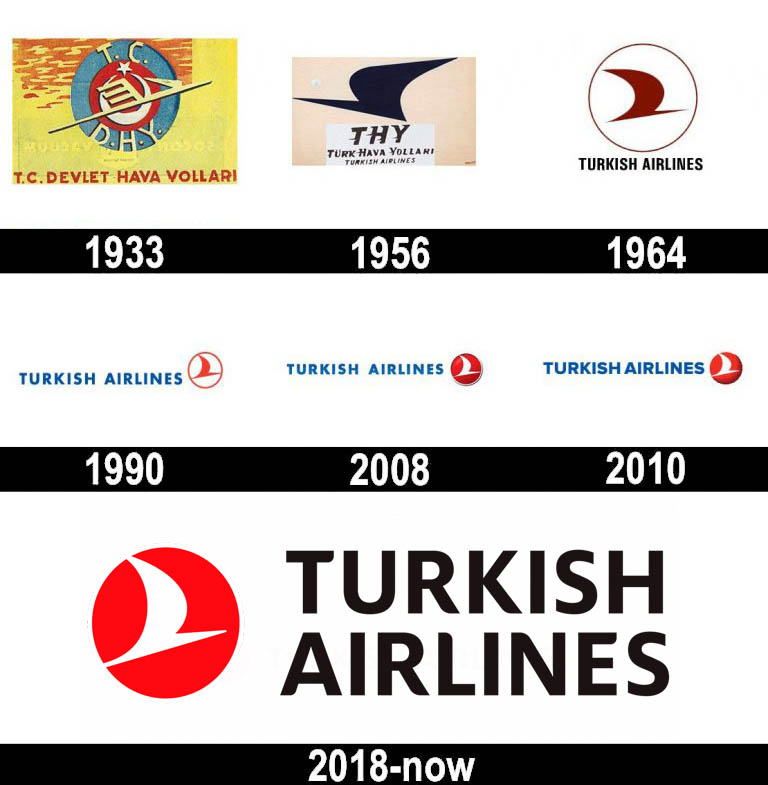
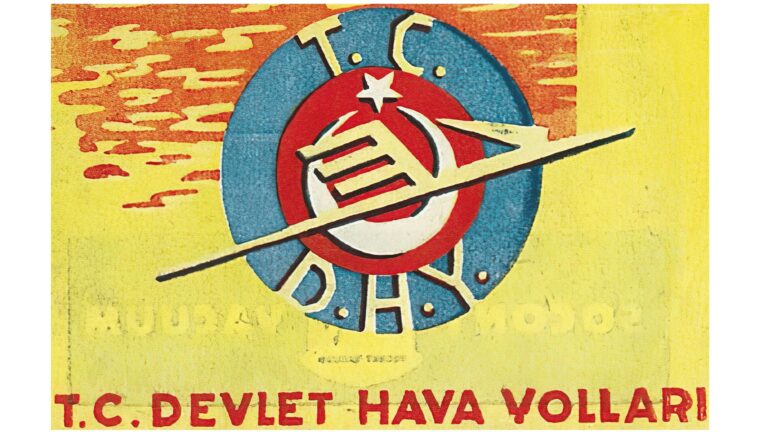
The first Turkish Airlines logo, introduced in 1933, reflected its origins as a state-run carrier. The emblem combined yellow, blue, and red, with a circular badge placed on a rectangular background. Along the bottom appeared the inscription “T.C. Devlet Hava Yollari” in uppercase lettering.
This early logo description prioritized official representation over brand personality, aligning the airline visually with governmental institutions rather than commercial enterprises.
1956–1964: The Birth of Abstract Flight Symbolism
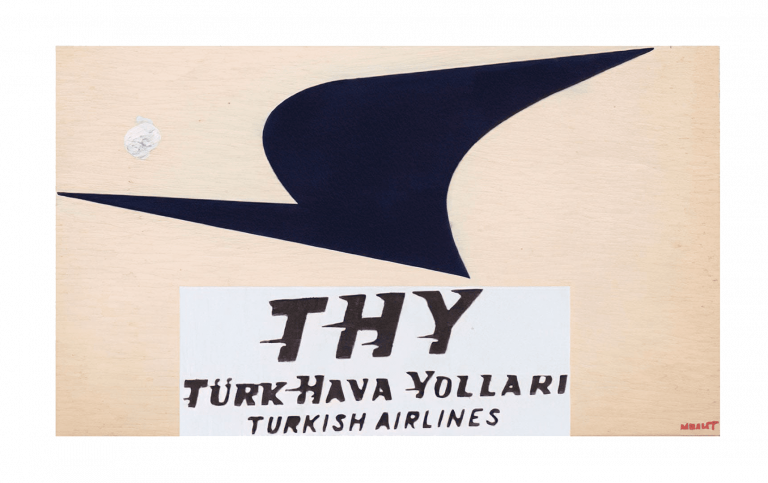
In 1956, Turkish Airlines introduced a radically different identity. The palette shifted to dark blue, cream, and warm pink tones, and the emblem became an abstract bird-like form with a thick, smooth wing facing left.
Typography appeared beneath the symbol in three lines, unified by the same blue tone. This redesign marked the first move toward abstraction, introducing the bird as a metaphor for flight, freedom, and progress.
1964–1990: Formalization and Global Orientation
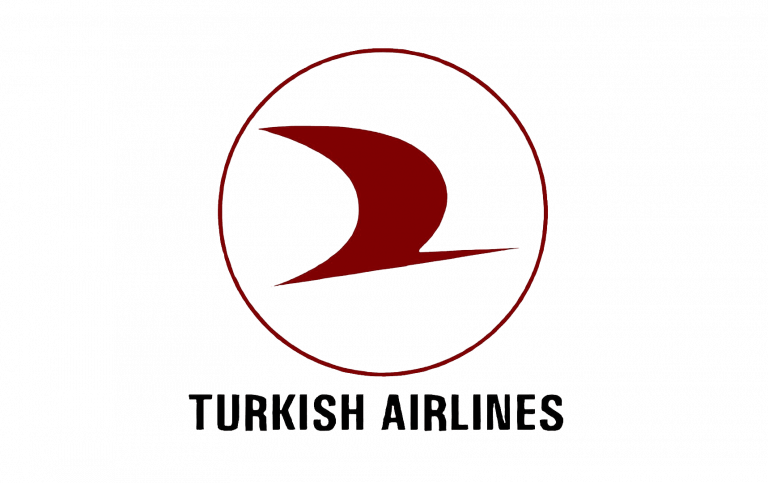
The 1964 redesign refined the abstract bird and placed it inside a thin circular frame. The bird now faced right, symbolizing forward motion. Burgundy and black replaced the previous palette, lending sophistication and seriousness.
The wordmark was shortened to “Turkish Airlines,” rendered in a narrow uppercase sans-serif. This version established a clearer international identity while retaining symbolic restraint.
1990–2008: Modernization and Color Confidence
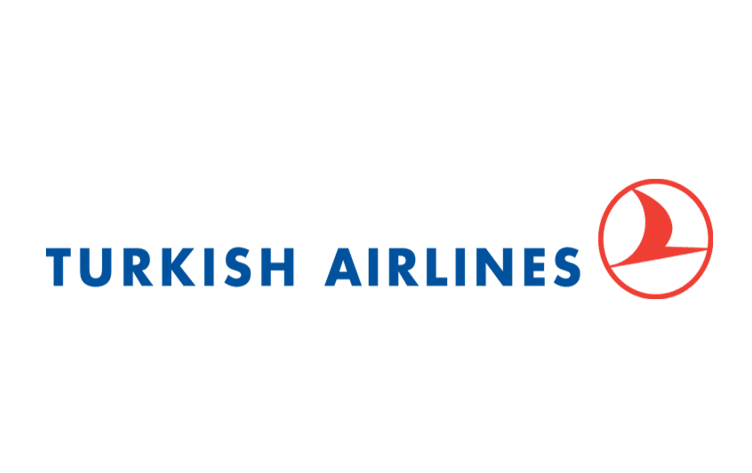
In 1990, the logotype was enlarged and repositioned to the left of the emblem. The color palette shifted again, adopting blue and scarlet red on a white background. The bird emblem became smaller and more refined, while typography gained sharper contours and improved spacing.
This update aligned Turkish Airlines with modern global carriers, enhancing legibility and brand confidence.
2008–2010: Dimensional Experimentation
The 2008 redesign briefly introduced three-dimensional effects. The emblem featured a white bird on a glossy red gradient background, while the lettering adopted blue gradients.
Although visually striking, this version was short-lived. It reflected the late-2000s trend toward depth and gloss before the industry returned to flat design principles.

2010–2018: Return to Minimalism
In 2010, Turkish Airlines reverted to a flat design approach. The red badge with a white bird remained, but circular framing was removed. Gradients were minimized, and the typography became solid and understated.
This iteration emphasized professionalism, scalability, and digital adaptability.

2018–Today: Pure Symbol and Global Clarity
The current Turkish Airlines logo represents the most distilled expression of its identity. The bird is now entirely abstract, composed of a single curved stroke forming the wing and a diagonal bar forming the body, directed upward.
The wordmark appears in a clean sans-serif typeface with classic proportions. This version embodies clarity, motion, and modernity, positioning Turkish Airlines among the most contemporary global brands.
Logo Symbolism: The Abstract Bird and Upward Motion
The symbolism of the Turkish Airlines logo centers on the bird, one of the oldest metaphors for flight. Unlike literal depictions, this bird is entirely abstract, allowing it to transcend cultural boundaries while remaining meaningful.
The upward orientation of the body suggests aspiration, growth, and forward momentum. The absence of detail ensures timelessness, preventing the logo from becoming visually dated.
Typography and Color Philosophy
Typography in the Turkish Airlines logo is bold, uppercase, and geometric, conveying stability and authority. Subtle rounding softens the structure, balancing strength with approachability.
The color palette—red, white, and black—is both national and universal. Red conveys passion and energy, white suggests clarity and transparency, and black adds seriousness and balance. Together, they reinforce trust and confidence.
Turkish Airlines Logo History and Symbolic Precision
The Turkish Airlines logo history demonstrates how abstraction and discipline can create one of the most enduring identities in aviation. By refining a single symbolic idea over decades, the airline achieved a logo heritage defined by clarity, motion, and international relevance.
Today, the Turkish Airlines logo stands as a masterclass in symbolic reduction—proof that a well-crafted emblem can communicate national pride and global ambition without excess.
FAQ: Turkish Airlines Logo Meaning and History
What does the Turkish Airlines logo represent?
The logo represents flight, progress, and aspiration through an abstract bird symbol.
Why is the Turkish Airlines bird abstract?
Abstraction ensures timelessness, scalability, and universal recognition across cultures.
When was the current Turkish Airlines logo introduced?
The current minimalist emblem was introduced in 2018.
What do the colors in the Turkish Airlines logo symbolize?
Red symbolizes passion and power, white represents clarity, and black conveys authority and stability.