Emirates Logo History: Meaning, Symbolism & Brand Heritage
In modern aviation logo history, Emirates represents one of the clearest examples of a visual identity built to project authority, cultural confidence, and global ambition from the very beginning. Unlike legacy carriers whose logos evolved slowly over decades, Emirates entered the industry with a carefully constructed identity designed to elevate Dubai as an international aviation hub almost overnight.
The Emirates logo history follows a path similar in strategic intent to Qatar Airways logo and the restrained state symbolism seen in Etihad Airways logo history, yet it differs in execution. Emirates chose language, calligraphy, and typographic elegance as its primary branding tools, avoiding pictorial emblems altogether. This decision anchored the brand in Middle Eastern heritage while ensuring global legibility and prestige.
Meaning and History: The Origin of the Emirates Logo
Emirates Airline began operations in 1985 with only two leased aircraft and an ambitious mandate: to connect Dubai with the world and position the emirate as a global crossroads. From its inception, the airline’s visual identity was designed not merely to identify, but to represent sovereignty, refinement, and cultural pride.
The logo meaning of Emirates is deeply tied to language. Arabic calligraphy dominates the composition, affirming national identity and heritage, while the English wordmark ensures accessibility to an international audience. This bilingual approach was intentional, reflecting Emirates’ dual mission as both a national symbol and a global airline.
Emirates Logo History Timeline
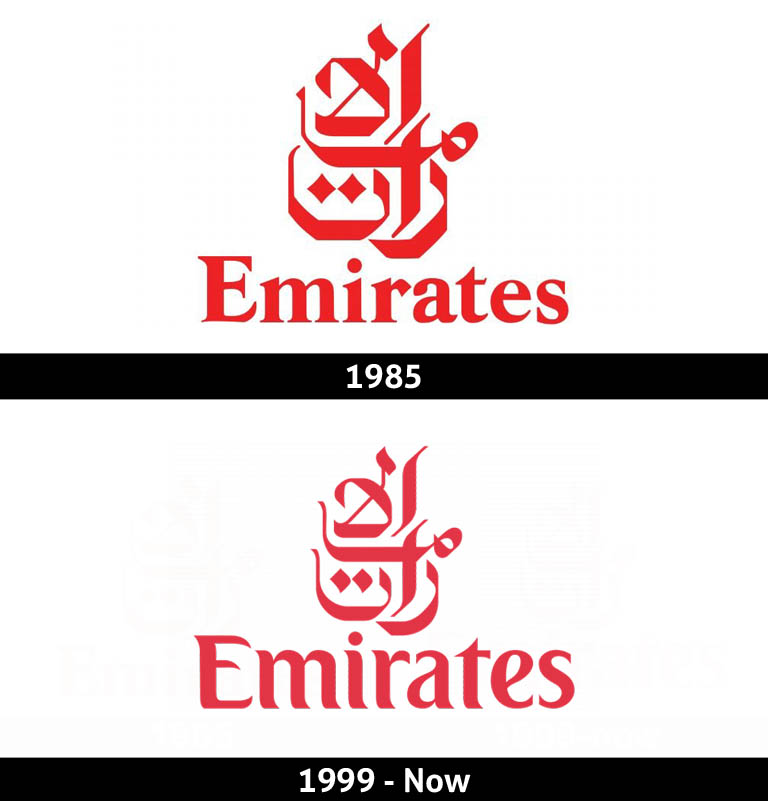
1985–1999: Cultural Authority and Foundational Identity
The original Emirates logo, introduced in 1985, was developed by the British design firm Negus & Negus. The design centered on the airline’s name rendered in refined Arabic calligraphy, positioned above the English wordmark.
Both scripts were executed with elegance and clarity, emphasizing balance rather than hierarchy. The Arabic lettering carried visual authority, while the English version reinforced global reach. This logo description avoided decorative symbols, relying entirely on typographic presence to convey strength and sophistication.
Aircraft livery complemented the logo by incorporating the UAE flag across the tail, visually reinforcing national affiliation without crowding the wordmark itself.
1999–Today: Refinement, Luxury, and Subtle Dynamism
The 1999 redesign retained the same core structure, making the update almost imperceptible at first glance. However, closer comparison reveals a refined and more luxurious execution.
Letterforms became lighter and more elongated, with sharper, more expressive terminals. The serif treatment grew more creative, particularly noticeable in the distinctive “E,” which features a single serif and extended ends that suggest forward motion. These subtle changes introduced dynamism without disrupting brand recognition.
This restrained evolution solidified Emirates’ logo heritage as one of continuity and polish, aligning perfectly with the airline’s premium positioning.
Logo Symbolism: Language as Identity
The symbolism of the Emirates logo lies not in imagery, but in script. Arabic calligraphy represents tradition, authority, and cultural continuity, while the English typography signals openness and internationalism.
By avoiding animals, crests, or abstract marks, Emirates positioned itself above trends, presenting the brand as timeless rather than fashionable. The bilingual composition functions as a bridge between cultures, reinforcing the airline’s role as a global connector.
Typography and Color Philosophy
Typography is the defining element of the Emirates visual identity. The custom serif wordmark combines curved strokes with flared, sharp endings, balancing elegance with strength. The letterforms appear stable yet fluid, suggesting confidence and controlled motion.
The color palette centers on a deep, refined shade of red. Slightly leaning toward pink, this red conveys luxury, power, and assurance rather than aggression. Set against white, it maintains clarity and authority across all applications, from aircraft fuselages to digital platforms.
Emirates Logo History and Global Prestige
The Emirates logo history demonstrates how typographic discipline and cultural confidence can create one of the most recognizable identities in global aviation. Rather than reinventing itself, Emirates refined its original vision, allowing recognition and prestige to compound over time.
Today, the Emirates logo stands as a benchmark of logo heritage, proving that language, proportion, and restraint can communicate power more effectively than overt symbolism. It is an identity built not on trends, but on timeless authority.
FAQ: Emirates Logo Meaning and History
What does the Emirates logo represent?
The logo represents cultural heritage, authority, and global ambition through bilingual typography.
Why does Emirates use Arabic calligraphy in its logo?
Arabic calligraphy reflects the airline’s origin, national identity, and cultural pride.
Has the Emirates logo changed over time?
The logo was refined in 1999, with lighter, more elegant letterforms, while preserving its original structure.
What does the red color in the Emirates logo symbolize?
The red symbolizes luxury, power, confidence, and premium service quality.