Qantas Logo History: Meaning, Symbolism & Brand Heritage

Within global aviation logo history, Qantas occupies a position defined by longevity, national symbolism, and disciplined visual evolution. Founded at the dawn of commercial aviation, Qantas developed alongside Australia’s geographic and economic expansion, becoming not only the country’s flag carrier but also one of the most trusted airline brands in the world. Its visual identity reflects this trajectory, evolving from utilitarian typography to one of the most iconic national symbols in aviation branding.
The Qantas logo history reveals how symbolism can mature without losing recognizability. Much like the royal continuity explored in KLM logo and the animal-based national symbolism analyzed in Lufthansa logo, Qantas built its identity around a culturally resonant emblem. Over more than a century, the airline refined this symbol to match technological progress, global ambition, and changing design standards, while preserving its emotional connection to Australia.
Meaning and History: The Origin of the Qantas Logo
Qantas was founded on November 16, 1920, under the name Queensland and Northern Territory Aerial Services Limited. The acronym QANTAS soon became the airline’s official name, reflecting both regional identity and operational clarity. From its earliest years, the airline emphasized safety, endurance, and national representation, values that would become central to its logo meaning.
The visual identity of Qantas evolved in direct response to the airline’s expansion beyond domestic routes. As Qantas transitioned from regional operations to long-haul international flights, its logo heritage shifted from descriptive insignia to symbolic storytelling. The kangaroo, a universally recognized emblem of Australia, became the core visual element, representing movement, resilience, and national pride.
Qantas Logo History Timeline
1920–1930: Typographic Origins and Functional Identity
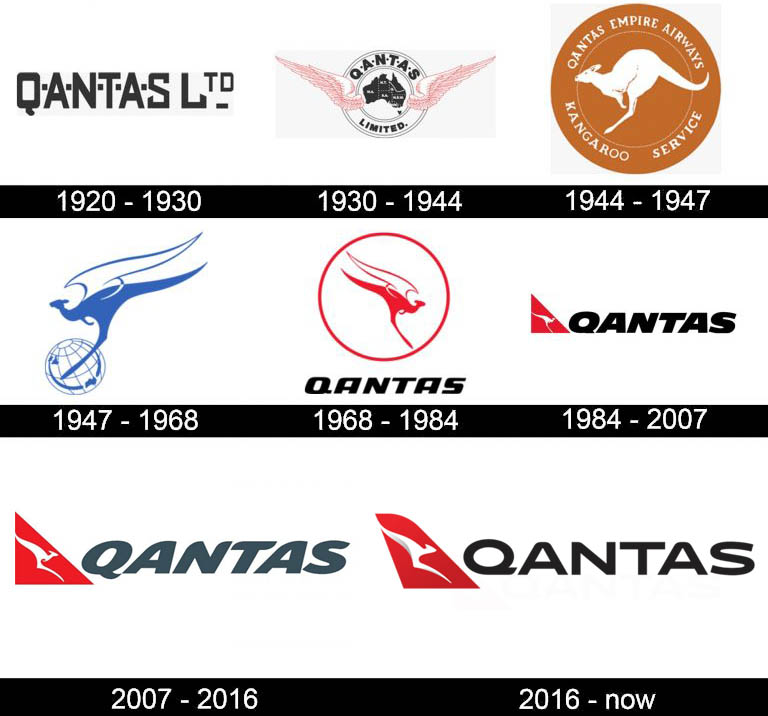
The first Qantas logo was purely typographic. It featured a capitalized wordmark in a custom sans-serif typeface, with each letter separated by small solid squares. Thick strokes and sharp angles conveyed technical precision and modernity, reflecting early aviation’s mechanical character.
This logo description emphasized clarity and practicality, appropriate for a young airline focused on establishing legitimacy rather than symbolism.

1930–1944: Geographic Identity and Winged Expansion
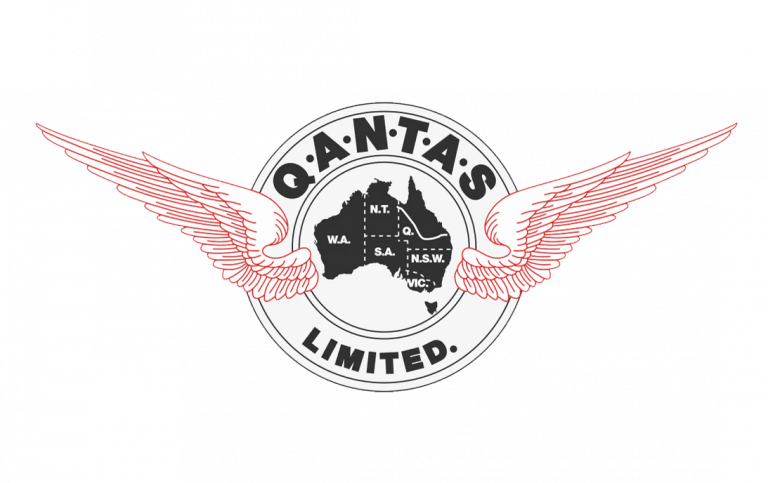
In 1930, Qantas adopted a far more illustrative emblem. A black outline of the Australian continent was enclosed within a double circular frame, flanked by detailed red wings. The wordmark was placed between the circles, following their perimeter.
This design explicitly linked the airline to Australia’s geography while introducing wings as a metaphor for expansion. The contrast between delicate wings and a solid continental form balanced elegance with strength.
1944–1947: The Kangaroo as Cultural Emblem
In 1944, the kangaroo appeared for the first time, inspired by its depiction on the Australian one-penny coin. The animal was placed inside a camel-brown circle, facing left, with the white Qantas wordmark around the perimeter.
This emblem marked a pivotal moment in Qantas logo symbolism. The kangaroo introduced warmth, approachability, and unmistakable national identity, transforming the logo from a corporate badge into a cultural icon.
1947–1968: The Birth of the Flying Kangaroo
The iconic Flying Kangaroo was introduced in 1947. The white kangaroo, enlarged and dynamic, appeared atop a blue globe, with elongated wings extending to the right. This composition symbolized global reach while maintaining national identity.
This version became the conceptual foundation for all future Qantas logos and remains one of the most recognizable airline symbols ever created.

1968–1984: Simplification and Corporate Strength
In 1968, the globe was removed. The Flying Kangaroo faced right and was enclosed within a red circular frame. Beneath it appeared a bold black sans-serif wordmark.
The new red, white, and black palette conveyed confidence, passion, and authority, aligning with Qantas’ position as a mature international airline.
1984–2007: Modern Geometry and Brand Dominance
The 1984 redesign removed the wings entirely. The kangaroo was drawn in white and placed inside a red triangular form reminiscent of an aircraft tail. The wordmark grew larger and moved to the right, becoming the dominant element.
Slight italicization softened the bold sans-serif type, adding elegance while preserving strength. This version marked Qantas’ transition into a globally competitive brand.
2007–2016: Refinement and Premium Positioning
In 2007, the logo was redesigned by Hulsbosch. The kangaroo’s lines became more elongated and fluid, while the typeface changed to a smooth, curved sans-serif. Black was replaced with gray, softening the overall tone.
This update introduced a more premium and refined aesthetic, reflecting service quality and brand maturity.
2016–Today: Contemporary Heritage and Digital Adaptation
The 2016 redesign, created with Houston Group, rounded the triangular form and introduced subtle gradients. The wordmark returned to black and adopted a custom modern sans-serif typeface with smooth, expressive contours.
This version balances heritage and modernity, ensuring clarity across digital platforms while preserving the emotional power of the Flying Kangaroo.
Logo Symbolism: The Kangaroo and National Identity
The symbolism of the Qantas logo is inseparable from the kangaroo. As a national emblem, it represents movement, endurance, and forward progress. Unlike birds or abstract forms, the kangaroo is uniquely Australian, anchoring the brand culturally while remaining globally recognizable.
Color plays a supporting role. Red conveys strength and ambition, white suggests clarity and safety, and black adds authority. Together, they reinforce Qantas’ positioning as both a national institution and a world-class airline.
Qantas Logo History and Enduring Iconography
The Qantas logo history illustrates how a brand can evolve visually while preserving emotional continuity. Across more than a century, Qantas refined its identity to reflect technological progress, global expansion, and design evolution, without abandoning its symbolic core.
Today, the Qantas logo stands as one of the strongest examples of logo heritage in aviation. The Flying Kangaroo is not merely a logo, but a cultural symbol that communicates safety, national pride, and enduring trust.
FAQ: Qantas Logo Meaning and History
What does the Qantas logo represent?
The logo represents Australian identity, progress, and reliability through the Flying Kangaroo symbol.
Why does Qantas use a kangaroo in its logo?
The kangaroo is Australia’s most recognizable national symbol, embodying movement and resilience.
Is Qantas one of the oldest airlines in the world?
Yes, Qantas is the third-oldest airline still operating, founded in 1920.
Has the Qantas logo changed significantly over time?
It evolved through refinement, but the Flying Kangaroo has remained the central element since 1947.