
Wizz Air Logo History: Meaning, Symbolism & Brand Heritage

Within contemporary European airlines logo history, Wizz Air stands out as one of the most visually distinctive low-cost carriers to emerge in the early 21st century. Founded in 2003, the airline entered a highly competitive market dominated by conservative branding and restrained color palettes. From the beginning, Wizz Air deliberately chose a radically different visual language, positioning itself as youthful, energetic, and unconventional.
The Wizz Air logo history is notable not for frequent redesigns, but for the strength and longevity of its original concept. While many airlines periodically reinvent their identities to signal modernization, Wizz Air has relied on refinement rather than reinvention. This strategy places the brand alongside carriers such as Ryanair logo history and easyJet logo heritage, which similarly built long-term recognition through consistency and bold chromatic choices.
Meaning and History: The Origin of the Wizz Air Logo
Wizz Air was founded in 2003 by a group of aviation professionals led by József Váradi, with a clear mission to serve Central and Eastern Europe through affordable, point-to-point air travel. The airline launched its first flight in 2004 from Katowice, Poland, and quickly expanded its network across the region.
From a branding perspective, Wizz Air rejected traditional airline symbolism almost entirely. The logo meaning was never intended to convey national identity, heritage emblems, or technical authority. Instead, the visual identity focused on emotional differentiation. Bright colors, exaggerated letterforms, and playful composition reflected the airline’s promise of accessible travel and a break from rigid legacy-carrier conventions. This approach became the cornerstone of Wizz Air’s logo heritage.
Wizz Air Logo History Timeline
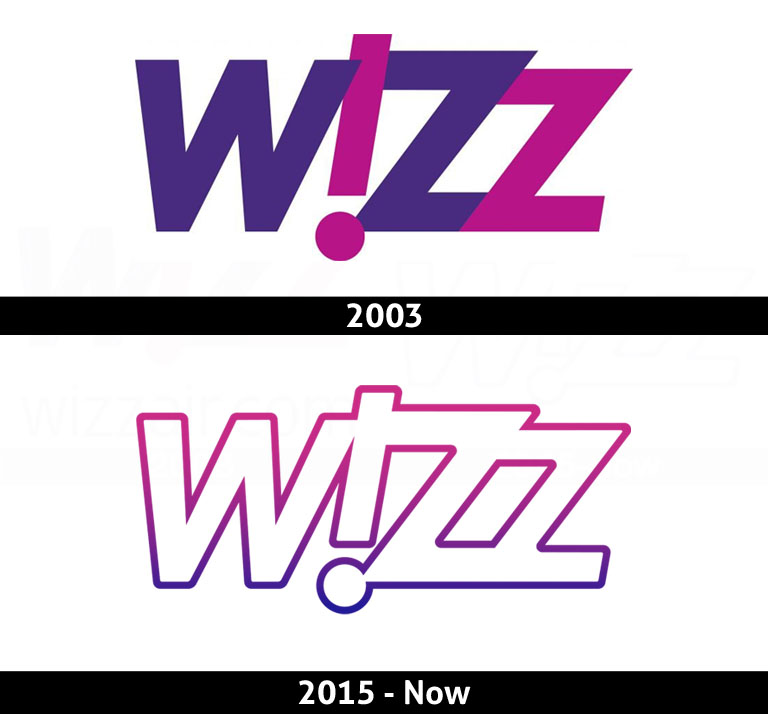
2003–2015: Playful Typography and Digital Identity
The original Wizz Air logo introduced in 2003 featured a highly stylized wordmark reading “W!ZZ,” rendered in vibrant purple and magenta tones. The letters varied in size and partially overlapped, creating a sense of motion and spontaneity. An exclamation mark replaced the letter “I,” reinforcing the playful and expressive character of the brand.
Below the primary wordmark, the airline’s website address was included, reflecting early-2000s digital branding practices. This logo description emphasized youthfulness and accessibility, intentionally distancing Wizz Air from the visual seriousness traditionally associated with aviation.
2015–Today: Refinement and Brand Maturity
In 2015, Wizz Air introduced a subtle but important update to its visual identity. The website address was removed, signaling increased brand confidence and recognition. The internal fill of the letterforms became white, while the outlines retained the distinctive magenta and purple color combination.
Later refinements introduced variations for digital environments, including blue letterforms with white outlines used on the official website. Despite these adjustments, the fundamental structure of the logo remained unchanged. This continuity reinforced brand recognition while allowing flexibility across platforms.
Logo Symbolism: Energy, Youth, and Accessibility
The symbolism of the Wizz Air logo is rooted primarily in color and typography. Pink and purple gradients evoke energy, creativity, and joy, qualities rarely emphasized in airline branding. The overlapping letters and irregular proportions suggest movement and informality, aligning with the airline’s low-cost, customer-friendly positioning.
Rather than communicating safety and authority through traditional cues, Wizz Air’s logo symbolism prioritizes emotional engagement and memorability. This approach reflects a broader shift in budget airline branding, where differentiation often relies on personality rather than prestige.
Wizz Air Logo History and Visual Consistency
The Wizz Air logo history demonstrates how a strong initial concept can sustain a brand for decades with minimal modification. Since its founding, the airline has relied on visual consistency to build recognition across Europe, resisting the temptation to conform to more conservative industry standards.
Today, the Wizz Air logo stands as a clear expression of the brand’s core values: affordability, accessibility, and modernity. Its bold colors and expressive typography continue to distinguish the airline within European aviation, proving that logo heritage can be built not only on tradition, but also on confidence and clarity of purpose.
FAQ: Wizz Air Logo Meaning and History
What does the Wizz Air logo represent?
The logo represents energy, creativity, and accessibility through expressive typography and vibrant colors.
Why does the Wizz Air logo use pink and purple?
These colors convey youthfulness and joy, helping the airline stand out from more conservative competitors.
Has the Wizz Air logo changed often?
No, the logo has undergone only minor refinements since 2003, maintaining strong visual continuity.
What is unique about the Wizz Air typography?
The custom typeface features overlapping, exaggerated letterforms that emphasize motion and personality.