Trivago Logo History: Meaning, Symbolism & Brand Heritage
In the highly competitive world of online travel, clarity and instant recognition are not optional—they are essential. Trivago entered the global market with a clear promise: to simplify hotel search by comparing prices across hundreds of booking platforms in one place. From its early days in Germany to its acquisition by Expedia, Trivago positioned itself as a neutral, data-driven guide in an industry often clouded by complexity and hidden costs.
This positioning is reflected directly in the Trivago logo history. Unlike many travel brands that rely on icons, landscapes, or abstract symbols, Trivago chose a text-based identity from the very beginning. Its logo heritage is built almost entirely on typography and color, signaling transparency, accessibility, and speed. A similar philosophy can be observed in Booking.com logo history and Hotels.com logo history, where wordmarks dominate to prioritize usability and trust over visual ornamentation.
As part of the broader travel platform logo heritage, Trivago stands out for its consistency. While the logo evolved in structure and refinement, its core visual language—lowercase lettering and segmented color logic—has remained recognizable for nearly two decades.
Meaning and History: The Origin of the Trivago Identity
Trivago was founded in 2005 in Düsseldorf, Germany, at a time when online hotel search was fragmented and inefficient. The founders envisioned a meta-search engine that would aggregate hotel offers and allow users to compare prices objectively. This mission shaped the brand’s identity from the start.
The early logo meaning focused on approachability and functionality rather than aspiration. Trivago was not selling dreams or destinations; it was selling information. As the platform expanded internationally and became part of Expedia Group, the logo evolved to support global scalability while preserving its original intent.
Throughout its evolution, Trivago’s visual identity avoided drastic reinvention. Each redesign refined legibility, balance, and color harmony, reinforcing the brand’s role as a practical, trustworthy tool rather than an emotional travel brand.
Logo Symbolism: Simplicity, Segmentation, and Search Logic
Trivago logo symbolism is subtle but deliberate. The absence of pictorial elements places full emphasis on the brand name, reinforcing memorability and directness. The segmented color treatment of the wordmark reflects the platform’s function: comparison.
By visually separating syllables through color, the logo mirrors the act of breaking down information into comparable parts. This design logic aligns perfectly with Trivago’s role as a meta-search engine. Rather than guiding users emotionally, the logo guides them cognitively.
Lowercase typography enhances accessibility and neutrality, avoiding hierarchy or dominance. The brand speaks as a facilitator, not an authority, which supports user trust in impartial search results.
Trivago Logo History Timeline
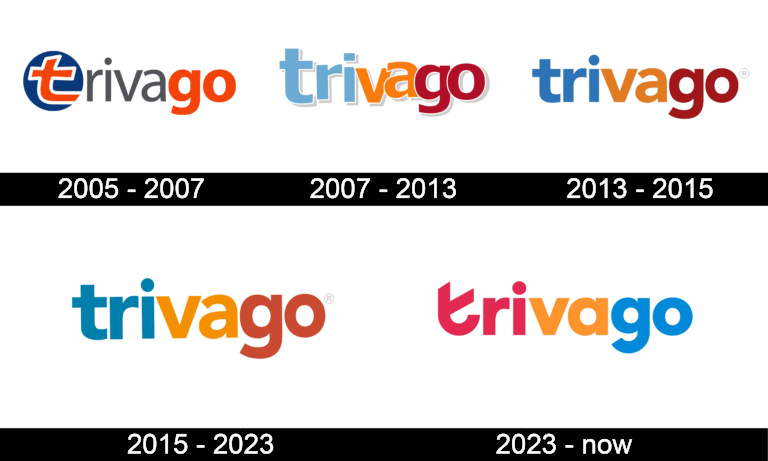
2005–2007: Experimental Wordmark with Icon Accent
The original Trivago logo introduced in 2005 featured a lowercase wordmark with a stylized “T” placed inside a blue circle. The “T,” rendered in orange and outlined in white, acted as a visual anchor. The remaining letters were split into dark gray “riva” and bold orange “go,” establishing the brand’s early multi-color identity.
This version emphasized experimentation and visibility during Trivago’s startup phase.
2007–2013: Color-Driven Identity Without Icon
In 2007, the circular emblem was removed, and the wordmark became the sole visual element. The lowercase letters overlapped slightly and featured a white outline with a soft gray shadow, adding depth.
Each segment of the name adopted a distinct color: light blue for “tri,” yellow for “va,” and red for “go.” This design increased visual energy and reflected Trivago’s growing confidence in brand recognition.
2013–2015: Structural Simplification
The 2013 update brought a more restrained approach. The wordmark remained lowercase but became more linear and stable. Blue and red dominated the palette, while letterforms were refined for better digital legibility.
This iteration marked Trivago’s transition from experimental branding to a more professional global platform.
2015–2023: Consolidation and Maturity
In 2015, the logo was redesigned again, keeping the core colors but aligning all letters on a single baseline. The typography became bolder and cleaner, reducing visual noise and improving scalability across devices.
This version is often considered the most balanced expression of Trivago’s logo heritage, combining recognizability with modern simplicity.
2023–Today: Minimalism with Color Logic Preserved
The current Trivago logo retains the lowercase wordmark and segmented color approach but further refines tone and contrast. Red, orange, and light blue are used more deliberately, creating a confident yet calm visual presence.
The typography is modern sans-serif, stable, and neutral, reinforcing Trivago’s position as a utility-first travel platform.
Typography and Color: Function Over Decoration
Trivago’s typeface is a bold, modern sans-serif, closely resembling Avenir Pro 95 Black. Its clean geometry ensures readability across languages and screen sizes.
Color plays a strategic role in Trivago logo meaning. Red conveys urgency and action, orange adds warmth and accessibility, and blue signals trust and reliability. Together, they form a balanced palette that communicates efficiency without emotional overload.
Corporate Logo: Abstract Motion and Brand Extension
The corporate Trivago logo introduces an abstract ring-like emblem rendered in the same red, orange, and blue palette. The open contour and slight rotation suggest motion, continuity, and global reach.
Placed above a neutral lowercase wordmark, this version is used for corporate communications and investor-facing materials, extending the brand’s visual system without diluting the core identity.
Trivago Logo Heritage and the Power of Clarity
The Trivago logo history demonstrates how restraint and consistency can outperform complexity in digital-first industries. By relying on typography, color segmentation, and incremental refinement, Trivago built a logo heritage that mirrors its product philosophy: simple, comparative, and transparent.
Within the broader context of logo heritage in travel and hospitality, Trivago stands as a clear example of how logo meaning and symbolism can emerge not from icons or metaphors, but from structure and logic.
FAQ: Trivago Logo Meaning and History
What does the Trivago logo represent?
The Trivago logo represents comparison, transparency, and accessibility through a clean lowercase wordmark and segmented color design.
Why does Trivago use multiple colors in its logo?
The colors visually separate parts of the name, reflecting the platform’s function of comparing multiple hotel offers.
Has the Trivago logo changed significantly over time?
The logo evolved gradually, refining typography and color balance, while preserving its core lowercase, text-based identity.
What typeface is used in the Trivago logo?
The logo uses a bold modern sans-serif typeface similar to Avenir Pro 95 Black.