
Affirm Logo History: Meaning, Symbolism & Brand Heritage

Affirm represents a new generation of financial brands built not on institutional legacy, but on transparency and user trust. Founded in Silicon Valley during a period of growing dissatisfaction with traditional credit systems, the company positioned itself as an alternative to opaque interest rates and hidden fees. Its logo history reflects this philosophy clearly, relying on openness, simplicity, and visual clarity rather than traditional banking symbolism.
In the same way that modern fintech identities such as Klarna logo history or Afterpay logo history departed from classical financial aesthetics, Affirm’s visual language embraces approachability and digital-native design. Its logo heritage is closely tied to its mission: making consumer finance understandable, predictable, and fair.
Meaning and History: The Origin of the Affirm Identity
Affirm was founded in 2012 in San Francisco by Max Levchin, Nathan Gettings, Jeffrey Kaditz, and Alex Rampell. Conceived as a response to the complexity and lack of transparency in consumer credit, the platform introduced point-of-sale financing with clear, upfront terms. From its earliest days, Affirm’s identity centered on trust through clarity, a principle that directly shaped its logo meaning.
Rather than borrowing visual cues from banks or credit card companies, Affirm adopted a clean, contemporary aesthetic aligned with digital products. The name itself is declarative and positive, suggesting reassurance, confirmation, and confidence. This linguistic simplicity carried directly into the logo description, where minimal elements communicate purpose without distraction.
As the company expanded its partnerships with major retailers and scaled globally, the visual identity evolved to reinforce credibility while preserving its original optimism and accessibility.
Logo Symbolism: Positivity, Balance, and Transparency
Affirm logo symbolism is intentionally restrained. There are no abstract financial icons, shields, or emblems of authority. Instead, symbolism is embedded within typography and subtle graphic gestures. The mirrored double “f” characters act as a central visual device, suggesting balance, symmetry, and connection between the consumer and the merchant.
The arc introduced in the later redesign functions as a conceptual bridge and a protective element. Positioned above the wordmark, it implies guidance and support, reinforcing Affirm’s role as a facilitator rather than a lender imposing conditions. This approach aligns closely with the brand’s emphasis on transparent terms and user empowerment.
Color also plays a symbolic role. Blue, widely associated with trust and reliability, reinforces financial confidence without appearing institutional. The shift from bright cyan to a more restrained palette reflects Affirm’s maturation within the fintech ecosystem.
Affirm Logo History Timeline
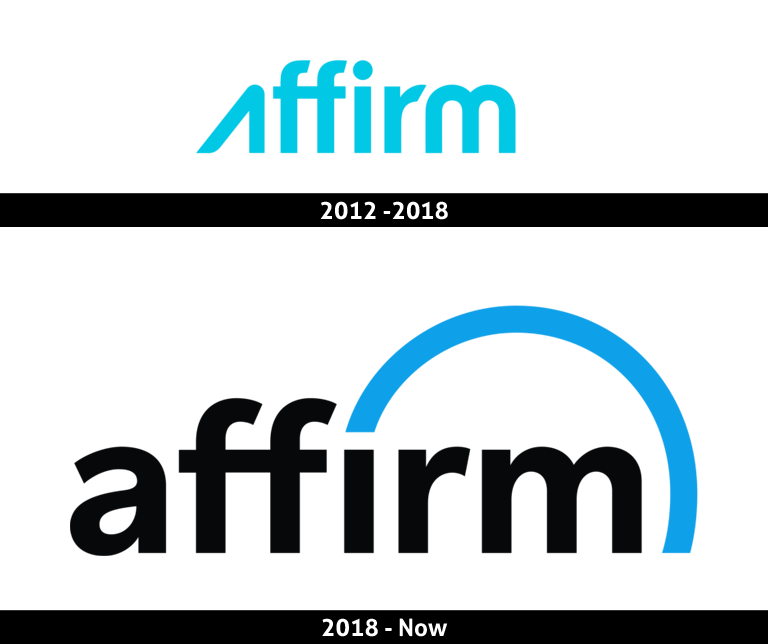
2012–2018: Digital Optimism and Fintech Accessibility
The original Affirm logo featured a bright cyan wordmark set in a bold, sans-serif typeface. The lowercase lettering reinforced approachability, while the mirrored double “f” characters created a distinctive visual rhythm. This symmetry subtly suggested partnership and balance, aligning with Affirm’s buy-now-pay-later model.
The color choice conveyed innovation and openness, positioning Affirm firmly within the emerging fintech landscape. The logo was optimized for digital environments, performing well across mobile interfaces and online checkout flows.
2018–Present: Visual Maturity and Structural Confidence
In 2018, Affirm introduced a refined logo that emphasized strength and long-term reliability. The wordmark shifted to black, increasing contrast and legibility across platforms. Above it, a blue arc was added, introducing a new symbolic layer.
This arc functions as both a visual anchor and a metaphor for support and protection. While the mirrored “f” structure remained intact, the overall composition gained a sense of grounded stability. The updated logo description reflects Affirm’s transition from disruptive startup to established financial platform.
Typography and Color: Digital-First Discipline
Affirm’s typography is custom and purpose-driven. Rounded sans-serif letterforms ensure clarity at small sizes while maintaining a friendly tone. The lowercase structure softens the brand voice, distancing it from traditional financial authority.
Color usage is restrained and intentional. Blue remains the defining accent, symbolizing trust and responsibility, while black and white provide neutrality and focus. This disciplined palette enhances recognition and supports Affirm’s logo heritage as a digital-native financial brand.
Affirm Logo Heritage and Modern Financial Trust
The Affirm logo history demonstrates how fintech brands can establish credibility without relying on centuries-old symbols. By embedding meaning into typography and subtle graphic elements, Affirm created an identity aligned with transparency and user empowerment.
Within the broader context of fintech logo heritage, Affirm stands out for its clarity-driven approach. Its logo meaning evolved through refinement rather than reinvention, mirroring the company’s growth while preserving its core values. The result is a visual identity that feels modern, trustworthy, and purpose-built for contemporary consumer finance.
FAQ: Affirm Logo Meaning and History
What does the Affirm logo represent?
The logo represents transparency, balance, and consumer-friendly financial support through minimal, approachable design.
Why are the double “f” letters mirrored in the Affirm logo?
The mirrored letters symbolize balance, connection, and partnership between consumers and merchants.
What does the arc above the Affirm wordmark mean?
The arc represents support, protection, and guidance, reinforcing Affirm’s role as a facilitator of responsible payments.
Has the Affirm logo changed over time?
Yes, the logo evolved in 2018 to emphasize maturity and stability while preserving its original structure.