
DAZN Logo History: Meaning, Symbolism & Brand Heritage
DAZN emerged during a decisive shift in how global audiences consume live sports. As traditional broadcasters struggled to adapt to on-demand viewing and mobile-first habits, DAZN positioned itself as a digital-native alternative built entirely around streaming. From its earliest days, the platform emphasized accessibility, flexibility, and international reach, offering fans live and on-demand sports content without long-term contracts. This disruptive positioning required a visual identity that felt modern, authoritative, and instantly recognizable across screens.
The DAZN logo history reflects the mindset of a tech-driven media brand rather than a legacy broadcaster. Instead of relying on illustrative symbols tied to specific sports, DAZN adopted a typographic and structural approach aligned with digital platforms. Similar strategies can be observed in the evolution of the ESPN logo history and the platform-first clarity seen in the Netflix logo history, both of which influenced the broader media and streaming logo heritage. DAZN’s identity was designed to be bold, adaptable, and globally consistent from the start.
Meaning and History: The Origin of the DAZN Identity
DAZN was first launched in Germany in 2016 and later expanded into markets such as Austria, Switzerland, Japan, Canada, and the United States. The name “DAZN,” pronounced “da zone,” was conceived to evoke the idea of a dedicated space where sports fans could access live action anytime, anywhere. From its inception, the platform focused on securing exclusive broadcasting rights for major leagues and events, including football, boxing, and international tournaments.
This strategic focus shaped the logo meaning. DAZN avoided references to specific sports, opting instead for a neutral yet powerful visual system that could scale globally. The square-like structure of the logo symbolized a contained environment, a “zone” for sports, while the stark black-and-white palette emphasized seriousness and focus. The logo heritage established in the first years proved strong enough to require only minimal refinement rather than reinvention.
Logo Symbolism: Focus, Structure, and Digital Authority
The DAZN logo symbolism is rooted in structure and balance. The stacked wordmark forms a compact square, reinforcing the idea of a self-contained platform. This symmetry communicates order and control, qualities associated with reliable live broadcasting. The framing lines used in the original version created a sense of enclosure, reinforcing the concept of a dedicated viewing space.
The absence of color is also symbolic. Black and white strip the identity down to essentials, allowing content to take center stage. This choice reflects DAZN’s positioning as a service-first brand, where the experience of live sports matters more than decorative branding. Over time, simplification of the logo further emphasized clarity and confidence, signaling maturity in a competitive streaming market.
DAZN Logo History Timeline
2016–2019: Framed Square Identity for a New Streaming Platform
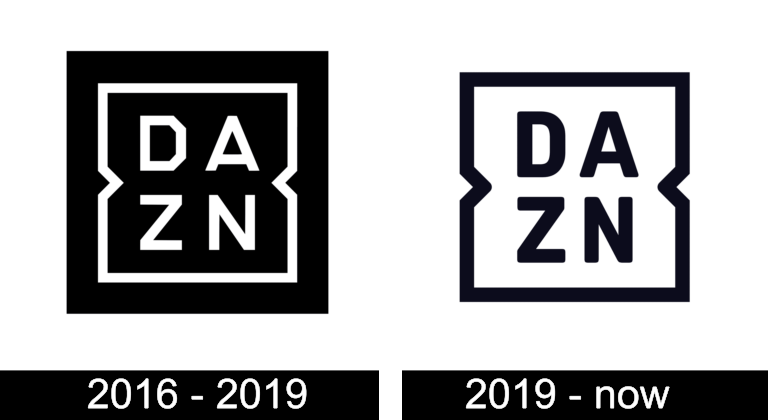
The original DAZN logo introduced in 2016 featured the brand name split across two lines, forming a near-perfect square. Set in a bold, geometric sans-serif typeface, the letters were enclosed within a thin white frame on a black background. Angular “V”-like elements on the sides added visual tension and distinction.
This design established DAZN as a modern, tech-forward platform. The symmetry supported digital usability, while the monochrome palette conveyed seriousness and authority. The logo was highly adaptable across apps, websites, and broadcast overlays, reinforcing consistency during the platform’s rapid international expansion.
2019–Today: Simplified Core Mark with Inverted Contrast
In 2019, DAZN refined its visual identity by stripping away the outer frame and focusing solely on the wordmark. The color scheme was inverted, and the typography was updated to a bolder sans-serif typeface with smoother curves and thicker strokes. This change enhanced legibility on small screens and emphasized strength and confidence.
The simplified logo retained the square composition, preserving brand recognition while aligning with contemporary digital branding trends. This evolution reflected DAZN’s transition from a disruptive newcomer to an established global sports streaming player.
Typography and Color Palette
Typography plays a central role in DAZN’s logo description. The original logo used a geometric sans-serif typeface similar to Air Force 45, reinforcing precision and structure. The current typeface, closer to Bio Sans Soft Bold, introduces subtle curvature, balancing strength with approachability.
The black-and-white color palette has remained constant throughout DAZN’s evolution. Black communicates authority, focus, and professionalism, while white provides clarity and contrast. This timeless combination ensures adaptability across markets, devices, and future platform developments.
DAZN Logo as a Digital-First Brand Statement
The DAZN logo history illustrates how a digital-native brand can establish a strong visual identity from day one. By prioritizing structure, neutrality, and clarity, DAZN created a logo that transcends specific sports and regional markets. Its logo heritage demonstrates that in modern media branding, restraint and consistency can be more powerful than constant reinvention.
As sports consumption continues to evolve, DAZN’s visual identity remains well-positioned to support expansion, innovation, and long-term recognition in the global streaming landscape.
FAQ: DAZN Logo Meaning and History
What does the DAZN logo represent?
The logo represents a dedicated digital “zone” for sports, emphasizing structure, focus, and accessibility.
Why is the DAZN logo black and white?
The black-and-white palette conveys authority, clarity, and timelessness, allowing sports content to remain the primary focus.
When was the DAZN logo redesigned?
The logo was refined in 2019, simplifying the design and updating the typography while preserving its core structure.
Has DAZN’s logo changed significantly since launch?
No, the changes have been evolutionary rather than radical, maintaining strong brand continuity since 2016.