
Red Hat Logo History: Meaning, Symbolism & Brand Heritage

Few technology brands have built their identity so closely around an idea as Red Hat. From its early association with Linux distributions to its transformation into a global enterprise software powerhouse, Red Hat represents a rare blend of countercultural roots and corporate credibility. Its visual identity evolved alongside this journey, translating open-source philosophy into a recognizable and authoritative logo system.
Much like the ideological clarity explored in Linux logo history and the long-term consistency seen in IBM logo heritage, Red Hat’s branding reflects a deliberate balance between symbolism and practicality. Within the broader context of company software logo History, Red Hat stands out for how clearly its logo meaning communicates independence, expertise, and trust.
Meaning and History: The Origin of the Red Hat Identity
Red Hat Software was registered in North Carolina in 1995 following the collaboration between entrepreneur Bob Young and software engineer Marc Ewing. Young, who operated a computer supply catalog business, recognized the rising demand for Linux distributions created by Ewing. Their partnership led to the formalization of Red Hat as a company focused on distributing and supporting open-source software.
Although the brand’s roots trace back to the early 1990s, Red Hat’s commercial breakthrough came with the development of Red Hat Enterprise Linux, which established Linux as a viable operating system for enterprise environments. This milestone reshaped the perception of open-source software, positioning Red Hat as a bridge between community-driven development and corporate infrastructure.
In 2018, Red Hat was acquired by IBM, yet it continued operating as an independent unit. This strategic move reinforced the brand’s standing while preserving its distinct identity, making Red Hat a unique case within modern software branding and logo history.
Logo Symbolism: Independence, Expertise, and Identity
The Red Hat logo symbolism is unusually literal yet powerful. The hat itself references Marc Ewing’s habit of wearing a red fedora, which became an informal identifier within early Linux communities. Over time, the hat evolved into a symbol of individuality, expertise, and nonconformity, values deeply tied to open-source culture.
The color red plays a central role in the logo meaning. It conveys confidence, leadership, and visibility, setting Red Hat apart in an industry dominated by blues and grays. Black, used consistently in typography, adds authority and balance, reinforcing the brand’s enterprise credibility.
The human silhouette featured in earlier designs emphasized community and movement, while later minimalist versions shifted focus toward clarity and scalability, reflecting Red Hat’s maturation into a global enterprise brand.
Red Hat Logo History Timeline
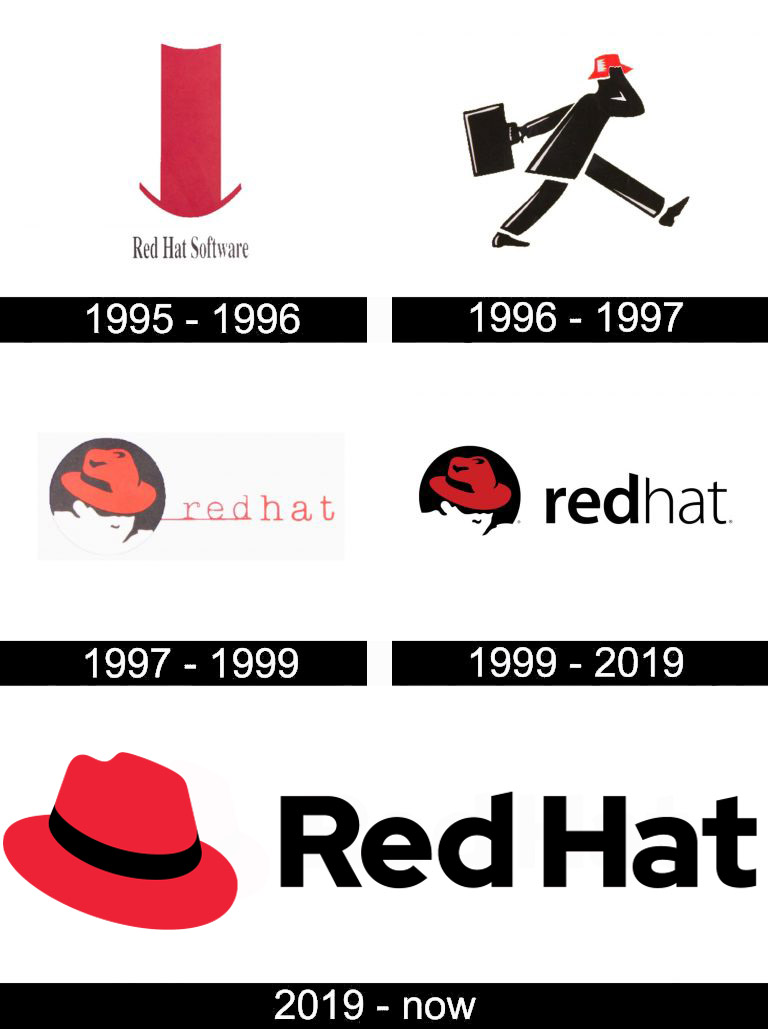
1995–1996: Vertical Top Hat and Early Wordmark
The first Red Hat logo appeared in 1995, featuring an elongated red top hat placed above a thin, compressed wordmark reading “Red Hat Software.” The design was simple and experimental, reflecting a young company still defining its visual language.
1996–1997: The Running Man Concept
In 1996, the logo shifted dramatically. A black silhouette of a man striding forward while wearing a red hat appeared against a yellow background. This “running man” symbolized progress, momentum, and independence, aligning with Red Hat’s role in advancing open-source adoption.

1997–1999: Head Silhouette and Circular Motifs
The 1997 redesign introduced a white head silhouette wearing a red hat with a black ribbon. Set within circular blue patterns and paired with a small red wordmark, this version leaned heavily into symbolism and complexity, emphasizing identity within the growing Linux ecosystem.

1999–2019: Scarlet Background and Stronger Typography
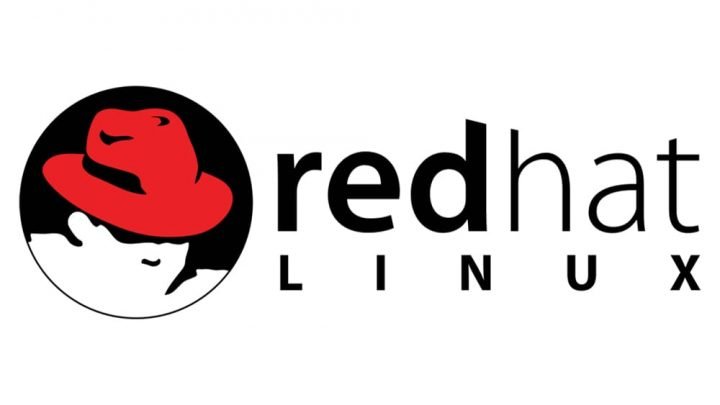
In 1999, the logo was refined for clarity and impact. The background became solid red, the wordmark turned white, and typography grew bolder and more legible. This version marked Red Hat’s transition into enterprise software, remaining in use for two decades and becoming deeply ingrained in the brand’s logo heritage.
2019–Present: Fedora Icon and Modern Wordmark
The 2019 redesign introduced a cleaner, more modern identity. The emblem became a simplified red fedora with a black ribbon, paired with a black title-case wordmark in a custom sans-serif typeface. Subtle diagonal cuts in the letterforms added a contemporary edge while preserving brand recognition.
Red Hat Logo Heritage and Open-Source Authority
The Red Hat logo history reflects a brand that evolved without abandoning its core symbolism. From expressive early designs to a refined modern identity, the logo meaning consistently communicated independence, expertise, and confidence. Within the technology sector, Red Hat’s logo heritage stands as a rare example of how open-source values can be translated into a globally trusted enterprise brand.
FAQ: Red Hat Logo Meaning and History
What does the Red Hat logo represent?
The logo represents independence, expertise, and the open-source philosophy, symbolized by the iconic red fedora.
Why is a hat used in the Red Hat logo?
The hat references founder Marc Ewing’s red fedora, which became an early identifier within Linux communities.
Has the Red Hat logo changed significantly over time?
Yes, but each redesign preserved the hat symbol while refining clarity and enterprise appeal.
Is Red Hat still independent after IBM acquired it?
Red Hat operates as a separate entity within IBM, maintaining its distinct brand identity.