Jimmy John’s Logo History: Meaning, Symbolism & Brand Heritage
Speed, freshness, and attitude define the visual and cultural identity of Jimmy John’s, a brand that transformed a simple college-town sandwich shop into one of the most recognizable quick-service names in the United States. From the beginning, Jimmy John’s relied not only on operational efficiency but also on a bold, unmistakable visual language that reinforced its promise of fast, high-quality food.
This approach places the brand alongside other personality-driven fast-food identities explored in Carl’s Jr. logo history, while its emphasis on simplicity and repetition echoes patterns found in Subway logo history. Within the broader landscape of fast food logo history, Jimmy John’s stands out for using typography and minimal symbolism to communicate speed, confidence, and consistency. The logo meaning has always been tightly connected to the brand’s origin and its unapologetically direct business philosophy.
Meaning and History: The Origin of the Jimmy John’s Identity
Jimmy John’s was founded in 1983 in Charleston, Illinois, by Jimmy John Liautaud, who was only 19 years old at the time. Located near Eastern Illinois University, the first shop catered primarily to college students seeking quick, affordable, and filling meals. The original menu was intentionally limited, focusing on a handful of sandwiches made with fresh ingredients and baked-in-house bread.
This operational simplicity shaped the brand’s identity from the start. Speed became a defining feature, later immortalized in the “Freaky Fast” slogan, while freshness distinguished Jimmy John’s from competitors relying on pre-prepared ingredients. As the company expanded through franchising, these principles were embedded into both operations and branding.
Ownership changes in later years, including acquisitions by Roark Capital Group and later Inspire Brands, did not disrupt the core identity. The logo history shows a gradual refinement rather than radical reinvention, reinforcing familiarity and trust as the brand scaled nationwide.
Logo Symbolism: Speed, Confidence, and American Simplicity
The Jimmy John’s logo symbolism revolves around clarity and assertiveness. Early designs embraced a hand-drawn, slightly chaotic aesthetic that conveyed personality and approachability, mirroring the brand’s grassroots beginnings. As the company matured, the logo evolved toward stronger geometry and bolder contrast, reflecting operational discipline and confidence.
The repeated use of initials, particularly the “JJ” monogram, became a central symbolic device. It functions as shorthand for speed and memorability, allowing the brand to be recognized instantly even without the full name. Circular badge formats introduced later suggest consistency, quality assurance, and completeness, reinforcing trust in a high-volume food service environment.
Color plays a critical role in the logo meaning. Red communicates urgency, appetite, and speed, while black adds authority and visual weight. Together, they form a logo description that is aggressive, efficient, and unmistakably American.
Jimmy John’s Logo History Timeline
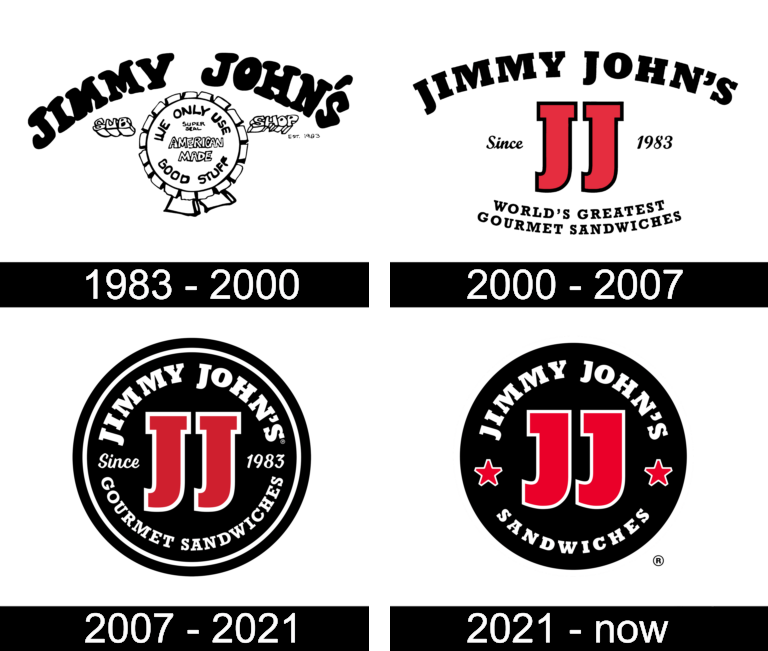
1983–2000: Hand-Drawn Typography and Foundational Identity
The original Jimmy John’s logo featured uneven, playful black lettering paired with a simple sandwich illustration. A ribbon-style seal carried the phrase “We Only Use American Made Good Stuff,” emphasizing ingredient pride and authenticity. The inclusion of “Est. 1983” anchored the brand in its origin story, reinforcing credibility and longevity even in its early years.

2000–2007: Bold Initials and Brand Confidence
This redesign marked a shift toward a more structured and assertive identity. The introduction of bold red “JJ” initials brought focus and memorability, while supporting text highlighted the brand’s founding year and declared “World’s Greatest Gourmet Sandwiches.” The design balanced modern confidence with heritage signaling.

2007–2021: Circular Badge and Heritage Emphasis
A circular badge format defined this era, placing the red “JJ” initials against a black background. Surrounding text referenced both “Since 1983” and “Gourmet Sandwiches,” reinforcing longevity and product focus. The badge-like composition conveyed quality assurance and brand maturity, aligning with Jimmy John’s rapid national expansion.
2021–Today: Simplified Monogram and Product Focus
The current logo retains the circular structure but strips it down to essentials. The central “JJ” remains dominant, flanked by two red stars that subtly suggest excellence and distinction. Surrounding text is reduced to “Sandwiches,” removing overt heritage claims in favor of clarity and modern minimalism. This update reflects contemporary branding trends while preserving instant recognition.
Jimmy John’s Logo Heritage and Fast-Food Identity
The Jimmy John’s logo history illustrates how consistency and gradual refinement can build a powerful brand presence. From hand-drawn beginnings to a disciplined monogram-based emblem, the logo meaning has remained aligned with the brand’s core values: speed, freshness, and confidence. Rather than chasing trends, Jimmy John’s strengthened recognition through repetition and simplification.
Within the fast-food sector, Jimmy John’s logo heritage stands as a case study in how typography and color alone can communicate a complete brand philosophy. Its emblem continues to reinforce the promise that defined its origin, delivering familiarity and trust at high speed.
FAQ: Jimmy John’s Logo Meaning and History
What does the Jimmy John’s logo represent?
The logo represents speed, confidence, and freshness, aligning with the brand’s fast service and quality ingredients.
Why does Jimmy John’s use the “JJ” initials?
The initials provide instant recognition and reinforce speed and memorability in a competitive market.
Has the Jimmy John’s logo changed significantly over time?
Yes, it evolved from a hand-drawn style to a clean, modern badge while preserving core visual elements.
What do the red stars in the current logo symbolize?
They suggest quality and distinction, reinforcing confidence without relying on detailed messaging.