
Navistar Logo History: Meaning, Symbolism & Brand Heritage
The visual identity of Navistar reflects the transformation of a legacy industrial operation into a modern transportation and mobility corporation. Emerging from the restructuring of International Harvester, Navistar inherited not only technical expertise but also a symbolic responsibility to represent continuity, strength, and forward motion. Its logo history tells a story of reinvention without erasing the past, using geometry and direction as visual metaphors for leadership and expansion.
This evolution follows a pattern familiar in American industrial branding, similar to the transitions explored in Packard logo history and the heavy-industry lineage examined in Studebaker logo heritage. Within the broader field of automotive logo heritage, Navistar occupies a distinct position, bridging traditional manufacturing with global logistics and long-distance transportation. The logo meaning is closely tied to roads, motion, and scale, reinforcing the company’s role in shaping modern commercial mobility.
Meaning and History: The Origin of the Navistar Identity
Navistar was founded in 1986 as the successor to the truck division of International Harvester, following that corporation’s collapse. Rather than starting from scratch, the new company inherited decades of industrial knowledge, manufacturing infrastructure, and brand recognition through its truck lines. This origin shaped Navistar’s identity from the beginning, positioning it as both a continuation and a renewal.
Throughout the 1990s, the company expanded through acquisitions and strategic partnerships, strengthening its presence in trucks, buses, engines, and military vehicles. This period of consolidation and growth is reflected in the logo history, which emphasized direction, ascent, and endurance rather than decorative branding. The logo description consistently aligned with the realities of long-haul transportation and heavy-duty performance.
Ownership changes in later years, including its acquisition by the Volkswagen Group through Traton, did not alter the core symbolic language of the brand. Instead, Navistar’s visual identity remained focused on clarity, strength, and road-oriented symbolism, reinforcing its role as a large-scale transportation leader.
Logo Symbolism: Roads, Direction, and Industrial Power
The Navistar logo symbolism is built around sharp geometry and implied motion. Triangles, wedges, and elongated forms dominate the emblem, visually suggesting ascent, acceleration, and leadership. These shapes create a sense of upward pull, reinforcing ambition and dominance within the commercial vehicle sector.
One of the most consistent symbolic elements across logo iterations is the road. Whether represented as a white strip or implied through converging lines, the roadway connects the brand directly to transportation, distance, and infrastructure. This choice grounds the logo meaning in real-world function rather than abstract imagery.
Color symbolism further supports this narrative. Dark tones emphasize durability and mechanical power, while brighter accents introduce ideas of growth, expansion, and renewal. Together, form and color create a logo description that communicates scale, reliability, and global reach.
Navistar Logo History Timeline
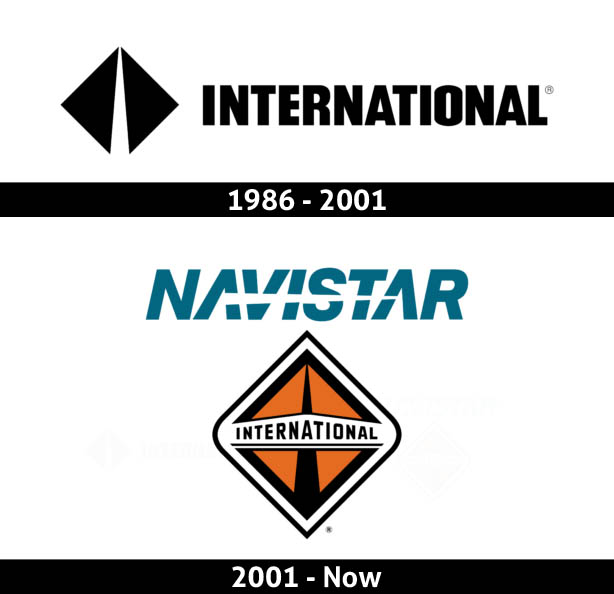
1986–2001: Foundational Geometric Emblem of Continuity
The original Navistar logo was introduced after the collapse of International Harvester, marking the birth of a new corporation built on inherited expertise. The emblem consisted of two black triangles joined at their vertices, forming an open rhombus. This mirrored structure symbolized continuity, suggesting that traditions, technologies, and values were preserved even as the company’s name changed.
At the center of the emblem, a white road appeared, open and unfinished, representing a new path forward. The triangular shapes also resembled unfolding wings, reinforcing the idea of resurgence and ascent. During this period, the brand name used in the logo referenced the truck line rather than the corporate entity, emphasizing the vehicles as the foundation of Navistar’s identity.

2001–Today: Road Sign Symbolism and Corporate Scale
The updated logo retained the core concept but introduced more complexity. The wordmark was stylized in uppercase letters, interrupted by a sharp wedge cutting through the center, symbolizing speed, motion, and long-distance travel. This break visually evoked a road converging toward the horizon.
Below the wordmark, the emblem evolved into a rhombus with partially rounded corners, colored in orange and framing a central roadway. The shape resembled a “Main Road” traffic sign, reinforcing the idea that Navistar vehicles belong on primary highways and major transport routes. Sharp vertical points stretched the composition upward, visually communicating growth and competitive ambition.
As the corporate name took precedence over individual brands, the logo signaled Navistar’s expanded scale, positioning International as one of several product lines rather than the defining identity.
Navistar Logo Heritage and Industrial Identity
The Navistar logo history demonstrates how visual identity can translate industrial purpose into symbolic clarity. Rooted in geometry, road imagery, and directional cues, the logo meaning consistently reflects strength, leadership, and long-distance mobility. Rather than pursuing decorative trends, Navistar relied on functional symbolism aligned with the realities of heavy transportation.
Within automotive and industrial branding, Navistar’s logo heritage stands as a clear example of continuity through transformation. Its emblem remains a visual expression of movement, endurance, and ambition, reinforcing the company’s role in shaping commercial transportation across generations.
FAQ: Navistar Logo Meaning and History
What does the Navistar logo represent?
The Navistar logo represents strength, direction, and leadership, using road symbolism and sharp geometry to convey industrial power.
Why does the Navistar logo feature triangular shapes?
Triangles suggest ascent, motion, and ambition, reflecting the company’s drive to lead in transportation and heavy manufacturing.
What is the meaning of the road element in the Navistar logo?
The road symbolizes long-distance travel, infrastructure, and the company’s connection to highways and commercial mobility.
Has the Navistar logo changed significantly over time?
The core concept has remained consistent, with refinements that reflect the company’s growth and expanding corporate scale.