
Packard Logo History: Meaning, Symbolism & Brand Heritage
In the landscape of early American automotive luxury, few names carry the same historical weight as Packard. Even decades after production ended, the Packard logo remains instantly associated with refinement, engineering excellence, and social prestige. Unlike brands that relied on constant reinvention, Packard built its visual identity around stability and authority, allowing its logo heritage to age with dignity rather than obsolescence.
Similar patterns of restrained elegance can be observed in Cadillac logo history and the aristocratic consistency explored in Rolls-Royce logo meaning, where branding served as a visual extension of product philosophy. Within the broader field of classic automotive logo heritage, Packard stands as a benchmark for how symbolism, typography, and proportion can communicate luxury without excess. The logo meaning is inseparable from the brand’s origin, reflecting a company that defined American prestige long before mass-market dominance became the industry standard.
Meaning and History: The Origin of the Packard Identity
Packard’s story begins in 1899, when brothers James Ward Packard and William Doud Packard founded the Ohio Automobile Company in Warren, Ohio. The decision was driven by dissatisfaction with the reliability of existing automobiles, prompting James Packard to pursue a better-engineered alternative. This commitment to quality and dependability quickly became the foundation of the brand’s identity.
The introduction of the first Packard vehicle in 1899 established the company’s reputation for innovation, particularly through its use of steering wheels instead of the more common lever systems. As the company evolved into the Packard Motor Car Company and relocated to Detroit, its origin became firmly tied to the rise of American automotive engineering. Throughout periods of rapid growth, wartime production, economic hardship, and eventual decline, Packard maintained a consistent visual language.
The logo history reflects this continuity. Rather than radical redesigns, Packard favored adaptations that preserved its core identity. Even as the company expanded, contributed to military manufacturing, and later struggled against increasing competition, the logo meaning remained aligned with trust, precision, and mechanical excellence.
Logo Symbolism: Luxury, Authority, and Motion
The Packard logo symbolism is rooted in balance and symmetry. Despite the brand’s association with luxury, its emblem avoided excessive ornamentation, instead relying on geometric clarity to convey confidence and control. Circular forms dominated the design, evoking wheels, motion, and mechanical perfection, all central themes in automotive branding.
Color played a crucial symbolic role. Blue suggested reliability, confidence, and safety, reinforcing Packard’s reputation for dependable engineering. White introduced a sense of purity and technical precision, while red, used sparingly, signaled boldness and innovation. Together, these elements formed a visual system that communicated both restraint and ambition.
Typography further strengthened the logo description. The handwritten-style wordmark introduced elegance and personality, while slanted letterforms and flowing lines conveyed movement and progress. The distinctive underline, extending from the final letter, became a signature element, reinforcing Packard’s elevated status within the global automotive market.
Packard Logo History Timeline
1899–1958: Geometric Emblem and Diagonal Wordmark Identity
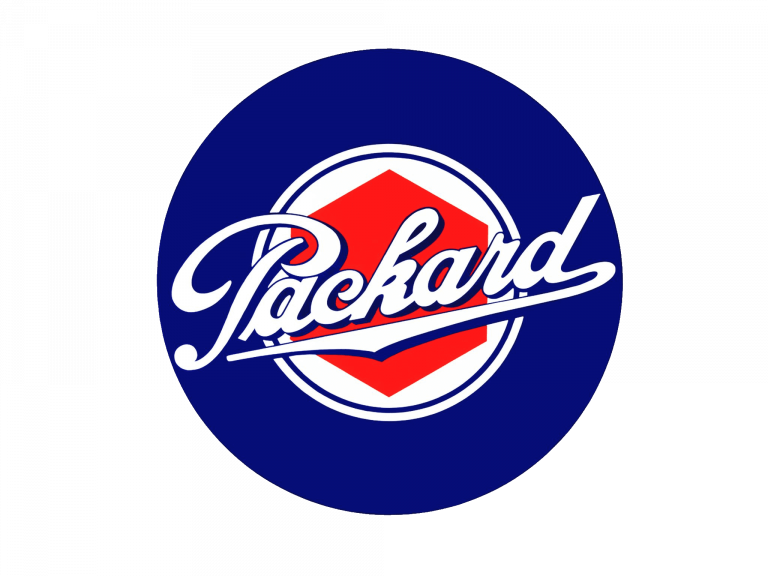
Throughout its active production years, Packard relied on a logo built around simple geometric forms and strong visual balance. The emblem centered on a large blue circle containing smaller white circular elements, visually referencing wheels and mechanical motion. A red hexagon placed at the center introduced contrast and symbolic boldness, reflecting the brand’s willingness to innovate and challenge convention.
A diagonal wordmark crossed the primary circle, creating a sense of upward movement and progress. This angled placement became a recognizable hallmark of the Packard logo history, reinforcing the idea of forward momentum and ambition. The handwritten-style lettering, combined with sharp angles and smooth curves, mirrored the sophistication of the vehicles themselves. This identity remained consistent until the end of Packard automobile production, anchoring the brand’s logo heritage in continuity rather than constant change.
Packard Logo Heritage and Enduring Prestige
The Packard logo history demonstrates how a disciplined visual identity can preserve brand prestige long after production ceases. Rooted in symmetry, thoughtful color symbolism, and elegant typography, the logo meaning consistently communicated luxury, reliability, and authority. Rather than chasing trends, Packard relied on coherence and restraint, allowing its logo heritage to endure as a symbol of American automotive excellence.
Today, Packard remains a reference point in discussions of classic car branding, admired by collectors and historians alike. Its logo symbolism continues to represent an era when engineering integrity and visual identity were inseparably linked.
FAQ: Packard Logo Meaning and History
What does the Packard logo represent?
The Packard logo represents luxury, reliability, and engineering excellence through balanced geometry and refined typography.
Why did Packard use circular shapes in its logo?
Circular forms symbolized wheels, motion, and mechanical perfection, aligning the logo with automotive innovation.
Did the Packard logo change significantly over time?
While details evolved, the core structure and symbolism of the logo remained consistent throughout the brand’s active years.
What colors are most associated with the Packard logo?
Blue, white, and red were key colors, symbolizing trust, precision, and innovation.