
Ram Logo History: Meaning, Symbolism & Brand Heritage

Few automotive badges communicate strength and endurance as immediately as the Ram logo. Closely associated with full-size pickup trucks built for demanding work and everyday utility, Ram has evolved from a Dodge sub-label into a standalone brand with a distinct visual and cultural identity. Its logo history reflects more than stylistic change; it mirrors shifts in ownership, market positioning, and the way American trucks are perceived globally. Much like the legacy-driven evolution explored in the Ford logo history and the bold symbolism seen in the Jeep logo heritage, Ram’s visual identity balances heritage with modern engineering ambition, securing its place within the broader narrative of American automotive logo history.
From early industrial wordmarks to aggressive animal symbolism and, most recently, minimalist typography, the Ram logo meaning has consistently revolved around power, resilience, and authority.
Meaning and History: The Origin of the Ram Identity
Ram Trucks traces its roots to the early twentieth century, when the Dodge Brothers began manufacturing vehicles designed for durability and mechanical reliability. Although trucks were part of Dodge’s portfolio from the beginning, the “Ram” name itself did not appear until 1981, when it was introduced for Dodge’s full-size pickup lineup.
The ram, as a symbol, was not chosen arbitrarily. Long before it became a brand identifier, the ram’s head had appeared as a hood ornament on Dodge vehicles, representing toughness, determination, and forward momentum. These qualities aligned perfectly with the functional demands of pickup trucks and the cultural expectations of their buyers.
In 2009, Ram Trucks was separated from Dodge as an independent brand within the Chrysler Group, later becoming part of Stellantis. This structural shift required a clearer, more autonomous visual identity. While the logo heritage remained connected to Dodge’s past, the Ram brand began refining its symbolism to stand on its own in a competitive global market.
RAM Logo History Timeline
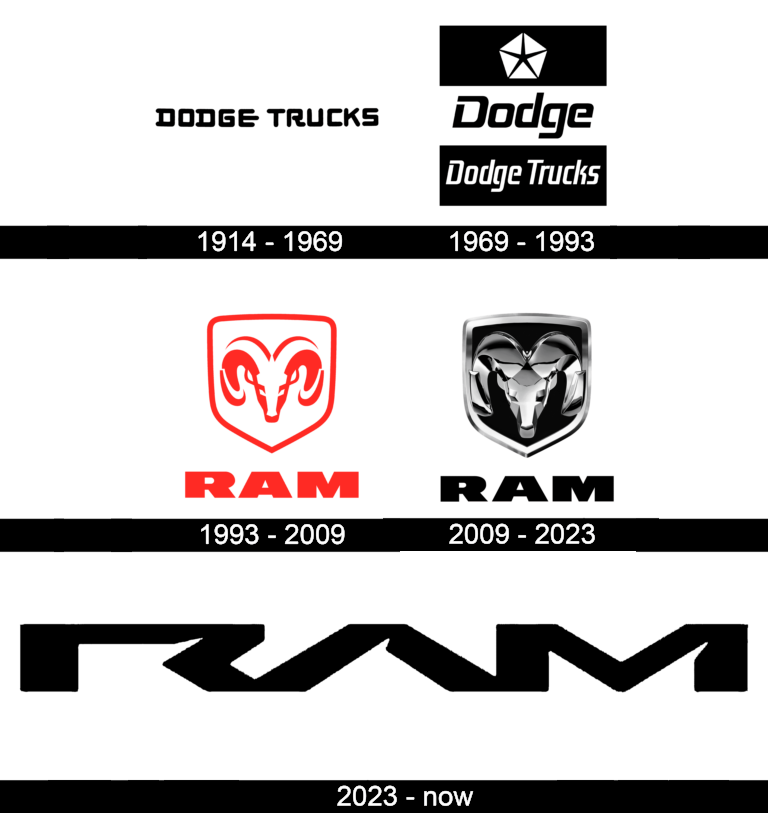
1914–1969: Early Dodge Truck Typography and Industrial Identity
The earliest truck-related logos associated with Dodge relied purely on typography. Thick, square letterforms spelled out “Dodge Trucks” in bold black against white backgrounds. The custom lettering featured geometric shapes, squared counters, and distinctive horizontal extensions, creating a mechanical and utilitarian feel. This design language reflected the industrial era in which trucks were tools first and lifestyle products second.

1969–1993: Structured Branding and Corporate Confidence
By the late 1960s, Dodge introduced a more structured visual system. Logos from this period often combined multiple elements, including rectangular frames, star symbols, and layered typography. “Dodge Trucks” appeared in heavy lettering, while the Dodge name was emphasized separately. The contrast between black and white surfaces added authority and visibility, signaling a more corporate and organized brand presence during a time of expansion.

1993–2009: The Ram Emerges as a Visual Icon
In the early 1990s, the Ram identity underwent its most dramatic transformation. Inspired by the ram’s head hood ornament, the logo introduced a powerful animal emblem as its centerpiece. The ram’s head, rendered with sharp angles and muscular contours, projected aggression and strength. Positioned above the “Ram” wordmark, the emblem faced forward, symbolizing progress and dominance. This design coincided with a major redesign of the trucks themselves and played a critical role in reestablishing Dodge Ram as a serious contender in the pickup market.
2009–2023: Independence and Three-Dimensional Refinement
When Ram Trucks became an independent brand in 2009, the logo was refined rather than replaced. The ram’s head and shield were preserved but transformed into a three-dimensional metallic emblem. Gradients, highlights, and shadows created a sculpted appearance, giving the badge a premium, engineered feel. The emblem filled the shield entirely, reinforcing a sense of containment and strength. This version emphasized modern manufacturing, advanced technology, and a more upscale positioning within the truck segment.
2023–Today: Minimalism and Typographic Authority
The most recent redesign marked a clear departure from decades of emblem-driven branding. Introduced in 2023, the new Ram logo focuses solely on typography. The word “RAM” appears in wide, angular, sans-serif letterforms with unconventional cuts and missing internal bars. This stripped-down approach reflects contemporary branding trends while signaling confidence in name recognition alone. The aggressive geometry maintains the brand’s assertive tone, even in the absence of the ram’s head.
Logo Symbolism: Strength, Dominance, and Evolution
Throughout its history, Ram’s logo symbolism has centered on power and reliability. The ram, as an animal, conveys physical strength, resilience, and a willingness to confront obstacles head-on. These attributes translated naturally into the pickup truck segment, where performance and toughness are core values.
The shift away from literal symbolism in 2023 does not abandon this meaning. Instead, it reinterprets it through form. The heavy, wide letterforms communicate mass and stability, proving that symbolism can persist even when imagery is removed.
Typography and Color Palette
Typography has become increasingly important in the Ram logo meaning. Earlier wordmarks emphasized weight and solidity, while later designs refined proportions for clarity and impact. The current logo uses a custom sans-serif typeface with broad, flattened characters and sharp angles. The absence of serifs and internal bars creates a raw, industrial impression consistent with the brand’s identity.
Color has remained largely restrained. Black and white dominate the logo heritage, ensuring versatility and contrast. Earlier iterations introduced red as an accent to convey energy and aggression, but modern versions favor monochrome schemes that emphasize form and structure over decoration.
Ram Logo Heritage and Brand Transformation
The Ram logo heritage reflects a brand unafraid of reinvention when necessary. From Dodge-era typography to emblematic animal symbolism and, finally, minimalist typography, each phase corresponds with strategic changes in product design and market positioning. Despite these shifts, the core values of durability and performance remain intact.
This adaptability has allowed Ram to maintain relevance as trucks evolved from purely utilitarian vehicles into lifestyle statements. The logo serves as a visual anchor, connecting decades of engineering heritage with contemporary expectations.
Ram Logo History and Modern Identity
The Ram logo history is a visual narrative of strength, independence, and calculated evolution. While the brand has moved away from its most recognizable symbol in recent years, it has not abandoned its origin. Instead, it has distilled its identity into a form that relies on confidence and recognition. This balance between heritage and modernity ensures that the Ram logo remains a powerful signifier in the global automotive landscape.
FAQ: Ram Logo Meaning and History
What does the Ram logo represent?
The Ram logo represents strength, durability, and forward momentum, originally symbolized by the ram’s head and now conveyed through bold typography.
When did Ram become a separate brand from Dodge?
Ram Trucks became an independent brand in 2009, separating from Dodge within the Chrysler Group.
Why was the ram’s head removed from the logo in 2023?
The 2023 redesign focused on minimalist typography to emphasize brand confidence and modern identity while maintaining symbolic strength through form.
Has the Ram logo changed significantly over time?
Yes. The logo evolved from simple typography to a detailed animal emblem and later to a minimalist wordmark, reflecting broader brand and industry changes.