Samsung Logo History: From Dried Fish to the 1993 Frankfurt Declaration
Samsung started in 1938 selling dried fish, noodles, and groceries, and the modern blue wordmark exists largely because of a 1993 crisis speech in which chairman Lee Kun-hee told his executives to “change everything except your wife and kids.”
How did Samsung actually start?
Lee Byung-chul founded Samsung in 1938 in Daegu, Korea, as a trading company exporting groceries, dried fish, and noodles, decades before the company touched electronics. The name “Samsung” combines “Sam” (three) and “Sung” (stars), chosen to represent something big, numerous, and powerful, like stars in the sky. Samsung Electronics was established in 1969, starting with black-and-white televisions and basic electronic components.
Lee Kun-hee, the founder’s son, became chairman in December 1987, shortly after his father’s death. In 1993, concerned that Samsung was producing large volumes of low-quality goods and losing ground to rivals like Sony, he gathered executives in Frankfurt and delivered what became known as the New Management declaration, telling them to “change everything except your wife and kids.” The directive pushed Samsung toward a quality-first strategy that reshaped the company over the following decade; by 2006, Samsung had overtaken Sony as the world’s largest television manufacturer.
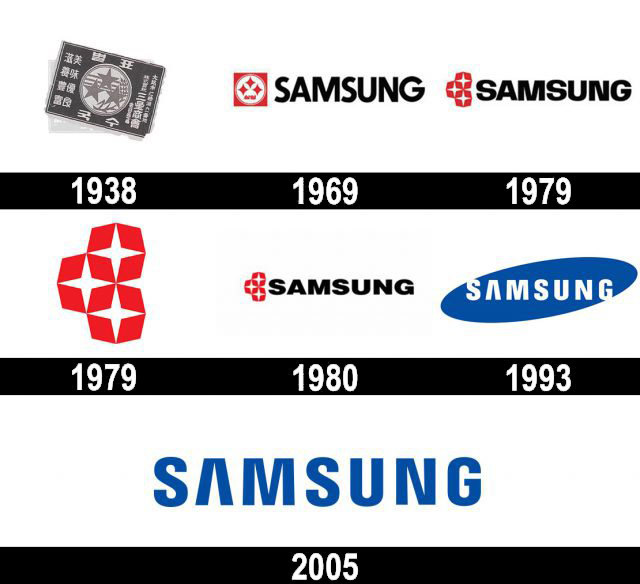
Logo evolution
1938: the circular emblem
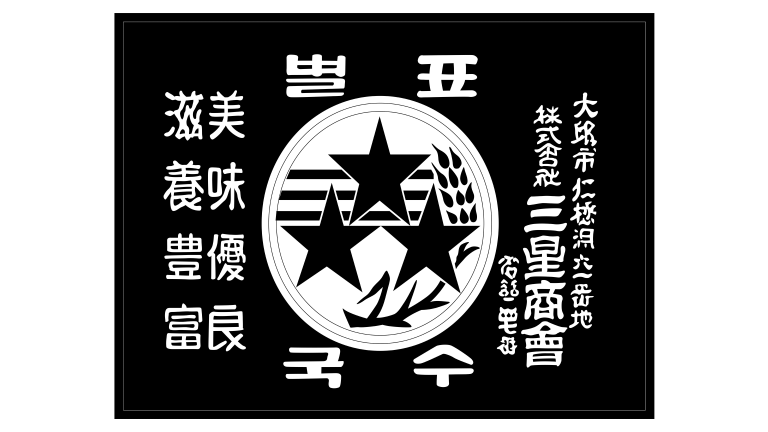
Samsung’s first logo resembled a formal Korean seal, circular and dense, combining Hangul characters, rice stalks, and three stars, reflecting the company’s agricultural trading origins.
1950s-1960s: a plainer wordmark
As Samsung expanded into textiles and manufacturing, the dense emblem gave way to a simpler sans-serif wordmark suited to an industrial company.
1969: the electronics era
With Samsung Electronics founded, the logo took on a sturdier, more mechanical typeface suited to the launch of the company’s first televisions and components.
1980: the sharpened star mark
The 1980 redesign dropped the circular frame, simplifying the three-star imagery into a bolder, more geometric mark paired with a shorter wordmark.

1980s-early 1990s: the blue box
As Samsung expanded into telecom and appliances internationally, it adopted a solid blue box logo intended to project corporate stability.
1993: the blue ellipse
The same year as the Frankfurt New Management declaration, Samsung introduced the blue ellipse logo, with the “S” and “G” of the wordmark extending past the oval’s edges. No single designer or agency is consistently credited for this redesign in available sources, so that detail is left open rather than stated as fact.
2005-today: the standalone wordmark
From 2005, Samsung began phasing out the ellipse in most contexts in favor of a plain wordmark in Samsung’s signature blue, better suited to small screens and digital use. Both forms still appear today depending on the product and context.
Why doesn’t Samsung’s “A” have a crossbar?
Samsung’s typography, refined around the 1993 rebrand, uses a stylized “A” without its usual horizontal bar, a detail the company has described as suggesting openness and forward motion rather than a closed, traditional letterform.
What is the Samsung Galaxy logo?
The Samsung Galaxy product line launched in 2009, pairing Samsung’s standard wordmark with a distinct typeface for “Galaxy,” used across the company’s smartphone and tablet range.
Does Samsung have a sound logo?
Samsung uses a four-note audio signature (E flat, A flat, D flat, E flat) composed by Austrian musician Walter Werzowa, giving the brand a recognizable sound identity alongside its visual one, something few consumer electronics companies have built.
Quick facts
| Founded | 1938, Daegu, Korea, by Lee Byung-chul, as a trading company |
| Samsung Electronics founded | 1969 |
| Lee Kun-hee becomes chairman | December 1987 |
| Frankfurt “New Management” declaration | 1993, same year as the blue ellipse logo |
| Overtook Sony as top TV maker | 2006 |
| Current wordmark | Since 2005 |
Related reading
Further reading
FAQ
What does the Samsung name mean?
“Samsung” combines the Korean words for “three” and “stars,” chosen to suggest something big, numerous, and enduring.
What was Samsung’s first business?
Samsung started in 1938 as a trading company selling groceries, dried fish, and noodles, long before entering electronics in 1969.
What was the Frankfurt Declaration?
In 1993, chairman Lee Kun-hee told Samsung executives to “change everything except your wife and kids,” launching a quality-first overhaul that reshaped the company over the following decade.
Why doesn’t the Samsung “A” have a crossbar?
The open “A,” introduced around the 1993 rebrand, is meant to suggest openness and forward motion rather than a closed, traditional letterform.