Meta Logo History: Heritage, Meaning & Symbolism
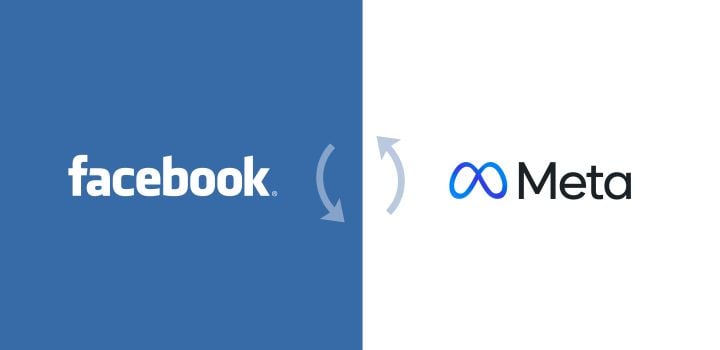
In late 2021, the tech world was flooded with speculation about a potential name change for Facebook. Many believed the social network itself would be rebranded. Instead, the transition affected only the parent company — a corporation now unified under a new name: Meta.
The platforms people use daily, including Facebook, Instagram, Messenger, and WhatsApp, remain unchanged. What evolved was the umbrella company and the vision behind it. Meta represents a long-term commitment to a new digital frontier: the Metaverse, a shared virtual universe where augmented reality, virtual reality, and real-world interactions coexist.
This shift marked one of the most significant rebrandings in Silicon Valley history — and with it came a new logo symbolizing the future of digital connectivity.
Meaning and History
Meta is more than a rebrand; it is a strategic repositioning. The new corporate identity reflects Mark Zuckerberg’s ambition to build the next evolutionary stage of the internet — an immersive environment where people can work, socialize, and create through hyper-realistic digital spaces.
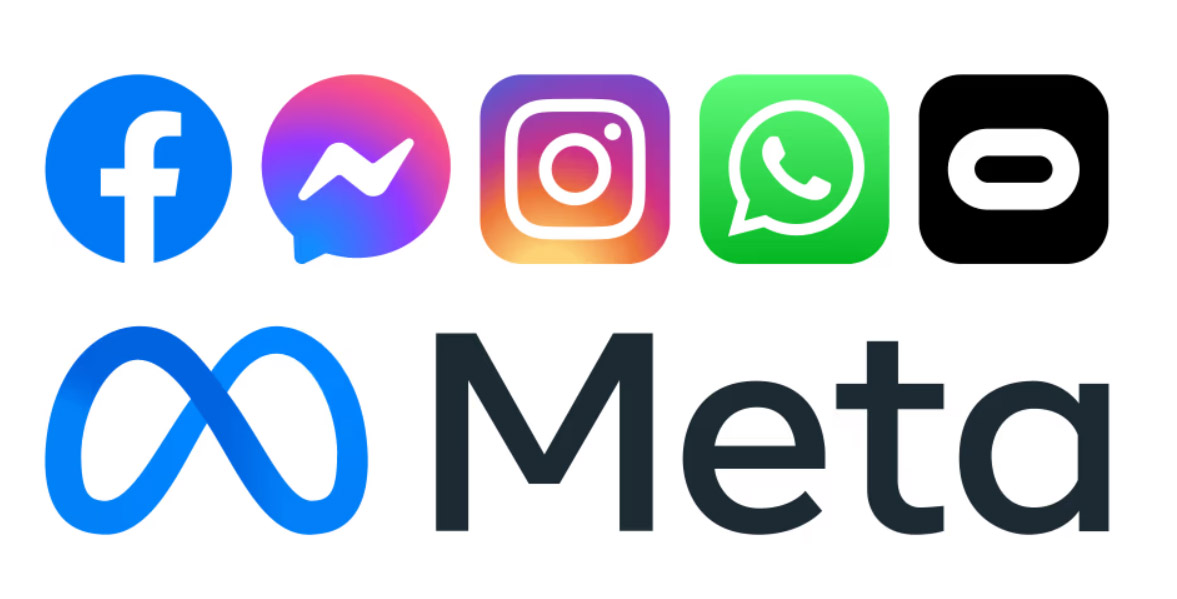
The company behind Meta continues to own its traditional platforms (Facebook, Instagram, WhatsApp, Messenger) as well as Oculus, the VR hardware brand essential to the metaverse vision.
In 2021, Meta invested over $50 million in the development of metaverse infrastructure and began testing VR innovations such as Horizon Workrooms, an application that allows people to attend meetings using customizable avatars. These emerging technologies support Zuckerberg’s belief that interactions in the future will no longer be limited by physical location or traditional interfaces.
New Name and Concept
The name Meta is derived from the Greek word μετά, meaning “after” or “beyond.” In the context of technology, it represents moving past the limitations of current digital platforms and entering a new era focused on immersive experience.
The Metaverse — Meta’s flagship concept — combines virtual and augmented reality into a multidimensional environment. Users will be able to attend virtual meetings, concerts, social events, and educational experiences that run simultaneously in real and digital spaces.
To participate, each user will be represented by a personal avatar, a virtual self that can interact with objects, environments, and other people across interconnected digital worlds. Voice recognition, gesture controls, AR glasses, and intelligent wearable devices will form the foundation of this immersive ecosystem.
Meta Logo History: 2021 – Today
The Meta logo introduced in 2021 represents a major departure from Facebook’s long-standing visual identity. Instead of a blue square with an “F,” the new emblem features an abstract infinity symbol drawn as a continuous blue Möbius loop. A Möbius strip is a topological form with only one continuous side, often used to represent unity, fluidity, and endless dimension — concepts central to the metaverse vision.
This infinity-shaped Meta symbol evokes:
-
limitless creativity
-
boundless digital spaces
-
continuity between the physical and virtual world
-
the company’s long-term focus on future technologies
The wordmark accompanying the logo uses a title-case, full-shaped sans-serif typeface in black. It appears modern, neutral, and balanced, resembling fonts like Carmen Sans Semi Bold or Nexa Text Bold. The choice of simple typography allows the infinity emblem to take visual precedence while reinforcing the seriousness and maturity of the parent company.
Symbolism: The Meta Emblem
The Meta symbol carries several layers of meaning. Its infinity form communicates the idea of endless possibilities, but its geometric shaping also resembles the letter “M,” subtly referencing the company’s name.
The blue color ties Meta back to Facebook’s visual heritage, ensuring continuity between the old corporate identity and the new one. Yet the tone is deeper and more refined, emphasizing innovation over tradition.
The Möbius-loop shape suggests a world with no frontiers — perfectly echoing the ambitions behind the Metaverse, where spaces are interconnected and users can transition seamlessly from one environment to another.
The Vision Behind the Metaverse
Meta’s rebranding came with significant technological commitments. Zuckerberg emphasized that the metaverse already exists in early forms through VR experiences, digital communities, and interconnected virtual services.
Products like the Portal video-call device and Oculus VR headsets allow users to “teleport” into virtual rooms, breaking down geographical barriers.
However, for the metaverse to fully emerge, Meta aims to build the “connective tissue” between digital spaces — a network through which individuals can move effortlessly, just as they move from one room to another in real life.
This vision of presence and immersion defines the essence of Meta’s brand heritage moving forward.
FAQ
Is Facebook’s name now Meta?
The social network remains Facebook. Meta is the new name of the parent company overseeing Facebook, Instagram, WhatsApp, Messenger, Horizon, and Oculus.
What does the Meta logo represent?
The emblem is a blue infinity symbol inspired by a Möbius loop. It signifies limitless digital possibilities and the interconnected nature of the Metaverse.
Why did Facebook rebrand to Meta?
The rebrand reflects Mark Zuckerberg’s vision of building a metaverse: a unified digital space combining VR, AR, and real-world interactions.
Does Meta still own Instagram and WhatsApp?
Yes. All platforms remain under the Meta umbrella, but each keeps its own name and identity.
5 Facts About Meta You Probably Didn’t Know
1. Meta’s name change was planned in secrecy, with most employees learning about it the same day it was announced.
2. The infinity logo was designed to be animated — it can twist, stretch, and rotate in three dimensions, unlike static corporate marks.
3. The Metaverse is expected to take over a decade to build fully, requiring major breakthroughs in graphics, AI, and wearable hardware.
4. Meta’s rebranding was partly inspired by the company’s heavy investment in Oculus, which has become essential to the metaverse ecosystem.
5. Although Meta is the parent company, the Facebook logo and identity remain untouched — a distinction many users still misunderstand.