Sega Logo History: From Service Games to the Blue Wordmark
Sega‘s blue wordmark carries no mascot and no emblem, just a custom-cut version of a 1970s display typeface. That restraint is a side effect of the company’s own history: Sega spent its first two decades as a coin-machine supplier and arcade operator before “video games” were a category, and the name itself is a leftover abbreviation from that earlier business.
Where does the name “Sega” actually come from?
The company’s roots go back to 1940, when Martin Bromley and Irving Bromberg formed Standard Games in Honolulu, Hawaii, to supply coin-operated amusement machines to US military bases. After a change in local gambling regulations, the same operation was reorganized on September 1, 1946 as Service Games, which expanded into occupied Japan in 1952 through employees Richard Stewart and Ray LeMaire, distributing jukeboxes and slot machines to American bases there.
“Sega” is a contraction of “Service Games,” first used in 1954 as a brand name on a slot machine called the Diamond Star Machine, not a name the company adopted wholesale the way the old framing implied.
How did Sega become a single company?
Separately, American businessman David Rosen had founded his own import-export operation in Tokyo in 1954, which grew into an arcade and amusement-machine business called Rosen Enterprises. In 1965, Rosen Enterprises merged with Nihon Goraku Bussan, the company that by then held the Service Games/Sega name and operations, forming Sega Enterprises, Ltd., with Rosen as CEO. In 1969, the combined company was bought by the American conglomerate Gulf+Western (also Paramount Pictures’ parent at the time), which owned Sega through the 1970s and into the early 1980s.
When the North American arcade market collapsed in the early 1980s, Gulf+Western looked to sell. In 1984, Rosen and Sega’s Japan-side president Hayao Nakayama led a management buyout backed by CSK Corporation, a Japanese software company; CSK chairman Isao Okawa became Sega’s chairman, a role he held into the Dreamcast era.
What did Sega actually make, and why did it leave hardware?
Sega’s console line ran from the SG-1000 (1983) through the Master System (1985), the Genesis/Mega Drive (1988), the Saturn (1994), and the Dreamcast (1998 in Japan). The Dreamcast was discontinued in 2001 after roughly five years of losses tied to the console side of the business, and Sega exited hardware manufacturing entirely that year to become a third-party software publisher, the role it still occupies today.
Logo Evolution Timeline
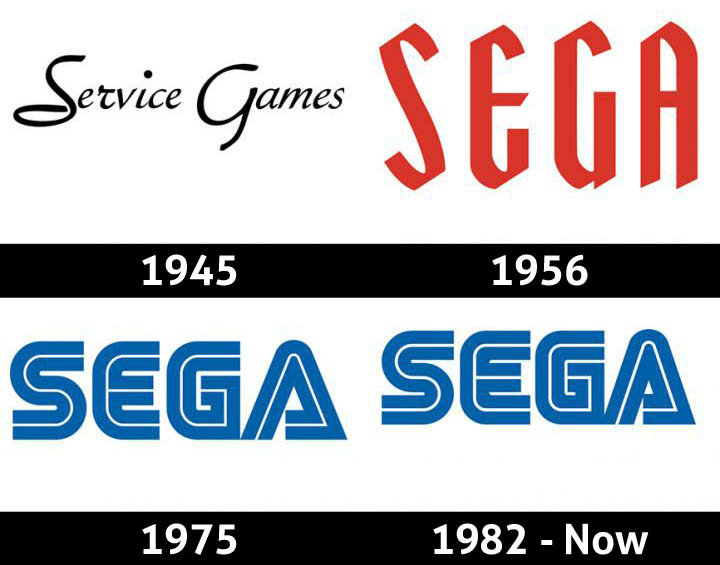
1940s–1950s: The Service Games wordmark
The earliest mark simply spelled out “Service Games” by hand, in plain block lettering, reflecting its job: labeling coin machines and slot machines rather than branding a consumer product.
1954–1975: Early “SEGA” lettering
After “Sega” entered use in 1954, the company used a rounded, continuous-stroke lettering style, sometimes rendered in red with a black outline. Documented examples from the late 1950s onward show the brand experimenting with color combinations, including white-on-black lettering with blue outlines, before settling on a fixed identity.
1975–1982: The Yagi Double-based wordmark
In 1975, Sega moved to the squared, striped letterforms still in use today, based on the Yagi Double display typeface (also used around the same period in CNN’s branding) and reworked with internal white lines through each letter. This version was originally rendered in black.
1982–today: The blue wordmark
In 1982, Sega switched the same lettering to cobalt blue, specifically so the logo would stand out under the neon and fluorescent lighting of arcades. That color choice, not a mid-1980s redesign, is what produced the wordmark still used on Sega’s games and branding now.
Quick facts
| Founded (as Standard Games) | 1940, Honolulu, Hawaii |
| Founders | Martin Bromley and Irving Bromberg |
| “Sega” name first used | 1954, on the Diamond Star slot machine |
| Sega Enterprises, Ltd. formed | 1965, merger with David Rosen’s Rosen Enterprises |
| Management buyout | 1984, David Rosen and Hayao Nakayama, backed by CSK Corporation |
| Exited console hardware | 2001, after the Dreamcast |
| Current logo colors set | 1982 (typeface from 1975) |
Related reading
Further reading
FAQ
Where does the name “Sega” come from?
It’s a contraction of “Service Games,” the name of the coin-machine company Sega grew out of. “Sega” was first used on a slot machine in 1954.
Who founded Sega?
Its earliest predecessor, Standard Games, was formed in 1940 in Honolulu by Martin Bromley and Irving Bromberg. Sega Enterprises, Ltd. itself was formed in 1965 when David Rosen’s company merged with the business holding the Sega name.
Why did Sega stop making consoles?
After the Dreamcast (1998) failed to turn the console business profitable, Sega exited hardware manufacturing in 2001 and became a third-party software publisher instead.
When did the Sega logo turn blue?
In 1982. The squared, striped letterforms themselves date to a 1975 redesign based on the Yagi Double typeface; blue was adopted specifically for visibility in arcades.